$700 Billion in Housing Wealth Just Evaporated — and Buyers Still Can't Afford a Home
The Fed's Z.1 data shows household real estate assets fell for two consecutive quarters to $47.9 trillion. Mortgage debt climbed to $13.8 trillion. The equity share is slipping. None of this helps the person trying to buy a home at 6% interest.
· 8 min read · By Affordable Housing Initiative
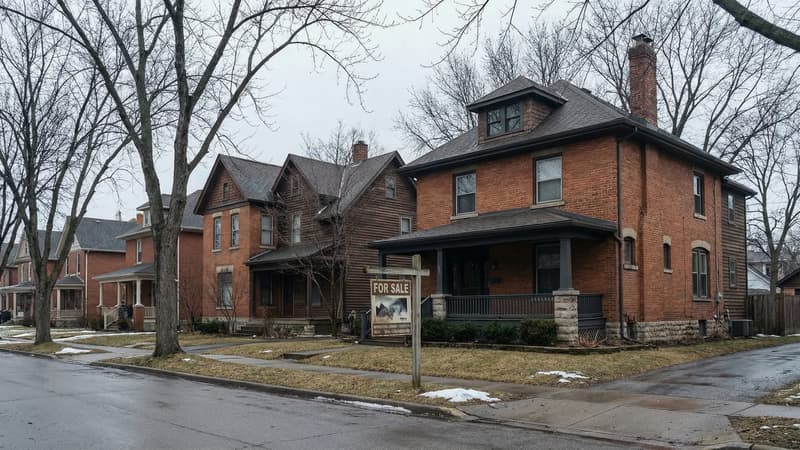
On March 19, 2026, the Federal Reserve released its quarterly Financial Accounts of the United States — the Z.1 report — covering the fourth quarter of 2025. Buried in the balance sheet data was a finding that sounds, at first, like encouraging news for housing affordability: the value of household real estate assets fell for the second consecutive quarter, dropping from a peak of $48.6 trillion in Q2 2025 to $47.9 trillion in Q4 2025. A $700 billion decline over two quarters. Meanwhile, household mortgage liabilities rose 2.9% year-over-year to $13.8 trillion — the highest level on record. Owners' equity as a share of real estate assets slipped to 71.3%, the second consecutive quarterly decline.
The natural instinct is to read this as progress. Housing prices are softening. The market is cooling. Is this not what affordability advocates have demanded?
The answer is no. And the data explains precisely why. This is not a supply-side correction. It is a demand-side compression. Housing prices are softening not because more homes are being built, but because the Federal Reserve's 3.75% federal funds rate has translated into 6% mortgage rates that have priced buyers out of the market. The result is the most paradoxical housing market in modern American history: falling asset prices that provide no relief to buyers.
What a Real Affordability Correction Would Look Like
A genuine affordability improvement requires one of three things: prices fall, financing costs fall, or supply increases. Ideally, all three move in the same direction. What is happening in early 2026 is none of these.
The median price of a new home in January 2026 was $400,500 — down 6.8% year-over-year. That is a real decline, and it matters. But consider the buyer's arithmetic. A $400,500 home financed at a 6% mortgage rate costs approximately $2,400 per month in principal and interest. The same home at 3% — the prevailing rate during the pandemic-era price surge — costs approximately $1,690 per month. The nominal price decline does not remotely offset the financing cost premium. The monthly payment, which is the actual constraint on affordability for most buyers, has barely moved.
The average 30-year fixed mortgage rate in February 2026 was 6.05% — the lowest reading since August 2022, according to Freddie Mac data. That is a meaningful improvement from the 7%+ rates of 2023 and early 2024. But it remains historically elevated, and the Federal Reserve's own projections offer little comfort for what comes next.
The Fed's Arithmetic: Two Years to Target
On March 18, 2026, the FOMC held the federal funds rate at 3.50–3.75% — the second consecutive pause since the Fed resumed easing in September 2025. The Summary of Economic Projections released alongside the decision is worth reading carefully. The Fed now projects core PCE inflation at 2.7% for 2026 — revised upward from 2.4% in December — with the 2% target not reached until 2028. The median projected path for the federal funds rate: 3.4% at end-2026 and 3.1% at end-2027. That implies one rate cut per year for the next two years.
There was one dissent. Governor Miran voted for a 25 basis point cut, arguing that tariff effects were limited and productivity gains would contain inflation pressure. His view did not carry the committee. NAHB subsequently revised its rate cut forecast for 2026 from two cuts to one, partly citing uncertainty in energy markets stemming from Middle East tensions. Chair Powell, in his press conference, described housing activity in a single word: "weak."
Translation for housing: construction loan rates — which track the federal funds rate closely — will remain elevated through at least 2027. The 30-year mortgage rate, which responds to the 10-year Treasury yield and mortgage-backed security spreads rather than the funds rate directly, will not materially improve without meaningful and sustained Fed easing. That easing, by the Fed's own projection, is at least 18 months away in any substantial form.
The Supply Freeze: Rate Lock-In Meets Demand Suppression
The more consequential effect of the rate environment is on the supply side of the market, and it runs directly counter to what an affordability correction would require.
Consider the rate lock-in mechanism. The majority of existing homeowners financed their homes during the near-zero rate era of 2020–2022, locking in mortgages at 3% or below. Selling and buying a replacement home at current rates would increase their monthly financing costs by 40% or more for the same dollar amount. The rational economic response is to stay, and that is exactly what is happening. Existing inventory is constrained not because there is a shortage of homes, but because the incentive structure created by the rate differential makes selling economically irrational for millions of current owners.
Single-family housing starts in January 2026 ran at a 935,000 annualized rate, down 2.8% from December — well below the approximately 1.5 million starts per year needed to meaningfully close the multi-year housing deficit. Total private housing permits fell 5.4% month-over-month and 5.8% year-over-year to 1,376,000 annualized. Builders are not responding to lower asset values with more construction; they are responding to weaker demand with lower prices and margin compression. 37% of builders cut prices in March 2026 (averaging a 6% reduction), and 64% were using sales incentives — the 12th consecutive month above 60%.
The NAHB/Wells Fargo Housing Market Index for March 2026 registered 38 — one point above February but well below the neutral threshold of 50. New home sales in January 2026 fell to a 587,000 annualized rate, down 11.3% year-over-year, with months' supply rising to 9.7 as the sales pace slowed rather than because inventory genuinely expanded. Only 19% of new homes sold were priced below $300,000 — a share that has trended lower since an October 2025 peak of 23%.
The picture is of a construction sector absorbing a demand shock through price cuts and incentives — not expanding output to meet long-run structural demand. That is precisely what you would expect when borrowing costs are elevated on both the construction loan side (which the developer pays) and the mortgage side (which the buyer pays).
The Transmission Problem: Friedman's Blunt Instrument
Milton Friedman's most persistent critique of activist monetary policy was its bluntness. The Federal Reserve operates through aggregate demand channels — it cannot target specific sectors, specific buyer profiles, or specific price points. When the Fed raises the federal funds rate to control inflation (as it did aggressively from 2022 through 2024), it simultaneously suppresses mortgage demand and makes construction loans more expensive. Both the demand side and the supply side of housing are compressed together.
The result is not a market correction. It is a market freeze. A genuine correction would have lower prices attracting new buyers at the margin, stimulating entry-level demand, and signaling to builders that new supply at lower price points could find buyers. None of that is occurring. Prices have softened modestly, but the monthly payment that governs actual purchase decisions has barely improved. New construction remains below structural demand. First-time buyer entry remains historically constrained.
Hayek's framework for the price system is instructive here. The price mechanism functions by transmitting information — rising prices signal producers to increase supply, falling prices signal buyers to enter. A monetary regime that simultaneously suppresses buyer purchasing power and raises developer borrowing costs corrupts both signals. Sellers who would clear the market at lower prices choose not to transact because the rate differential makes replacement unaffordable. The price discovery function of the market cannot operate when the transaction mechanism is frozen by financing incentives.
Thomas Sowell's observation about the seen and the unseen applies with particular force to the current FOMC decision. The "seen" effect of holding rates at 3.75%: inflation appears partially contained, with core PCE at 2.7% rather than spiking toward 3%. The "unseen" effect: every month at this rate is another month of expensive construction loans, another cohort of marginal housing projects that cannot pencil out at current financing costs, another group of first-time buyers priced out by the arithmetic of a 6% mortgage on a $400,000 home. The costs of the rate hold are diffuse and invisible in the aggregate statistics. They show up only in the individual buyer's spreadsheet.
The Equity Trap: Who Actually Benefits
The Z.1 data shows total owner equity in real estate at $34.1 trillion — an equity share of 71.3%, above 70% for 11 consecutive quarters, the longest such streak since the 1950s. This is an important data point that cuts against catastrophe framing: the housing market is not in a leverage crisis. Households are not dangerously underwater. The 2008 dynamic — negative equity, mass default, foreclosure cascade — is not in evidence.
But the equity distribution matters enormously. The $34.1 trillion in owner equity is held by existing homeowners. The $700 billion decline in aggregate real estate asset value represents a paper loss for that same group. Neither figure has any direct bearing on the person who does not yet own a home and is trying to enter the market.
Consider the three groups affected by the current environment. The equity-rich existing homeowner with a 3% mortgage has seen paper values decline modestly, but their monthly cost has not changed; they have little reason to sell; their economic position, while nominally diminished, is functionally unchanged. The would-be first-time buyer is looking at a $400,500 median new home price and a 6% financing cost — a combination that, even with the year-over-year price decline, produces a monthly payment that strains most first-time buyer budgets. The renter is watching property prices soften while rents remain sticky, because landlords with locked-in low-rate mortgages have no margin pressure to reduce rents simply because their asset's paper value has declined.
No one wins in a market where buyers cannot afford to enter and sellers have no incentive to leave. The wealth decline documented in the Z.1 data is real economic loss — $700 billion in value that existed in Q2 2025 has evaporated. Unlike a supply-driven correction, where lower prices would attract new buyers and stimulate entry-level activity, this demand-driven compression destroys wealth without distributing affordability benefit to anyone who needs it.
What Would Actually Help
The Fed's projected rate path — one cut in late 2026, bringing the funds rate to approximately 3.25% — would provide modest relief on the construction loan side of the market. NAHB's own analysis frames it plainly: "Supplying more housing and at lower cost is key to solving the ongoing housing affordability challenge. Lower financing costs are part of the overall solution" — not the entire solution.
Friedman's prescription for housing affordability was never "easier monetary policy." His argument was structural: remove the supply restrictions that prevent the market from responding to price signals. Zoning reform that allows higher-density development on urban land. Regulatory cost reduction that lowers the per-unit cost of new construction. Elimination of tariffs on building materials that pass directly through to home prices. Streamlined permitting that reduces the 18-to-36-month delay between project conception and occupancy.
Monetary policy can ease the financing environment at the margin. Only supply expansion solves the structural deficit. The Z.1 release makes this clear in aggregate: $47.9 trillion in real estate assets and $13.8 trillion in mortgage liabilities are the financial superstructure sitting atop a market that is not building enough homes. The Fed's tools cannot change that ratio by building a single unit.
The Wrong Reading of a $700 Billion Decline
The Federal Reserve's Z.1 data for Q4 2025 is not a harbinger of affordability recovery. It is a measure of demand compression. Household real estate wealth fell not because more homes were built — single-family starts are running at 935,000, far below structural demand — but because buyers pulled back under the weight of 6% mortgage rates and economic uncertainty.
The Fed is constrained by its own inflation arithmetic. With core PCE projected at 2.7% for 2026 and the 2% target not until 2028, the committee has limited room to ease, regardless of the housing sector's condition. Chair Powell's single-word assessment — "weak" — may be the most honest thing the Fed has said about housing in years.
A $700 billion decline in aggregate real estate values, accompanied by record mortgage liabilities and a frozen transaction market, is not an affordability correction. It is a market in suspension. The only path to genuine affordability runs through supply — more homes, at lower regulatory cost, on more available land. Waiting for the Fed to solve a supply-deficit housing problem with a blunt rate instrument is not a policy. It is wishful thinking with a balance sheet attached.
Part of the Monetary Policy & Housing research cluster.