The Backyard Revolution: How ADU Deregulation Unlocked a Hidden Housing Supply
America's housing shortage sits at 3.7 million units. One of the most powerful solutions costs taxpayers nothing. It only requires government to stop blocking private property owners from building on their own land.
· 5 min read · By AHI Research
Freddie Mac estimates the U.S. housing shortage at 3.7 million units as of the third quarter of 2024. That deficit does not close without a dramatic expansion in supply. Yet every serious supply-side proposal — new apartment towers, upzoned corridors, large-scale infill — runs headlong into community opposition, environmental review, and years of permitting delays. Meanwhile, a simpler, cheaper, faster solution has been hiding in American backyards: the accessory dwelling unit, or ADU.
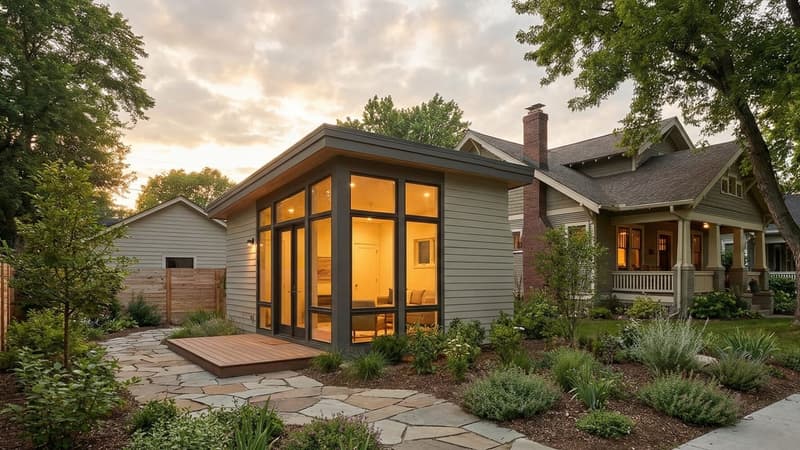
An ADU is a secondary housing unit built on a residential lot that already contains a primary dwelling. It can be a detached backyard cottage, a garage conversion, a basement apartment, or an addition to the main structure. The concept is neither radical nor new — granny flats, carriage houses, and in-law suites have existed for a century. What was new, until recently, was the government's decision to make them illegal.
A Market Response That Was Regulated Out of Existence
Through most of the 20th century, American municipalities systematically banned ADUs alongside broader single-family zoning ordinances. Owner-occupancy requirements forced property owners to live on-site as a condition of building any secondary unit. Minimum size mandates required new units to be as large as detached homes. Mandatory off-street parking requirements — sometimes two additional spaces per ADU — made construction physically impossible on many urban lots. Impact fees added tens of thousands of dollars before a single board was nailed.
None of these restrictions had anything to do with public health or structural safety. They were supply restrictions, plain and simple — the municipal equivalent of mandating that bakers may not sell more than one loaf of bread per oven. The homeowner who wants to build a rental unit on her property, and the renter who wants to pay market price to live in it, were prohibited from completing a voluntary, mutually beneficial transaction by bureaucratic decree. This is precisely the kind of interference Friedrich Hayek warned against: central planners substituting their preferences for the dispersed knowledge of millions of individuals who understand their own circumstances best.
What Happens When Government Steps Back: The California Experiment
Between 2016 and 2020, California enacted a series of sweeping ADU reforms. Assembly Bills 2299 and SB 1069 in 2016 required cities to allow ADUs as a matter of right. Subsequent legislation in 2019 and 2020 eliminated owner-occupancy requirements, reduced permit fees for smaller units, capped application processing times at 60 days, and prohibited cities from imposing arbitrary design standards that served no structural purpose.
The market's response was immediate and unambiguous. According to permitting data compiled by California's Department of Housing and Community Development and analyzed by California YIMBY, the number of ADUs permitted annually in California increased by 15,334% between 2016 and 2022, with 83,865 ADUs permitted across the state over that six-year period. By 2024, ADUs accounted for approximately one-fifth of all new housing units produced in California — roughly 25,000 new homes in a single year, created not by government programs but by private homeowners responding to market signals.
This is Milton Friedman's voluntary exchange in action. No subsidy. No public agency. No five-year plan. Property owners, responding to rental demand and income opportunity, converted garages, added backyard cottages, and finished basement apartments — allocating their own capital to its highest-valued use once the government removed the barriers preventing them from doing so.
The Economics: Why ADUs Work Where Other Policies Fail
ADUs have structural advantages that make them particularly well-suited to addressing housing affordability through market mechanisms.
First, they use land that is already paid for. An ADU built on an existing residential lot doesn't require acquiring new land, extending new infrastructure, or fighting environmental review for an undeveloped parcel. The sewer line, water connection, and street access already exist. Construction costs for a finished ADU typically range from $90,000 to $400,000 depending on type and location — materially less than the $500,000–$700,000 cost of a new detached home on a new lot in high-cost markets.
Second, they are built by private capital with no public expense. Unlike public housing, LIHTC tax credit programs, or inclusionary zoning mandates, ADUs require zero government subsidy. The homeowner finances the construction, collects the rent, and bears the risk. Taxpayers pay nothing. As Thomas Sowell observed in Basic Economics, the fundamental problem with government housing programs is that they substitute political allocation for price signals — creating units in the wrong places, at the wrong sizes, for the wrong tenants. ADUs, priced by the market and built where homeowners and renters voluntarily agree, avoid every one of these distortions.
Third, they add density incrementally without triggering the community opposition that large multifamily projects generate. A neighborhood that would vigorously oppose a 50-unit apartment building rarely notices when five homeowners on the same block quietly add backyard cottages. This is not an argument against density. It is an observation that ADUs can expand supply substantially while circumventing the political economy of NIMBYism that blocks larger projects.
What Still Holds ADUs Back
California's experience also reveals the limits of partial deregulation. Despite the permit surge, a significant gap remains between ADUs permitted and ADUs completed. Construction financing remains difficult: traditional mortgage lenders do not yet treat ADU rental income as qualifying income for underwriting purposes, which means many homeowners cannot access capital to build. Utility connection fees — charged separately from general impact fees — can add $10,000 to $30,000 to project costs in some California cities. And in states that have not followed California's lead, local ordinances continue to prohibit ADUs outright or impose restrictions so burdensome that construction is economically unviable.
California's Housing and Community Development Department continues to update ADU law annually, progressively stripping away remaining local barriers. Colorado enacted HB24-1152 in 2024 requiring municipalities statewide to allow at least one ADU per single-family lot. Washington, Oregon, and Montana have passed similar preemption bills. The pattern is consistent: when state governments override local supply restrictions, private construction follows.
The Free-Market Lesson
The ADU story is, at its core, a story about what markets do when allowed to function. America does not have a shortage of land, capital, or entrepreneurial homeowners willing to build rental housing. It has a shortage of government permission. For decades, municipalities across the country prohibited a category of housing that would have been built spontaneously — and affordably — by millions of private actors responding to visible price signals.
California's 15,000% permit surge is not a miracle of policy design. It is what happens when you remove a prohibition. No subsidy was required. No government agency did the building. Individual property owners, sensing rental demand and income opportunity, allocated their own resources accordingly — exactly as free-market economists would predict.
The prescription for the national housing shortage is not a new federal program. It is state legislatures following California, Colorado, and Montana in overriding the local regulations that prohibit Americans from building homes on their own land. The supply is there. It just needs to be unlocked.
Part of the Zoning & Land Use research cluster.