Single-Family Zoning: The Invisible Wall Blocking Affordable Housing
Across America, a century-old land-use regulation quietly prevents the construction of affordable homes on 75% of urban residential land.
· 8 min read · By AHI Research

If you want to understand why housing is so expensive in America, don't start with interest rates or construction costs. Start with a map. Pull up the zoning map of any major U.S. city — San Jose, Charlotte, Seattle, Arlington — and look at the color coding. The vast majority of residential land, often 75% or more, is shaded in a single designation: single-family residential.
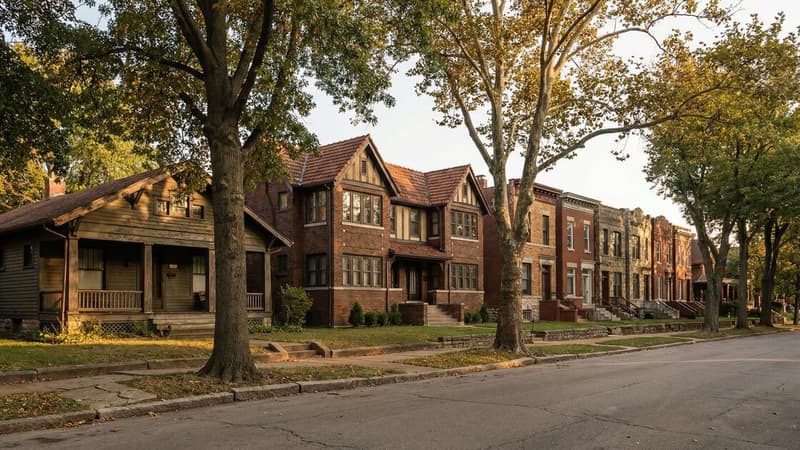
That designation means one thing: it is illegal to build anything other than a detached, single-family home on that land. No duplexes. No triplexes. No townhomes. No small apartment buildings. Just one house, on one lot, for one family. This is single-family zoning, and it is the most consequential housing regulation in America that most people have never heard of.
The Origins: Berkeley, 1916
Single-family zoning was born in Berkeley, California, in 1916. The city council created the nation's first single-family residential zone — not to manage traffic, preserve green space, or ensure public safety, but to keep a Black-owned dance hall from operating near a white neighborhood. From its inception, single-family zoning was a tool of exclusion.
The concept spread rapidly. The U.S. Department of Commerce, under Secretary Herbert Hoover, published the Standard State Zoning Enabling Act in 1924, providing a template for municipalities nationwide. By 1930, hundreds of cities had adopted comprehensive zoning ordinances, and single-family zones became the default designation for residential land.
After World War II, single-family zoning exploded alongside the suburbs. Federal housing policy — FHA mortgage insurance, the GI Bill, the Interstate Highway Act — subsidized suburban homeownership. Local governments, eager to attract middle-class tax revenue and exclude lower-income residents, zoned enormous swaths of new suburban land exclusively for single-family homes. By the 1970s, single-family zoning had become so normalized that most Americans didn't even realize it existed.
San Jose, CA: 94% of residential land zoned single-family
Seattle, WA: 75% of residential land zoned single-family (pre-reform)
Charlotte, NC: 84% of residential land zoned single-family
Arlington, VA: 71% of residential land zoned single-family
Portland, OR: 77% of residential land zoned single-family (pre-reform)
Los Angeles, CA: 75% of residential land zoned single-family
How Single-Family Zoning Restricts Housing Supply
The economics are straightforward. When 75% of residential land in a city is legally restricted to the lowest-density housing type, the supply of housing units is artificially constrained far below what the market would produce in a free system.
Consider a simple example. A single-family lot in a desirable neighborhood might hold one home for one household. That same lot, if zoning allowed it, could hold a duplex (2 units), a fourplex (4 units), or a small apartment building (8-12 units). Single-family zoning doesn't just reduce housing supply at the margins. It reduces it by multiples.
The constraint becomes devastating when combined with population growth. Between 2010 and 2024, the U.S. added approximately 20 million people. Cities like Austin, Boise, Nashville, and Raleigh saw population growth of 20-35%. But the residential land available for higher-density construction remained artificially limited by zoning maps drawn decades earlier.
The result is a housing shortage of staggering proportions. The National Association of Realtors estimated in 2023 that the U.S. faces a deficit of 5.5 million housing units. Freddie Mac placed the figure at 3.8 million. Regardless of the exact number, the direction is clear: America has far fewer homes than it needs, and single-family zoning is a primary reason why.
"In an economy where urban land is scarce, restricting the overwhelming majority of it to its least efficient use is not a free-market outcome. It is central planning at the municipal level." — Edward Glaeser, Harvard University
The Price Impact: What the Research Shows
The connection between restrictive zoning and housing prices is one of the most robust findings in urban economics. Economists Edward Glaeser and Joseph Gyourko at the Wharton School of Business have spent two decades documenting the relationship.
Their research, published through the Wharton Residential Land Use Regulatory Index, found that in heavily regulated markets, zoning and land-use restrictions add 20% to 50% to the cost of housing compared to what prices would be in a less regulated environment. In the most restricted markets — San Francisco, New York, Boston, Los Angeles — the "regulatory tax" on a home can exceed $200,000.
Glaeser-Gyourko Findings (Wharton Research):
In lightly regulated markets, home prices closely track construction costs.
In heavily regulated markets, prices exceed construction costs by 50% or more.
Median home price, San Francisco metro: $1,350,000 (2025)
Estimated construction cost for equivalent home: $450,000-$600,000
Implied regulatory premium: $750,000-$900,000
National housing deficit: 3.8-5.5 million units (Freddie Mac / NAR estimates)
A 2019 study by Chang-Tai Hsieh and Enrico Moretti estimated that restrictive land-use regulations in just three cities — New York, San Francisco, and San Jose — lowered aggregate U.S. GDP by 36% between 1964 and 2009 by preventing workers from moving to the most productive labor markets. When housing costs $1.5 million in San Jose, a teacher or electrician simply cannot afford to move there, even though their productivity would be higher.
"The gap between the price of housing and the cost of construction is a direct measure of the regulatory burden. In America's most expensive cities, that gap is enormous." — Joseph Gyourko, Wharton School of Business
Who Benefits and Who Is Harmed
Single-family zoning creates clear winners and losers. Understanding who they are is essential to understanding why reform is so politically difficult.
The winners are incumbent homeowners in single-family zones. By restricting supply, zoning protects and inflates the value of existing homes. A homeowner in a neighborhood where duplexes are banned benefits from artificial scarcity — fewer units competing for the same demand means higher prices for the units that exist. This is why homeowners so often oppose rezoning: it's not about "neighborhood character." It's about protecting a financial asset.
The losers are everyone else: renters, first-time buyers, young families, lower-income workers, and anyone who doesn't already own property in a supply-restricted market. They pay higher rents, face longer commutes (pushed to distant suburbs where land is cheaper), and accumulate less wealth over their lifetimes.
The racial dimension cannot be ignored. Single-family zoning has deep roots in racial segregation. After the Supreme Court struck down explicitly racial zoning in Buchanan v. Warley (1917), municipalities turned to single-family zoning as a race-neutral tool to achieve the same exclusionary outcome. By mandating large lots and detached homes, cities effectively set a minimum price of entry that excluded Black, Hispanic, and lower-income white families from entire neighborhoods. Research by Jessica Trounstine at UC Merced has shown that cities with more exclusionary zoning have significantly higher levels of racial segregation today.
The Reform Movement: From Minneapolis to California
The good news is that single-family zoning's grip is loosening. A bipartisan reform movement — driven by the unlikely alliance of free-market economists, progressive housing advocates, and YIMBY ("Yes In My Backyard") activists — has begun dismantling exclusionary zoning across the country.
Minneapolis, 2018: Minneapolis became the first major U.S. city to effectively end single-family zoning when the city council approved the Minneapolis 2040 plan, allowing duplexes and triplexes on all residential lots. Early research suggests the reform led to a measurable increase in small-scale development applications and moderated rent growth relative to comparable cities.
Oregon, 2019: Oregon passed House Bill 2001, requiring cities with more than 10,000 residents to allow duplexes on all residential lots and cities with more than 25,000 to allow fourplexes. It was the first state to broadly eliminate single-family zoning statewide.
California, 2021: Governor Gavin Newsom signed SB 9 and SB 10 into law. SB 9 allows homeowners to split lots and build duplexes on single-family parcels statewide. SB 10 streamlines local rezoning near transit to allow up to 10 units without environmental review. While implementation has been slower than advocates hoped, the laws represent a fundamental shift in California's approach to housing supply.
Other states including Montana, Washington, and Vermont have passed or are considering similar legislation. At the local level, cities from Gainesville, Florida, to Walla Walla, Washington, have moved to allow more housing types in formerly single-family zones.
States that have limited or ended single-family zoning: Oregon (2019), California (2021), Montana (2023), Washington (2023), Vermont (2024)
Major cities that have reformed SFZ: Minneapolis, MN; Portland, OR; Sacramento, CA; Gainesville, FL; Arlington, VA
Estimated new housing units enabled by Oregon HB 2001: up to 200,000 statewide over 20 years
The Free-Market Case Against Exclusionary Zoning
Here's the irony that too few conservatives recognize: single-family zoning is government intervention, not free-market policy. It is the government telling property owners what they cannot build on their own land. A property owner who wants to build a duplex on a lot they own — with their own capital, to sell or rent to willing buyers — is prohibited from doing so by municipal regulation.
Thomas Sowell has written extensively about how zoning and land-use regulations distort housing markets. In The Housing Boom and Bust, he documented how supply-restricted coastal cities experienced dramatically higher price volatility than cities with fewer regulations. In Basic Economics, he argued that housing prices are a function of supply and demand, and that government restrictions on supply are the primary cause of high prices in expensive markets.
"There are people who think that what is needed is more government intervention, more regulation, and more subsidies. But government intervention is what got us into this mess in the first place." — Thomas Sowell, The Housing Boom and Bust
Friedrich Hayek would have recognized single-family zoning for what it is: the fatal conceit of central planners who believe they can design a city better than the spontaneous order of free markets. When a zoning board decides that a particular lot must contain exactly one house — regardless of what the property owner, the market, or the community actually needs — it is engaging in the same kind of top-down planning that Hayek spent his career opposing.
The truly free-market position on single-family zoning is not to defend it, but to abolish it. Property owners should be free to build what the market demands, subject to reasonable health and safety standards. If people want duplexes, triplexes, and small apartment buildings — and the evidence overwhelmingly shows they do — the government has no business preventing them from being built.
Recent Changes: What Has Actually Passed
Single-family-only zoning was, for most of the past century, the least contested feature of American land use. Since 2018 it has become one of the most actively legislated, and the record is now long enough to describe rather than predict.
Minneapolis moved first among large cities, ending single-family-only zoning citywide through its 2040 Comprehensive Plan and pairing the change with the removal of parking minimums — a combination that matters, because a fourplex that must supply four parking spaces on a standard lot is often not buildable. Oregon followed at state scale in 2019, requiring middle housing in cities above its population thresholds. California's SB 9 extended lot splits and duplexes to single-family parcels statewide in 2021. Montana and Washington enacted their own middle-housing statutes in 2023.
Two patterns are worth naming. First, the reforms are converging on the same instrument — legalizing two to four units where one was allowed — which makes cross-state comparison unusually clean. Second, the political coalitions are not what a national reader would predict from the coverage: Oregon's law was positioned as progressive housing policy, while Montana's passed with near-unanimous support from both parties. The policy is travelling faster than the ideological framing attached to it.
The honest caveat is timing. Zoning changes what may be built; it does not finance construction. The lag between legalization and completed units runs to years, and it interacts with interest rates and construction costs that move independently of land-use law. A reform enacted into a high-rate environment will look weaker on a three-year view than the same reform enacted into a cheap-credit one, and attributing that difference to the zoning change is a mistake the early evaluations have not always avoided.
The Bottom Line
Single-family zoning is the invisible wall blocking affordable housing in America. It was created to exclude, it operates by restricting supply, and it benefits incumbent homeowners at the expense of everyone else. It is not a free-market policy. It is one of the most pervasive forms of government regulation in the American economy.
Reforming single-family zoning won't solve the housing crisis overnight. Monetary policy, construction costs, and counterproductive rent controls all play a role. But no serious effort to make housing affordable can ignore the fact that in most American cities, it is literally illegal to build affordable housing on three-quarters of the land.
The path forward is clear: allow property owners to build more housing, allow markets to respond to demand, and stop using the zoning code to protect incumbent wealth at the expense of the next generation of Americans who just want a place to live.
Part of the Zoning & Land Use research cluster.