Why America Can't Build Enough Homes: The Regulatory Bottleneck
Regulations designed to protect consumers now add nearly $94,000 to every new home — pricing out the very people they claim to serve.
· 7 min read · By AHI Research
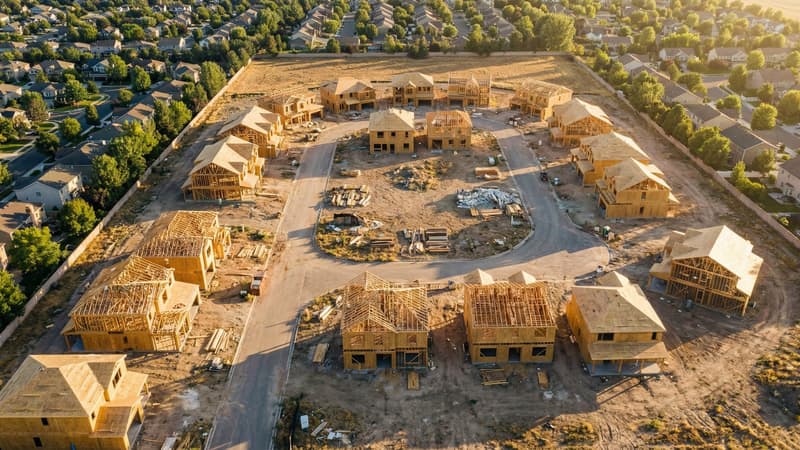
America is short roughly 3.8 million homes. That figure, calculated by Freddie Mac and echoed by the National Association of Realtors, represents the gap between the housing units the country needs and the housing units it has. Other estimates from the National Association of Home Builders place the deficit even higher, between 4 and 5 million units. The shortage is not a mystery of market forces. It is the predictable result of a regulatory apparatus that makes building homes extraordinarily slow, expensive, and uncertain.
The conversation about housing affordability in America tends to focus on demand-side factors: monetary policy, mortgage subsidies, and investor activity. These matter. But the supply side of the equation is where the most destructive government intervention occurs — not through spending programs, but through a thicket of regulations, permitting requirements, environmental reviews, building codes, and impact fees that have made it functionally impossible to build housing at the pace America needs.
Freddie Mac estimate: 3.8 million units short
NAR estimate: 4.5 million units short
Annual new construction: ~1.4 million units (2024-2025 average)
Annual household formation: ~1.7 million per year
Result: The deficit grows by ~300,000 units every year we fail to reform
Permitting Timelines: The 7-Month Minimum
Before a single nail is driven, a homebuilder must navigate the permitting process. According to the National Association of Home Builders' survey data, the average time to obtain a permit for a single-family home is 7.4 months from application to approval. For multifamily developments, the timeline routinely extends to 12-18 months. In California, builders report average permitting timelines of two years or more for projects of any meaningful scale.
These are not passive waiting periods. Each month of delay carries holding costs — land payments, property taxes, insurance, financing charges, and professional fees. The NAHB estimates that every month of permitting delay adds approximately $2,500 to $5,000 to the final cost of a single-family home. For a multifamily project held up for three additional years by permitting and review processes, delays can add tens of millions of dollars in carrying costs — costs that are ultimately passed to renters and buyers.
The permitting process itself has become an exercise in bureaucratic redundancy. A builder may need separate approvals from the planning department, building department, fire marshal, health department, environmental agency, public works department, and utility companies — each operating on its own timeline, with its own requirements, and often with contradictory demands. In many jurisdictions, there is no single point of contact and no binding timeline for review.
Regulatory Compliance Costs: $93,870 Per Home
The NAHB's most recent comprehensive study found that regulatory compliance costs account for $93,870 — or 24.3% of the final sales price — of an average new single-family home. This figure includes the costs of complying with building codes, zoning rules, environmental mandates, labor regulations, impact fees, and the permitting process itself.
Total regulatory cost per home: $93,870 (24.3% of sales price)
During development: $41,330 (fees, permits, inspections, impact fees)
During construction: $52,540 (building codes, labor rules, mandates)
Average new home price: ~$386,000
Price without regulatory burden: ~$292,000
Consider what this means. A home that could sell for $292,000 in a market with reasonable regulation instead sells for $386,000 — a 32% markup attributable entirely to government-imposed costs. For a first-time buyer making the median household income of $78,000, that $94,000 difference is the gap between qualifying for a mortgage and being priced out of homeownership entirely.
Thomas Sowell put it plainly: "The real goal should be to reduce the power of government to make housing unaffordable, rather than to have governmenteliminate the consequences of its own policies."
Environmental Review: NEPA and CEQA as Housing Killers
The National Environmental Policy Act (NEPA) at the federal level and the California Environmental Quality Act (CEQA) at the state level were enacted with legitimate environmental goals. In practice, they have become the most powerful tools available to block housing construction.
NEPA requires an environmental impact statement (EIS) for any project receiving federal funding or requiring federal permits. The average EIS takes 4.5 years to complete and costs between $1 million and $5 million. For federally funded affordable housing projects — the very projects most intended to help low-income Americans — NEPA review can delay construction by half a decade before a shovel touches dirt.
CEQA is even more destructive. California's law allows virtually any individual or organization to file a CEQA challenge against a proposed development, triggering environmental review that can delay projects for years. Research from Holland & Knight found that the majority of CEQA lawsuits target infill housing projects — developments in already-urbanized areas that pose minimal genuine environmental risk. The law has been weaponized by NIMBYs, labor unions seeking project labor agreements, and competitors seeking to block rival developments.
The irony is severe. By blocking dense, infill housing, CEQA forces development to the suburban and exurban fringe — producing the exact sprawl and environmental degradation the law was ostensibly designed to prevent. The environmental review process doesn't protect the environment; it protects existing homeowners' property values at the expense of everyone who needs a home.
Building Code Escalation: Death by a Thousand Mandates
Building codes serve a legitimate safety function. No serious observer argues for eliminating fire safety requirements or structural standards. But the steady escalation of building codes over the past two decades has pushed far beyond safety into social engineering, with each new mandate adding cumulative costs that are rarely evaluated in totality.
Energy codes have been the fastest-growing cost driver. The International Energy Conservation Code (IECC) is updated every three years, and each cycle adds new requirements — higher insulation R-values, tighter air sealing, more efficient HVAC systems, solar-ready wiring, and EV-charging infrastructure. The Department of Energy estimates that the 2021 IECC adds $7,200 to $11,800 to the construction cost of a new home compared to the 2009 code. States like California, Washington, and New York have adopted codes that go further still, mandating all-electric construction, rooftop solar, and battery storage readiness.
Accessibility mandates, fire sprinkler requirements (mandated in all new single-family homes under the IRC since 2009, though many jurisdictions have opted out), seismic upgrades, stormwater management systems, and noise insulation requirements each add thousands of dollars individually. Collectively, they represent a regulatory ratchet that only moves in one direction: up.
Energy code compliance (2021 IECC vs. 2009): +$7,200 - $11,800
Fire sprinkler mandate: +$5,000 - $10,000
Stormwater/drainage requirements: +$3,000 - $8,000
EV-ready wiring (where mandated): +$1,200 - $3,000
Solar-ready/solar mandate (CA, WA): +$8,000 - $15,000
Combined impact on a new home: +$25,000 - $48,000 in code-driven costs over 15 years
Each mandate is justified in isolation. But no one evaluates their cumulative impact on affordability. The political incentive is to add mandates — each one creates a visible benefit for a specific constituency — while the cost is diffused across all future homebuyers, who have no organized lobby.
Impact Fees and Exactions: The Hidden Tax on New Housing
Impact fees are charges levied by local governments on new development to fund infrastructure — roads, schools, parks, water systems, and sewer capacity. In principle, they ensure that new development pays for the public services it requires. In practice, they have become a revenue tool that cities use to extract maximum value from builders while shielding existing residents from tax increases.
The range is staggering. According to research compiled by the Reason Foundation and the NAHB, impact fees per housing unit range from under $20,000 in lower-cost markets to over $150,000 in high-cost California jurisdictions. In some Bay Area cities, impact fees alone exceed $100,000 per unit — more than the entire construction cost of a modest home in many parts of the country.
Beyond formal impact fees, cities impose "exactions" — requirements that developers build or fund public amenities as a condition of approval. These can include dedicating land for parks, funding traffic improvements, building affordable units on-site (inclusionary zoning), or contributing to public art funds. While each exaction may be individually reasonable, their cumulative effect is to make new construction a vehicle for funding services that should be paid for by the general tax base.
The economic incidence of impact fees falls primarily on two groups: landowners (who receive lower prices for raw land) and homebuyers (who pay higher prices for finished homes). In supply-constrained markets where land values are already high, the burden falls almost entirely on buyers. Impact fees are, in effect, a regressive tax on new housing that makes entry-level homes most unaffordable.
The Free-Market Solution: Build by Right
Milton Friedman observed that "one of the great mistakes is to judge policies and programs by their intentions rather than their results." The regulatory apparatus governing American housing construction was built with good intentions — safety, environmental protection, adequate infrastructure. Its results are a housing shortage of nearly 4 million units, $94,000 in unnecessary costs per home, and an entire generation locked out of ownership.
A free-market reform agenda would focus on three pillars:
- Streamline permitting to a binding 90-day timeline. Establish a single point of review with a "deemed approved" default if the jurisdiction fails to act within 90 days. Texas and Houston's relatively permissive permitting environments demonstrate that faster approvals produce more housing without compromising safety.
- Reduce regulatory compliance costs through code rationalization. Conduct a cumulative cost-benefit analysis of all building code mandates adopted in the past 15 years. Eliminate or make optional any mandate whose cost exceeds its measurable safety benefit. Allow builders to offer homes at different code tiers, letting market demand rather than bureaucratic mandate determine the level of energy efficiency and amenities.
- Establish by-right development for housing that meets objective standards. If a proposed project complies with zoning, building codes, and objective design standards, it should be approved without discretionary review, public hearings, or environmental litigation. Reforming single-family zoning to allow duplexes, triplexes, and accessory dwelling units by right would unlock millions of potential units on already-developed land.
Cap impact fees at a level tied to the actual marginal cost of infrastructure, and prohibit exactions unrelated to the direct impacts of the proposed development. Shift infrastructure funding back to the general tax base where it belongs, rather than loading it onto the price of new homes.
The Bottom Line
America's housing shortage is not a failure of the free market. It is a failure of government regulation that has made the free market unable to function. Every permit delay, every environmental review weaponized to block housing, every impact fee layered onto new construction, and every building code mandate adopted without regard to cumulative cost represents a choice — a choice to protect incumbents at the expense of those who need housing most.
The mortgage interest deduction subsidizes demand. Fed monetary policy inflates prices. But it is the regulatory bottleneck on the supply side that ensures those distortions can never self-correct through new construction. Until America confronts its regulatory addiction, the housing crisis will only deepen, and the people who pay the price will be those who can least afford it.
Part of the Zoning & Land Use research cluster.