The Hidden Cost of "Free" Parking: How Mandatory Minimums Price Americans Out of Housing
· 5 min read · By Affordable Housing Initiative
In virtually every American city, a developer who wants to build an apartment building must first answer a question that has nothing to do with how many people need homes: How many cars will your tenants park? Local zoning codes specify minimum parking ratios — typically one to two spaces per dwelling unit — that must be included in any new residential development, regardless of whether residents own cars, whether transit is nearby, or whether land is too valuable to be paved over. These mandates are not neutral administrative rules. They are a government-imposed subsidy for automobile storage, financed entirely by the people who need housing most.
The $40,000 Space Nobody Asked For
Concrete and steel are expensive. According to NAIOP, the Commercial Real Estate Development Association, structured parking in the United States costs approximately $30,000 to $40,000 per space nationally. In dense urban markets where land is scarce and construction is complex, that figure climbs significantly higher: Denver's Community Planning and Development office puts the cost of structured parking at up to $50,000 per space. Underground garages in high-cost coastal cities routinely exceed that figure.
Developers do not absorb these costs. They cannot. The economics of multifamily development leave no room for charitable car storage. Every dollar spent building a mandated parking space is a dollar embedded in the monthly rent or purchase price of every unit in the building. A 100-unit apartment building required to include 150 parking spaces at $40,000 each carries $6 million in parking infrastructure before a single foundation is poured. That burden is distributed across every resident — including the substantial share of urban renters who, according to Census Bureau American Community Survey data on vehicle availability, do not own a car and derive no benefit from the space they are forced to subsidize.
This is precisely the kind of distortion that Milton Friedman identified throughout his career: a government mandate that bundles an unwanted good with a necessary one, raising prices for everyone while benefiting a subset of users at the expense of the whole. When markets are allowed to function, developers build parking where tenants demand it and price it separately — as is done with any other amenity. When government mandates it, the market signal disappears and the cost becomes invisible, buried in rent.
Land Is Not Unlimited
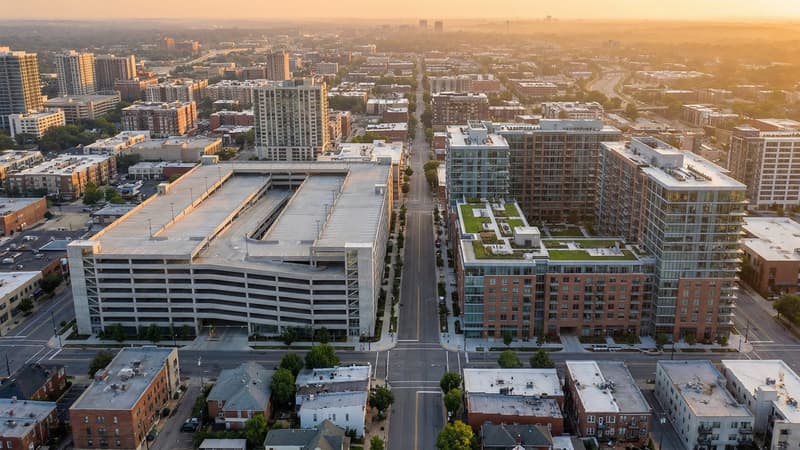
Beyond direct construction expense, parking minimums impose an opportunity cost that may be even larger: the land itself. Every square foot dedicated to a surface parking lot or a parking deck podium is a square foot that cannot become a home. In high-demand urban neighborhoods — precisely the areas where housing pressure is most acute — this trade-off is starkest. A single-story surface lot on a standard urban parcel could accommodate dozens of apartments. Instead, by regulatory mandate, it stores cars.
Research from NYU's Furman Center offers a revealing data point on how binding these constraints actually are. A Furman Center study of parking requirements in New York City found that developers consistently build only the bare minimum number of parking spaces required by zoning law — not one space more. This is not coincidence. It is the behavior of rational actors operating under a cost constraint: if the market wanted more parking, developers would supply it voluntarily without a mandate. The fact that they build only what is required proves that minimum parking requirements are a binding, distorting force — not a codification of market demand.
Friedrich Hayek's concept of the knowledge problem applies with particular force here. No city planner sitting in a planning commission can know the optimal ratio of parking to apartments for each neighborhood, each building, each tenant profile. That knowledge is dispersed across thousands of individual decisions — developers surveying their markets, tenants choosing buildings, landlords pricing amenities. Parking minimums override this decentralized discovery process and substitute a single mandated ratio for the entire city, at every location, for every use. The predictable result is systematic over-production of parking in transit-accessible neighborhoods and a corresponding under-production of housing.
Minneapolis: A Natural Experiment
In 2019, Minneapolis eliminated mandatory minimum parking requirements citywide as part of its Minneapolis 2040 comprehensive plan, the most ambitious zoning reform in the city's history. The plan also legalized duplexes and triplexes on all residential land. The results since then constitute one of the most instructive natural experiments in contemporary housing policy.
While national rents climbed roughly 22% between 2019 and 2024, rents in Minneapolis declined approximately 4% over the same period — a swing of more than 25 percentage points relative to the national trend. Minneapolis did not benefit from population decline or economic contraction; it maintained steady growth throughout. The divergence reflects the fundamental economics of supply: when you remove barriers to construction, builders respond, supply increases, and prices moderate. Parking reform was one component of a broader liberalization, but its contribution to unlocking development on constrained urban parcels was significant.
More than 3,700 cities across 22 countries have now enacted some form of parking minimum reform, according to the Parking Reform Network — including more than 100 that have eliminated minimums entirely. This is not a fringe experiment. It is an emerging consensus, driven by the observable economics of housing costs.
Who Bears the Cost
Thomas Sowell's most persistent analytical framework asks a deceptively simple question: And then what? Parking minimums exist because city councils respond to the loud and well-organized constituency of existing residents who drive and demand free or subsidized parking. The cost of that political accommodation is borne by people who do not yet live in the city — would-be residents priced out of housing that was never built because the economics of mandatory parking made it infeasible.
A 2025 study by researchers at the University of Denver and the Terner Center for Housing Innovation, examining the effects of parking requirement elimination in Denver, found that removing minimums led to measurably more multifamily housing construction — particularly in transit-accessible corridors where land costs are highest and the parking burden most severe. The study also found that the additional units were more likely to be affordable without subsidy, because the removal of mandated costs lowered the breakeven rent required to make projects financially viable.
The reform is straightforward. Cities should eliminate parking minimums in all areas within a reasonable distance of transit and allow the market to determine parking supply based on actual demand. Developers who believe their tenants want parking will include it and will price it separately — giving car-free renters the ability to opt out of a cost they do not need. This is not a radical proposal. It is the application of a basic market principle: goods should be priced by supply and demand, not mandated by planning codes written in the 1950s for a world that no longer exists.
The housing crisis has many authors: the Federal Reserve's monetary expansion, single-family zoning, regulatory permitting delays. But mandatory parking minimums deserve a prominent place in that catalog. They are a government mandate that increases construction costs, reduces housing supply, and forces car-free renters to subsidize car-owning neighbors — while making it harder to build the urban density that both the market and the data consistently show Americans need.
The Parking Tax: How Mandatory Minimum Parking Requirements Drive Up the Cost of Every New Home
Folded in from a companion piece first published . Its figures and sources are preserved below.
The next time someone tells you that housing is too expensive, ask how many parking spaces are required by law in the building they are discussing. In almost every American city, the answer is at least one — and often two or more — per unit. Nobody negotiated for this. Nobody signed a lease or a purchase contract demanding it. The mandate was written by local zoning officials, and its cost is embedded in every rent check and every mortgage payment made in this country. It is, in effect, a tax on housing — collected not by the Treasury, but by the parking garage.
A Mandate Built in the 1950s
Minimum parking requirements were first adopted broadly in American zoning codes during the 1950s, as the post-World War II automobile economy reshaped urban planning orthodoxy. The reasoning, at the time, seemed benign: new development should provide enough parking to accommodate its residents and visitors. But what began as a planning heuristic hardened into a compulsory floor — adopted jurisdiction by jurisdiction, until today these mandates are embedded in virtually every local zoning code in the country.
The typical residential requirement ranges from one to two parking spaces per unit, regardless of whether the building sits adjacent to a transit corridor, in a dense walkable neighborhood, or in a market where a significant share of residents do not own automobiles. The mandate applies uniformly. The actual demand of future residents for parking is never consulted. The price system — which would naturally reveal how much parking any given location warrants — is entirely bypassed. Central planners at city hall, working without a single market signal, determined how much parking each apartment in America must provide. That determination has been baked into construction costs ever since.
The True Cost of a Government-Required Parking Space
Building a parking space costs money. That money comes from somewhere, and it consistently comes from the residents who occupy the building, regardless of whether those residents own cars.
Research published by the Victoria Transport Policy Institute on parking requirements and housing affordability documents the cost range in detail: structured above-grade parking typically costs $20,000 to $40,000 per space to construct; underground parking facilities frequently cost $40,000 to $80,000 per space or more, depending on soil conditions, depth, and urban land values. Surface parking — nominally the less expensive option — consumes land that in high-density markets would otherwise be used for housing.
None of these costs are absorbed by developers as a charitable contribution. They are passed to residents through higher rents and higher purchase prices. In a city that mandates underground parking and requires two spaces per unit, a developer building a 100-unit apartment building may face $8 million to $16 million in parking construction costs — before a single residential square foot is built. That cost is distributed across every unit in the building, adding $80,000 to $160,000 per apartment to the effective production cost, whether the occupant drives or not.
The affordability math here is straightforward and sobering. NAHB's priced-out research finds that a $1,000 increase in the price of a median-priced new home — currently $413,595 — prices an additional 156,405 American households out of the market entirely. Apply that multiplier to even a $30,000 parking cost premium: roughly 4.7 million households priced out of homeownership by a government mandate for concrete storage. That is not incidental policy friction. That is structural harm imposed by regulation.
The Market Test That Governments Refused to Run
Milton Friedman's central insight about market prices applies with full force here: prices are information. When residents genuinely value on-site parking, they signal that preference through their willingness to pay a premium for units that include it. Profit-seeking developers, reading that signal, respond by providing parking — because it is profitable to do so. When residents are indifferent to parking, or when a neighborhood's transit access makes car ownership less attractive, developers respond accordingly, devoting more of a building's footprint to rentable housing rather than concrete decks.
Government minimum parking requirements eliminate this feedback mechanism entirely. They mandate a supply of parking regardless of whether market demand for it exists at the required level. The result is a compulsory subsidy: residents who do not own cars are forced to pay for parking infrastructure for those who do. Renters in transit-rich neighborhoods pay for garages they never enter. First-time buyers in walkable urban cores are handed a bill for facilities they did not request and cannot use.
F.A. Hayek's knowledge problem is directly implicated. Zoning authorities lack the dispersed, local, and continuously shifting knowledge needed to determine the correct supply of parking for each building in each neighborhood at each point in time. Only market prices can aggregate that information dynamically and efficiently. Minimum parking requirements substitute an administrative presumption — formed once, baked into code, and revised rarely if ever — for the price discovery mechanism that would naturally produce efficient outcomes. The predictable result is systematic over-investment in parking and systematic under-investment in housing.
Supply Destroyed Before It Is Built
The cost of parking minimums extends beyond construction expenditure. In dense urban environments, parking requirements consume developable land — permanently.
Every surface parking lot that zoning requires is land that cannot be used for housing. Every podium garage — in which apartments are stacked above mandatory floors of car storage — compresses the effective residential density of a site. In markets where land values are high and housing demand is acute, this represents a direct conversion of housing capacity into car storage, imposed by regulatory fiat rather than market preference.
The Census Bureau's Building Permits Survey documents the persistent gap between residential construction and underlying population growth. Groundbreaking research by Edward Glaeser and Joseph Gyourko, published by the National Bureau of Economic Research, demonstrated that in constrained urban markets, housing prices substantially exceed the marginal cost of construction — a gap that exists precisely because land-use regulations prevent supply from responding to demand. Minimum parking requirements are among those land-use restrictions. They artificially raise the cost floor, reduce the feasible residential density of development sites, and systematically prevent the construction of units that the market would otherwise produce and price efficiently.
A Growing National Reckoning
The economic evidence has begun, slowly, to reshape public policy.
In September 2022, California enacted AB 2097, which prohibits public agencies from imposing any minimum automobile parking requirement on residential, commercial, or mixed-use development located within one-half mile of a major transit stop. In the nation's largest housing market, the presumption that government planners should mandate parking near transit has been formally eliminated by statute.
Minneapolis removed citywide parking minimums as part of its sweeping 2040 Comprehensive Plan, which also abolished single-family-only zoning. The Minneapolis Federal Reserve has examined rent trends in the city since the 2040 Plan's adoption, tracking the relationship between supply reform and housing cost outcomes. Buffalo, New York, became the first major American city to eliminate parking minimums citywide in 2017, recognizing that mandated parking was a structural obstacle to housing production and neighborhood reinvestment.
These reforms share a common analytical foundation: that governments do not possess superior knowledge about the optimal supply of parking in any given location, and that the correct instrument for determining that supply is not the zoning code but the market. As Thomas Sowell would put it, the question is not whether parking is desirable — it often is — but who should decide how much of it gets built, and with whose money.
Let the Market Price the Parking
The housing affordability problem in the United States is, at its structural core, a supply problem. Government regulations — zoning restrictions, building codes, impact fees, environmental review processes, permitting delays — systematically prevent the market from building the housing that demand calls for. The NMHC and NAHB have documented that government regulation now accounts for 40.6 percent of multifamily development costs. Minimum parking requirements are a distinct and removable component of that burden.
Removing them does not mean parking disappears. Developers in car-dependent suburban markets will continue building parking — because their residents demand it and will pay for it. Developers near transit corridors will build less parking — because their residents are less likely to own cars and will not pay a premium for spaces they do not use. This is precisely how a functional price system operates: it routes investment toward its highest-valued uses without requiring a bureaucratic determination of what those uses are.
The parking mandate is a tax on housing. It was never voted on by the people who pay it. It persists not because markets failed, but because government replaced markets with a planning assumption formed in the Eisenhower era. The states and cities that have begun dismantling it are discovering what free-market economists predicted decades ago: when regulators step back and let prices do their work, the market builds more of what people actually need.
Part of the Zoning & Land Use research cluster.