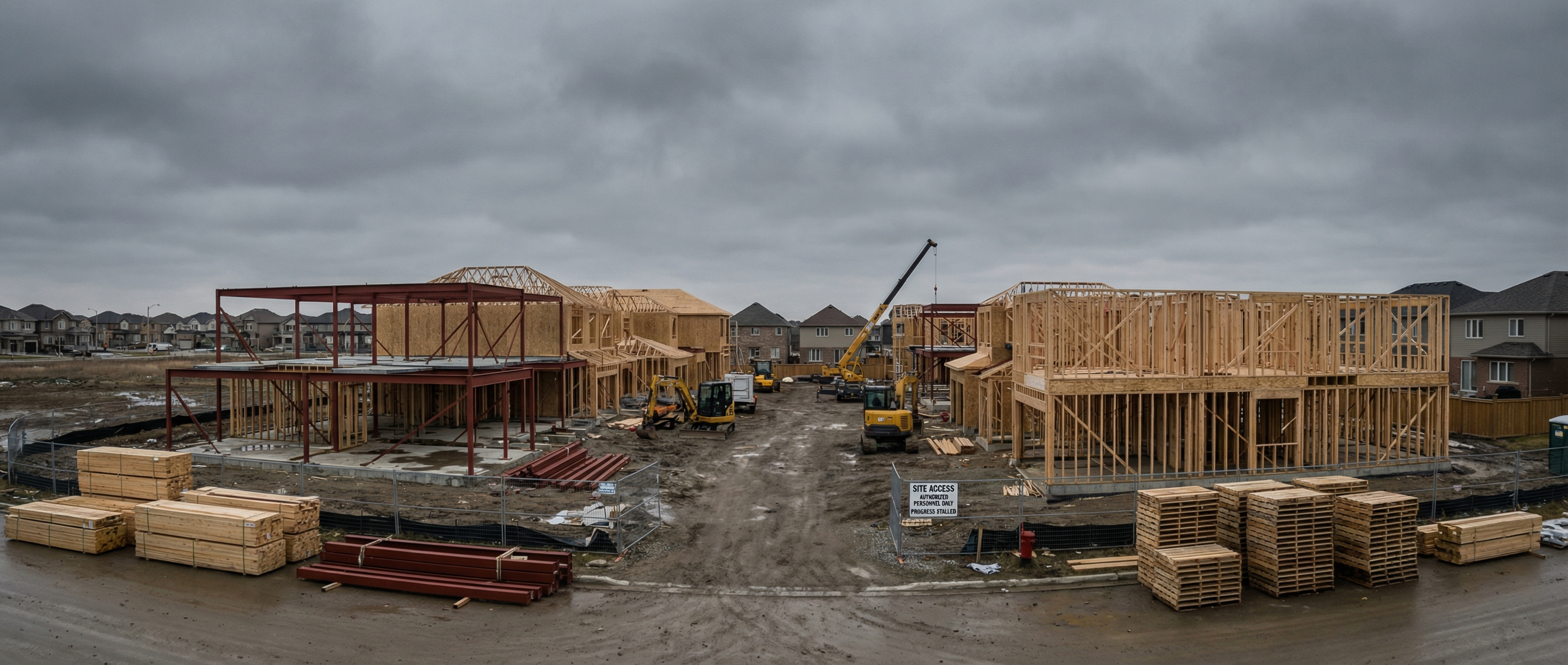
The Mortgage Ladder Keeps Rising: How FHA and Conforming-Loan Expansion Inflate Demand Faster Than Supply
When policymakers widen credit in a supply-constrained market, prices absorb the subsidy. The evidence in 2026 looks exactly like Chicago-school theory predicted.
· 5 min read · By Affordable Housing Initiative

Federal housing policy continues to treat affordability as a credit problem, even while supply remains constrained. In fiscal year 2024, FHA insured 766,942 forward mortgages, and HUD reports that more than 82% of FHA purchase endorsements went to first-time buyers. At the same time, FHFA raised the baseline conforming loan limit to $832,750 for 2026. In plain terms, Washington has kept widening the financing channel into the same structurally tight housing market.
From a Friedman-Sowell perspective, the mechanism is not mysterious. Demand subsidies increase effective purchasing power. If supply is inelastic in the short run, those subsidies capitalize into prices. You can call this support, inclusion, or market stabilization — but the math does not care about the label.
Credit Expansion Meets Inelastic Supply
The price response has been large. The S&P CoreLogic Case-Shiller U.S. National Home Price Index rose from 212.361 in January 2020 to 326.612 in January 2026 — a gain of roughly 53.8% over six years. That increase occurred while policymakers repeatedly expanded credit channels rather than removing local and state supply barriers.
The financing side has expanded as well. Household mortgage debt outstanding, as tracked in Federal Reserve flow-of-funds data, rose from $10.46 trillion in Q1 2020 to $13.77 trillion in Q4 2025. That is a debt increase of about 31.6% in five years. More leverage in a constrained market is not a path to lower real housing costs; it is mostly a path to higher bid prices and greater balance-sheet fragility.
The “Access” Story Is Real — and Incomplete
None of this means FHA has no social function. HUD’s own release shows FHA continues to serve borrowers who are less likely to be reached by purely private underwriting channels, including first-time and minority households, at meaningful scale in FY2024. That is a real policy objective, and it should be acknowledged honestly.
But the second-round effect is equally real: when government-backed credit reaches broad markets where new supply is administratively throttled, marginal buyers are forced to compete for a limited stock of homes. The immediate winner is not “affordability”; it is the incumbent seller who can command a higher clearing price. Hayek would call this a coordination failure imposed by policy architecture, not corrected by it.
Conforming-Loan Limits as an Automatic Demand Ratchet
The conforming-loan framework is often presented as a neutral technical tool. In practice, it behaves like an automatic ratchet. The 2026 FHFA announcement lifted the one-unit baseline by $26,250 year over year. The institutional signal is straightforward: as prices rise, policy raises the ceiling that federally backed channels can fund.
That is not merely accommodation; it is reinforcement. In high-cost and near-threshold markets, each limit increase broadens the quantity of housing that qualifies for subsidized secondary-market execution. Sellers, lenders, and buyers adapt quickly. The political optics are expansionary; the economic incidence tends to run through price.
Rate Volatility Magnifies the Distortion
When rates were abnormally low, this credit architecture amplified price acceleration. Freddie Mac’s 30-year average, captured in FRED, touched 2.65% in January 2021. By April 9, 2026, it stood at 6.37%. That swing did not unwind prices to pre-2020 levels; it mainly converted affordability stress from “price shock” into “payment shock.”
The result is a market where households face both high principal and high financing cost. This is why headline affordability remains strained even as nominal rate paths fluctuate. The Housing Affordability Index has improved from its recent trough, but at 117.6 in February 2026, it still reflects a market where median-income households do not have substantial error margin when rates, taxes, or insurance costs move against them.
What a Free-Market Correction Would Actually Prioritize
Chicago-school analysis does not require abolishing every federal program overnight. It does require policy sequencing that stops subsidizing bids before freeing supply. A coherent affordability agenda would:
1) Freeze further expansion of federally backed demand channels (including automatic upward drift in effective conforming coverage) until local supply constraints are demonstrably loosened.
2) Shift federal leverage toward removing barriers to construction throughput — permitting delay, exclusionary zoning, and code/fee accumulation that suppresses elasticity.
3) Evaluate housing “access” programs on incidence, not intent: who captures the subsidy in equilibrium, and how much of the transfer capitalizes into land and structure prices.
Affordability is fundamentally a supply-and-price problem, not a mortgage-product design problem. As long as Washington continues to widen purchasing power faster than cities and states allow housing output to respond, the cycle will repeat: larger loans, higher prices, heavier debt, and another policy round promising relief.
The uncomfortable conclusion is also the most empirically consistent one: credit can help households enter markets, but it cannot make structurally scarce housing cheap. Only abundant supply can do that.