The Property Tax Lock-In: How Assessment Caps Freeze Housing Supply
Well-intentioned property tax relief laws have become golden handcuffs, trapping long-term owners in place and starving the market of inventory, while first-time buyers pay the price.
· 7 min read · By AHI Research
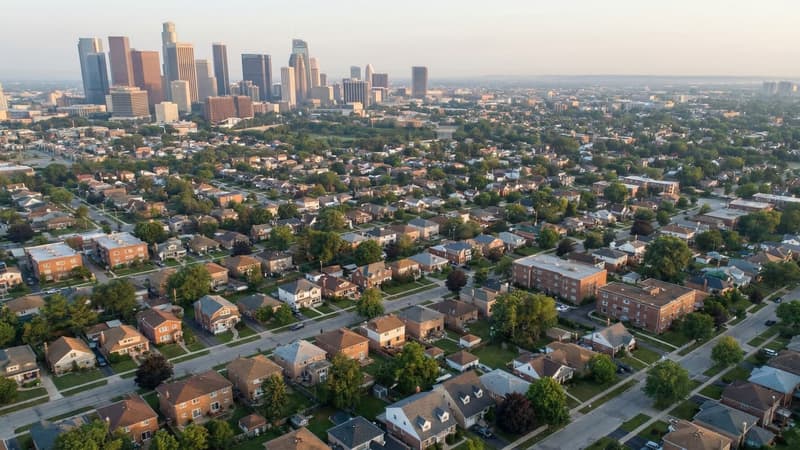
Consider two neighbors on the same Los Angeles street. One bought his house in 1990 for $200,000. The other bought an identical house next door last year for $1.2 million. The first neighbor pays roughly $4,700 per year in property taxes. The second pays $12,000. Same house. Same street. A tax bill 155% higher, simply because of when the purchase was made.
This isn't a quirk. It's the deliberate architecture of Proposition 13, California's landmark 1978 property tax law, and its equivalents in more than a dozen other states. And while these laws were sold as homeowner protection, the economic evidence is clear: assessment caps that freeze property taxes at purchase price don't just benefit long-term owners. They quietly punish everyone who wants to enter the housing market.
The Lock-In Mechanism: How Tax Caps Trap Supply
The logic is straightforward. Proposition 13 mandates a 1% property tax rate assessed at the time of purchase, with annual increases capped at 2% regardless of actual home price appreciation. In coastal California markets, where home values have compounded far faster than 2% annually for decades, this creates an enormous and growing subsidy for staying put.
The financial incentive to not sell becomes overwhelming. If you move to a comparable home nearby, your assessed value resets to current market price, and your annual tax bill potentially triples or quadruples overnight. Economists Nada Wasi and Michelle J. White documented this effect precisely in a 2005 NBER working paper. They found that from 1970 to 2000, average homeowner tenure in California increased by 1.04 years relative to comparison states — a 10% increase in how long people stay in their homes. For renters, the effect was even larger: a 19% increase in tenure length, as locked-in owners crowd out the turnover that would otherwise free up units for aspiring buyers.
The subsidies are not uniformly distributed. As NBER's digest of the paper explains, the lock-in effect scales directly with the size of the tax break. Homeowners in inland Bakersfield, where appreciation is modest, see a Prop 13 subsidy averaging only $110 per year, and their tenure length barely budges. Homeowners in coastal Los Angeles and San Francisco, where the tax subsidy can run into the tens of thousands of dollars annually, see their tenure length increase by two to three years. The more distorted the market, the stronger the incentive to stay frozen in place.
Twenty Years and Counting: The Data on Frozen Markets
These abstract incentives show up starkly in the current housing data. A March 2025 Redfin analysis of median homeowner tenure found that the typical American stays in their home for 11.8 years — itself near a historic high. But in Los Angeles, the median tenure reached 19.4 years in 2024, the longest ever recorded for the metro. San Jose clocked in at 18.3 years. Of the ten U.S. metros with the fastest-growing homeowner tenure over the past decade, five are in California.
Redfin's chief economist Daryl Fairweather was direct: Prop 13 gives California homeowners "extra reasons to stay put." The result, as CalMatters reported in July 2025, is a housing market "stuck in molasses" — new listings in San Francisco fell more than 17% year-over-year, and double-digit listing declines hit San Diego, Riverside, and Anaheim simultaneously. The supply simply isn't moving.
This matters enormously for buyers. Housing inventory is not a static pool. It circulates. Every owner who sells frees up a unit for a buyer, who may in turn free up a rental unit, which cascades through the market. When owners are financially anchored in place by policy, that circulation stops. The existing stock calcifies.
Transfer Taxes: A Second Layer of Friction
Property tax assessment caps aren't the only policy creating lock-in. Real estate transfer taxes — levied at the point of sale — impose a direct cost on the very act of moving. And the research on their effects is just as damning.
A landmark NBER study by Wojciech Kopczuk and David Munroe examined New York City's "mansion tax" — a 1% levy on transactions above $1 million. The researchers found that this single-percentage-point tax at a defined threshold eliminated 0.7% of all transactions in the affected price range. Between 2003 and 2011, they identified 2,800 "missing" transactions — sales that would have occurred but didn't because sellers pulled their homes from the market rather than trigger the tax. The tax also induced price distortion: to avoid the $10,000 liability on a $1 million sale, some sellers offered discounts of up to $20,000, destroying value in the market while still reducing supply.
The lesson is consistent across research from Australia, Canada, Germany, Finland, the UK, and the US: taxing transactions reduces transactions. When you make it expensive to sell, fewer people sell. When fewer people sell, fewer people can buy.
Milton Friedman's "Least Bad Tax" — and What We're Doing Instead
The frustrating irony is that economists across the political spectrum have long identified the solution. In 1978 — the same year Californians passed Proposition 13 — Milton Friedman articulated a clear principle: "The least bad tax is the property tax on the unimproved value of land, the Henry George argument of many, many years ago." This quote, preserved at EconLib, captures a critical distinction that Prop 13 collapses.
A tax on unimproved land — the raw earth beneath the structure — is economically efficient because land is in fixed supply. You cannot build more of it. Taxing something that cannot be produced or destroyed doesn't distort production decisions. But a tax on assessed value, frozen at purchase price, does something entirely different: it taxes the transaction itself, implicitly, by making the act of selling trigger a dramatic tax increase on the replacement property. The result is a policy that discourages the very market activity — turnover — that keeps housing circulating to its highest-valued users.
The Tax Foundation's 2025 analysis puts it plainly: assessment limits and tax swaps "create more problems than they solve, distorting property markets and undermining long-term housing affordability." A well-designed levy limit — one that caps the total tax bill rather than the assessed value — can provide relief to homeowners facing rising bills without creating the lock-in distortion. Targeted circuit breakers for low-income owners can protect vulnerable households without applying the same perverse incentive to million-dollar homeowners in Beverly Hills.
Who Pays the Price
The distributive consequences of assessment cap policies deserve direct scrutiny. Warren Buffett famously noted the absurdity in 2003: he paid $2,264 per year in property taxes on his $4 million California home — an effective rate of 0.056% — while his $500,000 Nebraska home carried a $14,410 bill at 2.9%. Prop 13 had saved him over $12,000 per year relative to market-rate taxation. The same dynamic plays out for every long-tenured California homeowner whose assessed value has drifted far below market reality.
Meanwhile, the young teacher, the first-generation immigrant family, the middle-income professional trying to buy their first home — they face full market-rate taxation from day one, in a market where prices have been elevated by the very supply constraint that tax policy helped create. The American Institute for Economic Research notes that the property tax is one of the most economically efficient taxes available to local governments — but only when it functions as an honest market-rate assessment. Distort it into a purchase-price freeze, and you transform an efficient revenue instrument into a supply-suppressing subsidy for existing owners.
The housing shortage is not one problem with one cause. But when we trace the incentive structures that keep existing homes off the market, property tax policy sits near the top of the list — an overlooked lever hiding in plain sight, backed by decades of rigorous economic research, and waiting for policymakers with the courage to reform it.
Part of the Subsidies & Tax Policy research cluster.