The Green Code Tax: How Federal Energy Mandates Are Pricing First-Time Buyers Out of New Homes
· 5 min read · By Affordable Housing Initiative
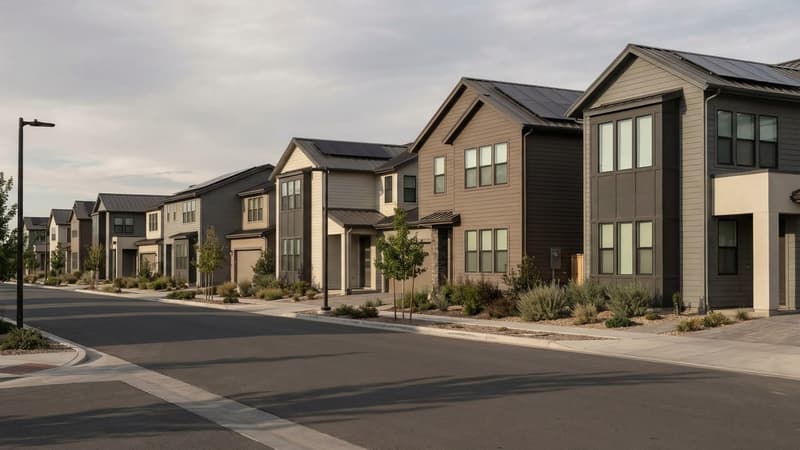
When a government mandate adds up to $31,000 to the purchase price of a starter home — before a single brick is laid, before a single nail is driven — and the buyer must wait up to 90 years to recoup that cost through lower utility bills, it is not an energy efficiency policy. It is a regressive tax on homeownership, extracted at the point of entry and borne most heavily by the households least equipped to bear it. That is precisely what the federal government's 2021 International Energy Conservation Code (IECC) mandate has imposed on every family seeking a new home financed through an FHA or USDA loan.
The Cost Buried in the Building Code
In April 2024, the U.S. Department of Housing and Urban Development (HUD) and the Department of Agriculture (USDA) finalized a determination requiring all newly constructed housing financed through their programs — FHA-insured single-family mortgages, USDA rural housing loans, public housing capital funds, and others — to comply with the 2021 IECC energy efficiency standard.
The government's own cost estimate, published by HUD's Office of Policy Development and Research, put the incremental first cost at $3,087 per home above the prior 2018 IECC standard — framed reassuringly as "less than 1 percent of the cost of the median FHA-financed new home." What that framing obscures is the cumulative regulatory stack. Each IECC update adds costs layered atop the previous cycle. And the real-world compliance cost, as builders actually experience it, runs far higher.
Home Innovation Research Labs, in its cost-effectiveness analysis commissioned by the National Association of Home Builders, found that compliance with the 2021 IECC adds more than $20,000 to the price of a new home. Builders in practice have reported incremental costs of up to $31,000 per unit — a figure cited by NAHB in its formal opposition to the HUD/USDA rule. The gap between the government's $3,087 estimate and the industry's $31,000 experience is not a rounding error. It reflects the difference between a modeled compliance cost and what a builder must actually spend to get a structure permitted, inspected, and sold.
The Payback Illusion
Proponents of energy code mandates argue that higher upfront costs are offset by lower utility bills over time. The math, however, does not survive contact with reality. The Home Innovation analysis found payback periods ranging from 79 to over 100 years depending on climate zone, meaning the average first-time buyer who purchases a new home today will never live long enough to break even on the mandated efficiency premium.
This is precisely the kind of calculation Milton Friedman addressed throughout his work on voluntary exchange versus coercion. In a free market, a buyer who values long-term energy savings can choose to pay more upfront for a more efficient home. And many do. The market responds to that preference with a range of products. What the mandate does is eliminate that choice: it dictates the premium without asking whether the individual buyer's circumstances, time horizon, or financial position make the trade-off rational. A 28-year-old first-time buyer with a 30-year mortgage who plans to move within seven years is not in the same position as a retiree buying a forever home. One-size-fits-all federal code treats both identically, pricing out the former to theoretically benefit the latter.
The Wrong Instrument for the Job
Even accepting the premise that government should act to reduce residential energy consumption, mandating efficiency in new construction is arguably the least efficient tool available. NAHB, citing the National Renewable Energy Laboratory, notes that energy upgrades to the existing housing stock — approximately 130 million homes built before modern energy codes were introduced — could yield a projected reduction of 5.7 percent of total annual U.S. electricity consumption by 2030. New construction, by contrast, adds only about 1 percent of the total housing stock per year.
The arithmetic is straightforward. If the goal is national energy efficiency, those 130 million existing inefficient homes represent the meaningful opportunity. Roughly 1.3 million new single-family and multifamily homes are permitted annually — a rounding error in the aggregate. By concentrating regulatory burden on new construction, the policy achieves the smallest possible energy impact while inflicting the largest possible affordability damage — precisely where housing markets are already strained by supply shortfalls, land costs, and a thicket of prior mandates. As we have documented in examining the full regulatory stack on new construction, federal, state, and local regulations already add close to $94,000 to the price of every new home before a single energy-code-specific line item is tallied.
The Knowledge Problem Writ Large
Friedrich Hayek's insight about the limits of central planning is nowhere more visible than in the application of a uniform national energy code to a country spanning eight climate zones, from Miami to Fairbanks. The 2021 IECC assigns compliance packages by climate zone. But a federal mandate by definition cannot account for the granular variation in local energy prices, grid composition, construction labor costs, and buyer preferences that make a given efficiency measure cost-effective in one market and wasteful in another.
In Climate Zone 4 (the mid-Atlantic and much of the Pacific Northwest), Home Innovation found that the 2021 IECC provision for a 2,500-square-foot house carries a payback period of up to 100 years. In warmer Climate Zone 2 (Florida, coastal Texas), the mandated specifications address heating loads that barely exist. The federal code does not know what a Phoenix buyer needs. A Phoenix buyer does. State and local jurisdictions, closer to the economic realities of their markets, have historically calibrated code adoption accordingly. But the HUD/USDA mandate overrides that calibration for any project touching federal mortgage finance.
California illustrates the trajectory. The state updates its Title 24 energy standard on a three-year cycle; the 2025 Building Energy Efficiency Standards took effect January 1, 2026, layering new cost obligations atop already-expensive baseline construction in the nation's least affordable major housing market. Each cycle adds incremental compliance costs that are invisible in any single regulation but compounding across decades of code updates.
When Mandates Become Gas Bans
Energy code mandates represent only one face of the regulatory escalation. Local and state jurisdictions have moved further, using building codes to prohibit natural gas connections entirely in new construction. Berkeley, California pioneered this approach, then saw the ban struck down by the U.S. Court of Appeals for the Ninth Circuit in 2024. Montgomery County, Maryland has enacted a ban on natural gas in new home construction set to take effect in 2027. Other jurisdictions are advancing similar measures.
All-electric construction mandates impose costs beyond energy code compliance alone: electrical panel upgrades, heat pump installation requirements, and higher utility rates in regions where electricity is priced above natural gas on a BTU-equivalent basis. These are real dollar costs to real buyers — costs that the mandate's architects do not pay.
The Market Alternative
None of this analysis suggests that energy efficiency in housing is undesirable. It suggests that coercing buyers to pay for it — regardless of their circumstances, preferences, or financial position — is an inefficient and inequitable mechanism for achieving it. Thomas Sowell's distinction between the "constrained vision" and the "unconstrained vision" applies directly here: policymakers who design energy mandates proceed as if buyers are making irrational choices that government must override. The constrained vision asks: what trade-offs are buyers actually facing, and does the price they're being forced to pay bear any relationship to the benefit they will actually receive?
A market-consistent approach would require energy cost disclosure at point of sale — giving buyers the information to price efficiency into their decisions — rather than mandating the outcome. It would focus retrofit incentive programs on the existing housing stock where the efficiency gains are largest. And it would permit state and local jurisdictions to calibrate code requirements to their specific climate and economic conditions without federal override through mortgage program eligibility.
Until then, every FHA-financed starter home carries a hidden green code tax — one that its buyer will almost certainly never recoup, extracted by a mandate that achieves less than 1 percent of the energy savings available in the homes already standing.
Part of the Construction Costs research cluster.