The Tariff Tax on Housing: How Trade Protectionism Inflates the Cost of Every New Home
· 5 min read · By Affordable Housing Initiative
When politicians talk about making housing more affordable, they rarely mention the import duties sitting on the materials used to build it. They should. According to the National Association of Home Builders, building material costs have risen 41.6% since the start of the COVID-19 pandemic — far outpacing general inflation — and tariffs on softwood lumber, steel, and aluminum have played a significant and measurable role in that increase. The NAHB's April 2025 Housing Market Index survey found that builders estimate a typical cost effect from recent tariff actions at $10,900 per new home. That is not a subsidy for domestic workers. It is a direct, regressive tax — paid by every homebuyer — routed through the price of wood and steel.
A Tax by Another Name
Milton Friedman was characteristically direct on tariffs: they are taxes on consumers, dressed in the language of national interest. A tariff does not fall on a foreign government or a foreign producer. It is collected at the border by the U.S. Treasury and passed through the supply chain to the person who ultimately buys the finished product. In residential construction, that person is the homebuyer.
The mechanics are straightforward. NAHB estimates that $204 billion worth of goods were used in the construction of new single-family and multifamily housing in 2024, with $14 billion — roughly 7% — sourced from abroad. Softwood lumber, steel, aluminum, and engineered wood products constitute the bulk of those imports. When the federal government imposes a 25% duty on steel or a 35% levy on Canadian lumber, the importer absorbs a portion and passes the rest to the builder, who passes it to the buyer. The incidence falls heaviest on those trying to afford their first home in an already supply-constrained market.
Softwood Lumber: Decades of Self-Inflicted Damage
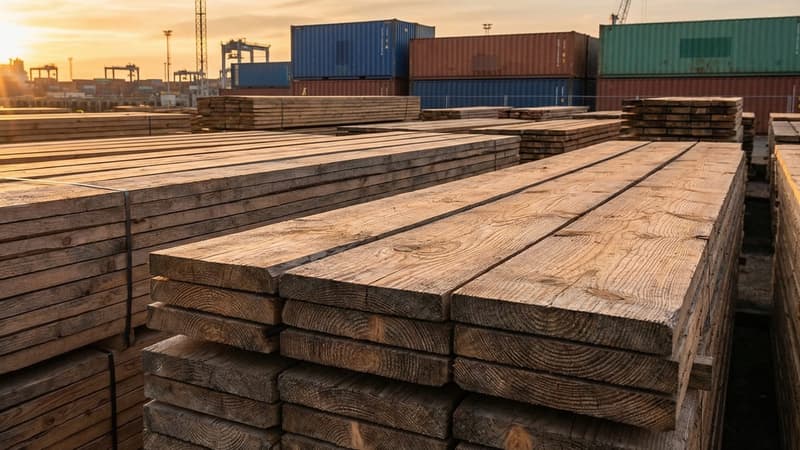
The softwood lumber dispute between the United States and Canada is one of the longest-running trade conflicts in North American history, and its damage to housing affordability has compounded with every escalation. Canada supplies approximately 85% of U.S. softwood lumber imports and accounts for nearly a quarter of total U.S. lumber supply — a market reality that protectionist tariffs cannot simply wish away.
The dispute stems from a structural difference in how timber is sold in each country. In Canada, roughly 94% of timber comes from crown land, where stumpage fees are set by provincial governments. U.S. producers argue this constitutes a subsidy, enabling Canadian mills to undercut American prices. The Commerce Department agrees, at least in part. Anti-dumping and countervailing duties have been in place since 2017.
The rate history tells the story. In August 2024, the Commerce Department raised the combined tariff rate on Canadian lumber from 8.05% to 14.54% following its fifth administrative review. By the summer of 2025, those anti-dumping and countervailing duties had climbed to a combined rate of approximately 35.2% on average, with an additional 10% tariff layered on top of Canadian softwood lumber exports as of mid-October 2025. The effective combined rate now exceeds 45% on the material that frames most American homes.
The effect on lumber prices has been dramatic at peak moments. In May 2021, the Framing Lumber Composite Price hit $1,500 per thousand board feet — nearly three times its pre-pandemic baseline — and set all-time highs for nine consecutive weeks. Even adjusted for inflation, 2021 lumber prices were 17% above their 25-year average, breaking a record that had stood since 1996. A portion of that spike was pandemic-driven demand. But the restricted import supply — a direct consequence of tariff policy — amplified every upward pressure. Prices have since moderated to roughly $600 per thousand board feet as of early 2026, but with tariffs at historic highs, the floor has been raised.
Steel, Aluminum, and the Cascading Cost Problem
Softwood lumber is not the only building material caught in the crossfire. In February 2025, the White House announced that 25% tariffs on all imported steel and aluminum products would take effect in March. Steel is ubiquitous in residential construction. It reinforces concrete foundations, forms structural beams in commercial and multifamily buildings, shapes window frames and HVAC components, and anchors the metal-framed walls of townhomes and apartments. Aluminum is the standard material for window frames, exterior cladding, and roofing systems.
NAHB Chairman Carl Harris was direct in response to the announcement: "The administration's move to impose 25% tariffs on all steel and aluminum products imports into the U.S. runs totally counter to this goal [of reducing housing costs] by raising home building costs, deterring new development and frustrating efforts to rebuild in the wake of natural disasters. Ultimately, consumers will pay for these tariffs in the form of higher home prices."
The steel tariff escalated further to 50% by June 2025. When these levies are stacked atop the lumber duties, the cumulative effect is significant: building material costs have risen 41.6% since the pandemic, far outpacing the 19.6% general price inflation recorded between January 2020 and January 2024. The building materials component has inflated more than twice as fast as the broader economy.
Bastiat's Broken Window, Applied to a Housing Shortage
Frédéric Bastiat's 1850 essay "That Which Is Seen, and That Which Is Not Seen" laid the groundwork for understanding why protectionist policies always appear more attractive than they are. The seen benefit of a lumber tariff is visible and politically legible: domestic sawmill jobs protected, campaign donors satisfied, a talking point about American workers. The unseen costs are dispersed, invisible, and borne by millions of individual homebuyers whose purchasing power quietly erodes.
Thomas Sowell captured the same logic in his observation that "there are no solutions, only trade-offs." When the government imposes a 45% tariff on Canadian lumber to protect American mill workers, it does not create lumber. It makes existing lumber more expensive for every builder, in every market, at every price point. The trade-off falls hardest on entry-level buyers who are already priced out of a market suffering from a structural shortage of 3.7 to 4 million units.
Hayek's insight about prices as information is equally relevant. The price of softwood lumber, undistorted by tariffs, would signal to builders and developers exactly how much wood costs to source and would direct capital toward the most efficient supply chains. Tariff-inflated prices transmit false information: they make imported lumber appear artificially expensive, domestic lumber artificially cheap, and they discourage the investment in production and trade relationships that would increase total supply. The result is a market that builds fewer homes than it otherwise would, at higher prices than necessary.
The Path Forward: Free Trade in Building Materials
The free-market prescription is clear and consistent across every tradition of liberal economics: unilaterally eliminate tariffs on building materials. Not negotiate, not reciprocate, not pause — eliminate. The U.S. does not need Canada to lower its stumpage fees before American homebuyers deserve access to affordable lumber. The tariff is a tax levied by the American government on American buyers. Congress can remove it at any time.
NAHB has repeatedly urged exactly this. The association has called on successive administrations to suspend tariffs on Canadian lumber and enter into a new softwood lumber agreement that would eliminate duties altogether. The economic logic is straightforward: the United States cannot domestically produce enough softwood lumber to meet current construction demand. Restricting imports does not change that constraint. It simply makes the shortage more expensive. A country that faces a housing deficit of nearly 4 million units cannot afford to tax the materials needed to close it.
Friedman, asked on the Donahue show whether free trade cost American jobs, gave the answer that still stands: of course it moves some jobs. But it creates far more wealth than it destroys, and it raises the living standards of everyone who buys the resulting goods — including everyone who cannot currently afford to buy a home. The tariff on lumber is not a housing policy. It is an anti-housing policy, and the data make that case as plainly as any economist could.
The Tariff Tax on New Homes: How Import Duties Are Pricing Out American Buyers
Folded in from a companion piece first published . Its figures and sources are preserved below.
The NAHB/Wells Fargo Housing Market Index for March 2026 registered 38 — below the 50-point threshold that separates optimism from pessimism, and the twelfth consecutive month in which the majority of American homebuilders have viewed market conditions as poor. Buyer traffic, a leading indicator of near-term demand, came in at 25. That is not a soft market. That is a market in which buyers are visibly absent from model homes and sales offices across the country.
The instinctive diagnosis is "high mortgage rates." That is partly correct. But it is incomplete in a way that matters enormously for policy. High mortgage rates are partly a function of Federal Reserve policy, yes, but the floor price of new construction has been independently elevated by a separate set of government decisions: import tariffs on the materials American builders use to build American homes. Understanding the distinction matters because the remedies are different. One requires monetary policy restraint. The other requires trade policy restraint. Both are within the power of government to correct. Neither correction is politically easy. Both are economically necessary.
What Materials Actually Cost in 2026
Materials account for roughly 49 percent of the final sales price of a new single-family home, according to NAHB cost-of-construction research. That share makes the production price of dimensional lumber, steel studs, aluminum framing, copper pipe, and imported finished goods — not the cost of land, labor, or financing — the largest single input category in American homebuilding.
The February 2026 Producer Price Index, published by the Bureau of Labor Statistics, shows the scale of the problem. Final demand goods prices rose 1.1 percent in a single month — the largest monthly advance in that category since August 2023. Year-over-year, final demand goods are up 3.4 percent. The subindex for final demand less foods, energy, and trade services — which strips out the most volatile components and reflects the structural, embedded cost environment — rose 3.5 percent year-over-year, marking ten consecutive months of advance. Construction materials are woven throughout these numbers. They do not appear as a line item, but their influence is visible in the trajectory: persistent, not transitory, and accelerating.
The specific tariff regime driving these costs is layered. Canadian softwood lumber — the dimensional lumber used in nearly every American wood-frame home — now carries a combined duty rate of approximately 45 percent after antidumping, countervailing duty, and Section 232 assessments. Steel and aluminum, subject to Section 232 tariffs since 2018 and extended or expanded since, flow into steel studs, reinforcing bar, HVAC components, and fasteners. A broad range of manufactured building products imported from China — electrical fixtures, plumbing components, tile, flooring — carry tariff rates ranging from 7.5 percent to 145 percent under various Section 301 actions. These are not emergency measures. They are the permanent cost floor of American residential construction in 2026.
The Pass-Through Mechanism: Who Actually Pays
The political framing of tariffs presents them as a cost imposed on foreign exporters. The economic reality is precisely the reverse for intermediate goods — the inputs to production. Decades of empirical research on tariff incidence consistently find that tariffs on intermediate goods are borne predominantly by domestic buyers of the final product, not by the foreign producer.
The mechanism is straightforward. A Canadian lumber mill does not absorb a 45 percent duty imposed at the U.S. border. It prices in U.S. dollars for the U.S. market, and American builders pay the duty at the point of import. The builder then faces a choice that is not really a choice: absorb the cost at the expense of margin, or pass it through to the buyer in the form of a higher list price. In a healthy market — one in which buyer traffic is strong and demand exceeds supply — builders would pass the cost through. In the March 2026 market, where buyer traffic is at 25 and 37 percent of builders have already cut prices an average of 6 percent, the answer is both: margins are being compressed and prices are still too high for marginal buyers to qualify.
NAHB has published research estimating that every $1,000 increase in the median new home price prices approximately 150,000 potential buyers out of the market nationally. The arithmetic of tariff pass-through, applied to a home with $150,000 in materials content at a 45 percent average duty rate on Canadian lumber and a 25 percent rate on steel, produces an embedded tariff cost well into five figures. The buyers who disappear at that margin are not wealthy. They are the first-time buyers, the dual-income households at 100–120 percent of area median income, the people for whom a new entry-level home represented the last affordable rung on the homeownership ladder.
The Mortgage Rate Amplifier
The tariff cost does not arrive in isolation. It arrives embedded in a home price that must then be financed at elevated interest rates. The Federal Reserve's H.15 Selected Interest Rates release of March 24, 2026 shows the 10-year Treasury constant maturity at 4.34 percent. The 30-year Treasury is at 4.91 percent. Conventional 30-year mortgage rates typically price at a spread of 2.5 to 3.0 percentage points above the 10-year Treasury — placing the effective mortgage rate for most buyers in the 6.75 to 7.25 percent range.
At 6.75 percent, every $10,000 added to a home's purchase price increases the monthly payment by approximately $65 and the 30-year cost by roughly $23,000 in interest. A tariff-induced materials premium of $15,000 to $20,000 — a conservative estimate given current duty structures — translates to $100 to $130 per month in additional mortgage burden for a buyer who is already stretching to qualify. For a household at the margin of qualification, that difference is not cosmetic. It is disqualifying.
Friedrich Hayek and the Price Signal the Market Is Sending
Friedrich Hayek's central insight about price signals applies directly to what the March 2026 Housing Market Index is telling us. In a functioning market, prices encode information about costs, preferences, and scarcity. When government distorts input prices upward — through tariffs, regulatory mandates, or any other mechanism — the price signal to the market is: produce less of this. Builders respond to that signal not with ideological resistance, but with rational business decisions. They start fewer homes. They defer projects that no longer pencil. They walk away from land they would otherwise develop.
The HMI's buyer traffic subindex at 25 is the downstream expression of this signal. When input costs push list prices beyond what buyers can finance, buyers stop appearing. When buyers stop appearing, builders stop building. The result is a housing shortage that is not a market failure. It is a policy outcome wearing a market failure's clothes.
Milton Friedman's analysis of tariffs in Free to Choose is instructive here: every tariff is, in the final analysis, a tax on domestic consumers, dressed in the language of protection for domestic producers. In housing, there is no meaningful domestic substitute for Canadian dimensional lumber — the U.S. does not produce sufficient softwood timber to replace Canadian imports at scale, certainly not on the timeline that matters for housing affordability. The tariff does not create American lumber jobs sufficient to offset the damage to American homebuyers. It raises costs, suppresses construction, and concentrates the pain on the households least able to absorb it.
The Shelter CPI Connection
The feedback loop between construction cost suppression and shelter inflation is visible in the headline price data. The February 2026 Consumer Price Index, published by the Bureau of Labor Statistics, shows shelter costs rising 3.0 percent year-over-year and contributing more than any other category to the monthly CPI increase. Shelter is rising at 3.0 percent because housing supply is structurally insufficient, and tariffs on construction inputs are one of the forces holding that supply down.
The policy incoherence here deserves explicit attention. Policymakers at the federal level simultaneously express concern about housing unaffordability and maintain tariff regimes that systematically inflate the cost of building new homes. These positions are not in tension. They are directly contradictory. You cannot impose a 45 percent duty on the lumber that frames American homes and simultaneously claim to be working to make housing more affordable. The math does not permit both to be true.
What Builder Behavior Is Actually Telling Us
The March 2026 HMI data from the National Association of Home Builders is more than a sentiment gauge. It is a real-time inventory of builder responses to the current cost environment:
Sixty-four percent of builders are using sales incentives — mortgage rate buydowns, closing cost assistance, appliance packages, design upgrades — to move inventory. This is the twelfth consecutive month in which that figure has exceeded 60 percent. Builders are not incenting buyers out of generosity; they are incenting because the base price, at current materials costs, is above where buyers can qualify without structural assistance.
Thirty-seven percent are cutting list prices, with an average cut of 6 percent. A 6 percent price cut on a $400,000 home is $24,000 in absorbed margin. That $24,000 is not a builder gift to buyers. It represents the compression of margins that would otherwise fund the next project. When margin compression is deep enough and prolonged enough, new project approvals decline. The Census Bureau's new residential construction data reflects this dynamic over time. Fewer starts today means fewer homes available to buyers in 18 to 24 months — perpetuating the cycle of undersupply that tariff-inflated input costs helped create.
Construction Under Tariff: How Import Duties on Building Materials Are Pricing Buyers Out of New Homes
Folded in from a companion piece first published . Its figures and sources are preserved below.
Milton Friedman famously observed that there is no such thing as a free lunch. Tariffs, he would add, are perhaps the least-free lunch in all of economic policy. They impose their costs invisibly — passed through supply chains, embedded in material prices, and ultimately extracted from the buyer at the closing table. In 2026, with housing affordability already at generational lows, the tariff burden on construction materials has become one of the most consequential — and least-debated — drivers of new home costs.
The latest data from the Bureau of Labor Statistics, analyzed by the National Association of Home Builders' Eye on Housing research blog, make the magnitude of the problem clear. The price index for inputs to new residential construction rose 3.4% year-over-year as of February 2026, with goods inputs — the materials that actually go into a house — up 3.0% from a year ago and services inputs up 4.2%. These are not transitory fluctuations; they represent a structural elevation in the cost of building.
The Price Signal the Market Cannot Ignore
Within the broad materials index, the damage from tariffs on metal products is stark. Across all metals and metal products used in residential construction, prices are up 16.6% year-over-year. The specific line items are more alarming. Metal molding and trim — the connective tissue of modern framing — saw prices rise 61.7% compared to one year ago. Metal windows, increasingly standard in new construction, are up 20.2% year-over-year, according to the NAHB Eye on Housing analysis of BLS Producer Price Index data.
These are not numbers that builders can absorb through efficiency gains or value engineering. When the raw material cost of a window frame rises by a fifth in a single year, that cost is passed forward — to the builder's margin, then to the contract price, and finally to the buyer's mortgage. Tariffs on building materials are not a tax on imports; they are a tax on new homes.
The Lumber Story: Duties, Disrupted Imports, and Sawmill Contraction
No building material illustrates the tariff problem more concretely than softwood lumber. Canada supplies roughly 80% of U.S. softwood lumber imports, and throughout 2025, the duty burden on those imports was systematically raised. NAHB data tracking lumber market conditions shows that combined antidumping and countervailing duties on Canadian lumber doubled to 35%, and all softwood lumber imports then became subject to a new 10% Section 232 national security tariff effective in October 2025. The result: Canadian softwood lumber — the single largest input to residential framing — now enters the United States facing a combined 45% duty rate.
The market responded exactly as economists would predict. U.S. imports of softwood lumber in 2025 totaled an estimated 12.7 billion board feet — the lowest annual import volume since 2014. Fourth-quarter import volumes were the lowest recorded since the first quarter of that same year. The supply contraction was not offset by domestic production; sawmill utilization rates remained near 70%, and sawmill employment fell to approximately 85,400 workers in Q3 2025, the lowest level since Q1 2013 — the tenth consecutive quarterly decline in an industry that is simultaneously being taxed on its primary foreign input and starved of residential construction demand to justify domestic expansion.
Hayek's insight about price signals is directly applicable here. In a free market, rising lumber prices would attract new investment in domestic sawmill capacity and incentivize suppliers to find alternative sources. But when high prices are the product of a government-imposed duty rather than a genuine scarcity signal, the market's self-correcting mechanism is confounded. Investment signals are distorted, domestic capacity does not scale to meet the implied demand, and the buyer is left paying a premium with no increase in supply to show for it.
The New Home Price Paradox
The cost pressure from materials is visible in a striking price inversion in the new home market. Historically, new homes commanded a substantial premium over existing homes — from 2010 to 2019, that average premium was approximately $66,000 — reflecting the value of fresh construction, modern systems, and builder warranty. That relationship has been collapsing.
According to Census Bureau and National Association of Realtors data compiled by NAHB, the median price for a new single-family home in the fourth quarter of 2025 was $405,300, while the median price for an existing home was $414,900. This marks the third consecutive quarter in which existing home prices have exceeded new home prices, an anomaly that has appeared in five of the past seven quarters.
The explanation is straightforward: builders are absorbing cost pressure and cutting margins to move product, because the alternative is sitting on unsold inventory while mortgage rates remain elevated. New home median prices fell 3.34% year-over-year in Q4 2025. But this price moderation is not a sign of a healthy market finding equilibrium. It is a sign of builders being caught between artificially inflated material costs on one side and an affordability-constrained buyer pool on the other. The squeeze reduces the volume of homes that can be profitably built, which worsens supply, which ultimately pushes all prices higher.
Builder Confidence and the Investment Signal
The forward-looking measure for residential construction, the NAHB/Wells Fargo Housing Market Index, has reflected this cost-side pressure all year. Builder confidence ticked upward in March 2026 but remains well below the 50-point threshold that separates expansion from contraction. An index reading below 50 means that more builders view current conditions as poor than good. The most frequently cited reasons are construction costs, regulatory burden, and affordability constraints on buyers.
When the investment climate for builders is consistently pessimistic, the downstream effect is predictable: fewer housing starts, reduced pipeline, and sustained upward pressure on prices. A tariff policy that artificially raises input costs is, by direct mechanism, a housing-supply suppression policy. It is as if the government imposed zoning restrictions not in local ordinances but in the trade ledger.
The Friedman Framework: What Tariffs Actually Do
Friedman's argument against protectionism was never abstract. He asked a simple question: who benefits, and who pays? The answer for building material tariffs is the same as for any tariff. A small number of domestic producers — steel mills, domestic lumber operations, metal component manufacturers — receive protection from foreign competition. The cost of that protection is spread across millions of housing transactions, home buyers, renters, and construction workers whose employment prospects are reduced when building activity slows.
Thomas Sowell's observation that "there are no solutions, only trade-offs" applies with particular force here. Tariffs do not eliminate the need for lumber or steel; they raise the price of obtaining it. The trade-off is between the concentrated benefit to protected industries and the diffuse, invisible cost borne by every American who wants to buy or rent a home. That the cost is diffuse and invisible is precisely why it is politically sustainable — even as it compounds the affordability crisis year by year.
The Tariff Surcharge Nobody Talks About: How Metal Price Inflation Is Adding Thousands to Every New Home
Folded in from a companion piece first published . Its figures and sources are preserved below.
The price of a new home has never been only about mortgage rates. But as the spring market opens in 2026, it is worth examining what is actually embedded in that sticker price before a single brick is laid or a loan is approved.
According to the Bureau of Labor Statistics' Producer Price Index for February 2026, analyzed by NAHB Eye on Housing, metal molding and trim prices are up 61.7% year-over-year. Metal windows are up 20.2%. Across all metals and metal products used in residential construction, prices are up 16.6% year-over-year. These are not rounding errors. They are among the largest sustained input cost increases recorded for any construction material category in a generation.
The source of this increase is not a natural scarcity of steel or aluminum. It is not driven by the kind of supply chain disruptions that characterized 2020–2021. It is driven by trade policy, specifically, the layered tariff architecture that survived the Supreme Court's February 2026 ruling on IEEPA authority, and which continues to function as an excise tax on the inputs required to build American homes.
This is the tariff surcharge nobody talks about. Policy conversations about housing affordability focus on mortgage rates, zoning laws, and land prices. But metal molding and trim — the structural framing, window casings, and ductwork of a modern home — is 61.7% more expensive than it was a year ago. That cost doesn't appear as a line item on a housing policy white paper. It appears as a higher number on a builder's materials invoice, which becomes a higher price tag on every new unit sold.
What the BLS PPI Is Telling Us
The NAHB analysis of BLS Producer Price Index data for February 2026 gives a systematic view of where construction cost pressure is concentrated. The overall price index for inputs to new residential construction rose 3.4% year-over-year and 0.7% in February alone — persistence that rules out a transient one-time shock. Building materials specifically: +3.5% year-over-year, +0.6% in February.
But the headline figure undersells the story. Within that overall increase, the distribution is sharply skewed toward metals:
- Metal molding and trim: +61.7% year-over-year — the single largest annual increase in any building material category BLS tracks
- Metal windows: +20.2% year-over-year — accelerating throughout 2025–2026
- All metals and metal products in residential construction: +16.6% year-over-year
BLS notes that this data was collected during the week of February 13 — before the additional Section 301 trade investigations announced in March 2026 targeting approximately 80 trading partners. Current figures likely understate the trajectory.
But the most analytically significant piece of the data is not the headline increase. It is what BLS experimental data on import vs. domestic construction inputs reveals about the mechanism of those price increases. Domestic goods in new construction rose 3.0% year-over-year through December 2025. Imported goods in new construction fell 3.2% year-over-year. Imported materials are getting cheaper. Domestically produced materials are getting more expensive.
In the absence of tariffs, these price signals would converge through market competition — importers undercutting domestic prices, domestic producers responding by reducing margins or improving efficiency. Tariffs prevent that arbitrage. The Section 232 tariffs on steel (25%) and aluminum (10%) floor domestic metal prices above the level at which imported competition would otherwise price them. The tariff's primary visible effect is not to restrict imports. Those are falling in price. It is to allow domestic producers to maintain elevated margins in a market where their foreign competition is actually cheaper.
Thomas Sowell called this the "third-party cost" structure: the benefits of the tariff are visible, concentrated, and politically legible (domestic steel and aluminum producers in identifiable congressional districts). The costs are diffuse, invisible, and spread across millions of housing consumers who have no seat at the trade policy table.
The Tariff Architecture After the Supreme Court
On February 20, 2026, the Supreme Court ruled 6-3 in Learning Resources Inc. v. Trump that the International Emergency Economic Powers Act does not authorize the president to impose tariffs unilaterally. Chief Justice Roberts, writing for the majority, held that Congress's delegation in IEEPA did not encompass broad tariff authority, and that the major questions doctrine required clearer statutory authorization. The full opinion is available from the Supreme Court.
The administration responded within hours. President Trump invoked Section 122 of the Trade Act of 1974, imposing a new 10% global import surcharge through a separate legal mechanism. Section 122 carries a 150-day statutory clock that expires approximately in July 2026, creating a defined but unresolved sunset. In March 2026, the U.S. Trade Representative additionally opened Section 301 investigations into approximately 80 trading partners for alleged unfair labor and trade practices — a process that could layer additional duties atop the existing structure.
For homebuilders, the most important element of the post-SCOTUS landscape is what the ruling did not change: Section 232 tariffs on steel (25%) and aluminum (10%) were not imposed under IEEPA authority. They rest on a separate statutory basis and were not affected by the ruling. The metals driving the sharpest residential construction cost increases — the 61.7% surge in metal molding and trim — are precisely the products most exposed to Section 232.
The combined effect is a layered tariff regime that is simultaneously legally uncertain and materially persistent. For builders trying to project material costs six months forward, this is Hayek's "impossibility of planning" problem in concrete form: the price of the steel studs in next quarter's homes is genuinely unknowable.
Friedman's Cost Floor: The Tariff as a Housing Tax
Milton Friedman's analysis of how government-imposed cost floors operate explains precisely why Section 232 tariffs function as an excise tax on residential construction rather than a protection for domestic industry.
When the government imposes a tariff on an input for which there are no ready substitutes, the tariff operates not as a competitive barrier but as a price floor. Structural metals in construction have no scalable substitutes at current price points. Wood framing cannot replace steel window systems; composite materials cannot replace metal molding and trim at anything approaching comparable cost. The builder does not have an exit option. The cost floor holds regardless of what happens to demand.
In this context, the Section 232 steel tariff functions exactly like an excise tax on new residential construction. The revenue from the tariff flows to the federal government. The above-market margin flows to domestic steel and aluminum producers. The cost is borne by the homebuyer — not because they are party to any of these transactions, but because the cost is embedded in the production function of every new unit built. A family paying $8,000–$10,000 more for a new home than they would in the absence of Section 232 tariffs — a reasonable estimate given the materials intensity of residential construction and the 16.6% metal cost increase — is not filing comments with the USTR. They are writing a check to a builder who has already absorbed the full cost before determining the listing price.
This is what Friedman identified throughout his career: costs that are diffuse and invisible to individual consumers aggregate into significant harm but generate no political response, while concentrated, visible benefits generate intense lobbying. The political economy of the tariff is perfectly designed to persist regardless of its effects on housing affordability.
Hayek's False Price Signal and the Builder Response
The Hayekian insight is both simpler and more damaging: tariffs do not merely redistribute costs. They distort the information system through which markets coordinate activity.
When metal prices rise 16.6% year-over-year due to government intervention, builders receive a price signal that says: build less, build smaller, cut quality, or don't build at all. And they are doing exactly that. NAHB reports that builders have been reducing specifications, moving to smaller footprints, and offering price concessions — rate buydowns, upgraded fixtures, closing cost contributions — to move inventory in a market where the cost structure doesn't support the prices buyers can pay.
The problem: this rational response is responding to a false signal. The price signal that elevated metal costs sends is not a signal of genuine scarcity. It is a signal manufactured by government intervention. The market is allocating resources in response to a policy distortion, not a real underlying condition. The homes getting smaller are not smaller because that's what the market efficiently produces. They're smaller because tariff-inflated input costs have priced out the square footage that buyers actually want.
The uncertainty dimension compounds this: because Section 122 expires in July, Section 301 outcomes are unpredictable, and congressional action on trade policy is unlikely before that deadline, builders cannot price their pipeline confidently. Uncertainty is itself a cost. A project that pencils out at current material prices may not pencil out at post-July prices if the tariff regime escalates. The rational response — which many builders are executing — is to delay ground-breaking on projects where material cost assumptions are too uncertain to underwrite. That delay becomes a supply reduction that persists for years.
The New Home Price Inversion: Third Quarter of Builder Stress
The aggregate consequence of rising input costs is visible in NAHB's analysis of Census Bureau and NAR data for Q4 2025. The median new single-family home price was $405,300 — a $9,600 discount to the existing home median of $414,900. This is the third consecutive quarter of this reversal.
The historical norm from 2010 to 2019 was a $66,000 new-home premium over existing homes. New homes carry modern specifications, energy efficiency, builder warranties, and no deferred maintenance — buyers paid for that freshness. The collapse of the premium, from $66,000 above to $9,600 below, tells you how much margin builders have surrendered trying to stay price-competitive in a market where input costs have surged.
New home prices fell 3.34% year-over-year in Q4 2025. Existing home prices rose 1.25% over the same period — their tenth consecutive quarter of increases. Builders are absorbing rising input costs through margin compression. Existing home sellers, who face no such input cost pressure, are not. The result: new homes are now cheaper than existing, but builders are building fewer of them. Housing starts were down 6.2% year-over-year in early 2026. Less new supply means continued pressure on existing home prices, which means sustained affordability deterioration for buyers in every market segment.
Household real estate wealth reflects this dynamic. Federal Reserve Z.1 data shows total household real estate market value declined to $47.9 trillion in Q4 2025 — down 0.7% from Q3, the second consecutive quarterly decline — while outstanding mortgage liabilities reached a record $13.8 trillion. Owners' equity remains at 71.3%, but the trend reversal is meaningful for buyers who purchased at peak prices.
The Fed Trap: Monetary Policy Can't Fix a Cost Floor
The Federal Reserve held the federal funds rate at 3.75% at its March 2026 FOMC meeting — the second consecutive pause. Chair Powell characterized the housing market as "weak" in the press conference. The Fed's Summary of Economic Projections revised core PCE inflation upward to 2.7% for 2026 (from December's 2.4% projection), with a return to the 2% target not projected until 2028. NAHB now expects just one rate cut in 2026, down from its prior forecast of two. The Federal Reserve H.15 release showed the 10-year Treasury at 4.42% and 30-year at 4.93% as of March 26, with 30-year mortgage rates hovering just above 6%.
The structural irony is precise: the Federal Reserve is holding rates elevated in part because of supply-side cost-push inflation, while that same elevated inflation is partially driven by tariff-imposed cost floors that monetary policy cannot address. The Fed cannot solve tariff-driven construction cost inflation by adjusting the federal funds rate. Lower rates would ease mortgage payments for buyers and reduce financing costs for builders — both real benefits at the margin. But they would not reduce the price of steel studs, metal window systems, or galvanized structural components. Section 232 operates independently of monetary conditions.
The correct framing — evident in any supply-side reading of the March FOMC data — is that when inflation is supply-side in origin, the appropriate response is supply-side in nature. Demand suppression through elevated rates cannot fix a cost floor imposed by trade policy. The free-market prescription is not complicated. Section 232 can be terminated by presidential proclamation. Section 122 carries its own July 2026 sunset. The mechanism exists. The political question is whether it will be deployed.
The 21st Century ROAD to Housing Act — which passed the Senate 89-10 and was signed in March 2026 — provides NEPA streamlining, zoning incentive grants, and manufactured housing deregulation. These are genuine supply-side gains. But a manufactured home whose chassis requires steel that is 16.6% more expensive than last year captures fewer of those gains than the legislation's architects intended. Zoning reform without construction cost reform delivers into a cost environment that partially negates it.
Conclusion: Remove the Cost Floor
The BLS data for February 2026 is not a political document. It is a measurement. Metal molding and trim is up 61.7% year-over-year. Metal windows are up 20.2%. The domestic vs. imported data inversion tells us these costs are not being driven by global supply conditions. They are being maintained by a government-imposed price floor that protects domestic metal producer margins above the level at which import competition would otherwise price them.
Section 122's 150-day clock creates a decision point around July 2026. Section 232 can be removed by presidential proclamation at any time. Section 301 investigations can be resolved through negotiated frameworks rather than additional duties.
The most direct near-term policy action available to reduce housing affordability's construction cost component is not a new program, subsidy, or legislative initiative. It is the removal of a tax on residential construction inputs — one that was partly imposed through a legal authority the Supreme Court has now determined does not exist — and that continues to embed thousands of dollars of artificial cost in every home built in America.
The market is trying to build. The data shows exactly what is stopping it.
Data sources: BLS Producer Price Index (February 2026) via NAHB Eye on Housing; BLS PPI Input Indexes (Experimental, December 2025) via BLS.gov; New vs. existing home prices Q4 2025 via NAHB Eye on Housing / Census Bureau; Federal Reserve Z.1 Financial Accounts via NAHB Eye on Housing / Federal Reserve; FOMC statement and SEP (March 2026) via Federal Reserve; H.15 interest rates via Federal Reserve; SCOTUS opinion, Learning Resources Inc. v. Trump, via supremecourt.gov.
One Year of Liberation Day: How Trade Protectionism Became Housing's Hidden Tax
Folded in from a companion piece first published . Its figures and sources are preserved below.
On April 2, 2025, President Trump stood in the White House Rose Garden and declared a national emergency over the U.S. trade deficit. He held up a chart. He called it "Liberation Day." The tariffs he announced that afternoon — sweeping import duties on goods from nearly every nation on earth — came with a set of promises: manufacturing would be reborn, jobs would roar back, consumers would pay less, and the national debt would shrink under a flood of tariff revenue. One year later, the housing market offers a precise and data-rich verdict on each of those claims. It is not a favorable one.
The specific interest of this publication is narrow and clear: what did Liberation Day do to the cost of building a home in America? The answer, drawn from the Federal Reserve, the Bureau of Labor Statistics, the National Association of Home Builders, the Tax Foundation, and the Yale Budget Lab, is that tariffs on construction materials functioned exactly as free-market economists predicted they would — as an excise tax on housing production. They raised the cost floor for new homes, suppressed supply at the margin, and concentrated the burden on the households least able to absorb it.
The Policy Architecture: From Rose Garden to Construction Site
To understand the tariff burden on housing, it helps to distinguish between the two overlapping regimes that have shaped construction costs since 2025. The first is the longstanding Section 232 framework — steel tariffs of 25% and aluminum tariffs of 10%, imposed under national security authority and upheld by the courts. These were in place before Liberation Day and remained intact even after the Supreme Court struck down the broader IEEPA framework in late 2025. They form a structural cost floor that has been embedded in residential construction for years.
The second layer was the Liberation Day IEEPA tariff regime. At its peak, the effective average tariff rate reached 21.5%, encompassing 42% of U.S. imports at a blended 13.6% rate before the Supreme Court ruling constrained the IEEPA authority. The administration pivoted to alternative legal authorities: a global 10% surcharge under Section 122 now sits on top of the surviving Section 232 rates. The cumulative regime is historically elevated. The Tax Foundation estimates the tariffs imposed between 2025 and 2026 represent a 10-year fiscal drag approaching $3.2 trillion at their peak exposure.
For residential construction, the transmission mechanism is direct. Homes are built from steel, aluminum, and lumber. Each percentage point of tariff protection on those materials is a percentage point increase in the cost of the finished product. There is no exception, no workaround, and no insulation. The excise tax lands at the framing stage.
What the BLS Data Shows: A Structural Cost Escalation
The Bureau of Labor Statistics Producer Price Index for construction inputs tells the story in numbers. As of February 2026, construction input prices were up 3.4% year-over-year. That headline figure understates the tariff-specific impact because it blends across all input categories. The metals data is far more striking:
- Metal building components: +16.6% year-over-year
- Metal molding and trim: +61.7% year-over-year
- Metal windows and doors: +20.2% year-over-year
These are not supply chain disruptions or demand spikes. They are the predictable consequence of a 25% tariff on steel inputs. The domestic steel producers benefiting from those tariffs have raised prices to just below the tariff-inclusive import price — a rational response, but one that passes the cost directly to builders.
The lumber picture is structurally different but equally damaging. Canada supplies approximately 80% of U.S. softwood lumber imports. Canadian softwood now faces a combined antidumping, countervailing, and Section 232 duty of approximately 45%. The result: U.S. softwood lumber imports in 2025 totaled an estimated 12.7 billion board feet — the lowest annual import level since 2014. American sawmills, insulated from Canadian competition, have not increased output to compensate. They have maintained elevated prices against reduced competition. The family building the home pays the spread.
Based on NAHB construction cost survey data and materials intensity analysis, the tariff-driven additions to construction costs range from approximately $7,000 to $13,000 per median new home from metals alone, with additional impact from lumber tariffs. These costs are not absorbed by builders. They are passed to buyers. The builder who absorbs them simply builds fewer homes.
60 Percent of Builders Report Direct Tariff Cost Increases
NAHB's own survey data, cited in connection with the bipartisan Housing Tariff Exclusion Act introduced by Senators Rosen and Coons in February 2026, found that roughly 60% of builders have already seen cost increases directly attributable to tariffs. The legislation would create an automatic exemption process for building materials — a recognition by Congress that the tariff regime is functionally incompatible with housing affordability goals.
NAHB Chairman Bill Owens stated directly: "This bill is an important step forward to create more certainty for American businesses and to address the nation's housing affordability challenges." The legislative recognition is notable because it comes from the industry, not from critics. Builders are not ideologically opposed to tariffs as a general matter. They are reporting a factual constraint: the cost of materials has risen to a level that makes projects economically marginal.
The Housing Market Index — NAHB's monthly confidence reading — has been below 50 for 23 consecutive months as of March 2026, sitting at 38. A reading below 50 signals that more builders view conditions as poor than favorable. In March, 37% of builders cut prices (average 6%) and 64% offered incentives. Builders are cutting prices in a market where input costs are rising. That is a mathematically unsustainable posture. The outcome is fewer projects greenlit, not a long-run equilibrium. Supply destruction is quiet, incremental, and invisible — exactly what Thomas Sowell would describe as the unseen cost.
The Massachusetts Case Study: Where the Numbers Become People
National aggregates obscure the human dimension of supply destruction. Massachusetts provides a specific, verifiable illustration. Governor Maura Healey signed a $5.1 billion housing bond bill in 2024 with a stated target of 222,000 new homes by 2035. One year into implementation, permits issued in 2025 totaled approximately 12,000 — a pace that would yield roughly 108,000 units by the target year, less than half the goal.
Nonprofit builders in Massachusetts are reporting a specific cost problem: Canadian lumber, which has historically supplied Northeast construction projects, now arrives with a 45% tariff premium. The alternative — shipping from Pacific Northwest domestic mills — adds substantial freight cost on top of already elevated prices. The construction economics of the affordable units the bond program is meant to produce have deteriorated in direct proportion to the tariff burden. The state has appropriated the money. The units will not get built on schedule. The policy costs are real; the homes they preclude are invisible.
Rider Levett Bucknall's Q4 2025 construction cost report for the Eastern U.S. found that Boston construction costs rose more than 4% from the end of 2024 to 2025, with metal-intensive components driving the largest share of the increase. This is not an outlier. It is a region-wide reflection of national tariff policy applied to local construction economics.
The Regressive Structure: Who Actually Pays
The burden distribution of construction tariffs is doubly regressive. First, they raise the cost of the good — a new home — and housing costs as a share of income fall most heavily on lower-income households. Second, they reduce the supply of entry-level housing, which is the segment most sensitive to construction cost floors and most critical to housing access for first-time buyers.
The NAHB/Wells Fargo Cost of Housing Index for Q4 2025 found that a family earning the national median income of $104,200 needed 34% of its income to cover the mortgage payment on a median-priced new home. A family earning half the median income — $52,100 per year — would need 67% of its income for the same payment. The tariff-induced cost increase of $7,000 to $13,000 per home translates directly into a qualification barrier: at a 6.5% mortgage rate, a $10,000 increase in home price raises the required qualifying income by approximately $2,500 per year.
The Yale Budget Lab estimated that Liberation Day tariffs represented a peak household income loss of $2,400, and that this burden fell regressively, hitting lower-income households harder as a percentage of their consumption. In 2025, the Tax Foundation calculated an average household tax burden of approximately $1,000 from tariffs, with an additional $600 estimated for 2026.
Milton Friedman's framework for evaluating excise taxes applies with precision here: a tax on a consumption good that constitutes a larger share of lower-income budgets is regressive by definition. A tariff on construction materials is an excise tax on shelter. It extracts resources from the poorest consumers and redirects them to the most politically organized domestic producers. The steel mill and the sawmill lobby effectively; the renter who will never qualify for a mortgage because the cost floor rose does not.
Did Liberation Day Deliver on Its Promises?
The Tax Foundation's retrospective assessment of Liberation Day's one-year record is systematic and worth engaging directly. On manufacturing employment: manufacturing shed approximately 89,000 jobs between April 2025 and February 2026, per Bureau of Labor Statistics data. ISM Manufacturing contracted for nine consecutive months following the Liberation Day announcement. Construction employment in manufacturing fell. The sector that was supposed to be "reborn" contracted.
On revenue: customs duties raised an estimated $264 billion in 2025 — the highest effective tariff rate since 1947 on a percentage-of-imports basis. This is a real number. But the promised debt paydown did not materialize. Federal debt continued to rise. And the revenue came at the cost of offsetting reductions in income and payroll tax bases as economic activity contracted.
On prices: tariffs contributed an estimated 0.8 percentage points to CPI inflation during 2025. Manufacturing output fell 3.2%. The promised investment surge did not materialize in the data. For housing specifically, the tariff regime generated real government revenue, and it extracted that revenue directly from the residential construction sector, reducing supply at the margin and raising the cost floor for every American family trying to buy a new home.
One Year On: The Arithmetic of Policy
The anniversary of Liberation Day is an appropriate moment for a clear-eyed accounting. On housing, the promises have not been kept, and free-market theory explains exactly why they could not have been. When you tax construction materials, you get less construction. When you reduce construction, you reduce supply. When you reduce supply against persistent demand, you get higher prices. The family who couldn't qualify was not failed by the market. They were failed by the policy.
A 1.2 million unit housing shortfall is not solved by making each unit more expensive to build. The solution is not more targeted exemptions, more exclusion processes, or more legislative carve-outs — though each of those would be an improvement. The solution is the recognition that trade barriers on construction materials are, in effect, tariffs on shelter. Twelve months of data confirm what economic theory has always predicted. The question now is whether the policy responds to the evidence.
Part of the Construction Costs research cluster.