Friday Market Recap — March 21, 2026: Fed Holds, Rates Climb to 6.22%, and the Spring Market Stalls
· 8 min read · By Affordable Housing Initiative

The week of March 17–21, 2026 delivered three data releases that, read together, paint a coherent and troubling picture of what happens when a housing market faces compounding institutional constraints. The Federal Open Market Committee held rates at 3.50%–3.75% for the second consecutive meeting, but added language about Middle East uncertainty that signals ongoing wariness about premature easing. Freddie Mac's Primary Mortgage Market Survey for March 19 showed the 30-year fixed rate jumping to 6.22%, the highest reading since January 8, 2026, continuing a reversal from the brief sub-6% window that briefly appeared to be opening a door for spring buyers. And the National Association of REALTORS' pending home sales report for February provided the data equivalent of a shrug: a 1.8% monthly gain that, when measured year over year, still represents a -0.8% decline. None of these releases are catastrophic. Together, they confirm that the spring market is not gathering momentum. It is losing it.
This Week's Core Market Dashboard
| Indicator | Latest Reading | Prior Reading | Change | Source |
|---|---|---|---|---|
| 30-Year Fixed Rate (PMMS) | 6.22% | 6.11% | +0.11 pp | Freddie Mac, Mar 19 |
| 15-Year Fixed Rate (PMMS) | 5.54% | 5.50% | +0.04 pp | Freddie Mac, Mar 19 |
| Federal Funds Rate | 3.50%–3.75% | 3.50%–3.75% | Held | FOMC, Mar 18 |
| Pending Home Sales (Feb, MoM) | +1.8% | — | -0.8% YoY | NAR, Mar 17 |
| NAHB Builder Confidence (HMI) | 38 | 36 (Feb) | +1 pt | NAHB, Mar 17 |
| NAHB Builders Cutting Prices | 37% | 36% (Feb) | +1 pp | NAHB, Mar 17 |
Mortgage Rates: The Sub-6% Window Has Closed
Four weeks ago, for exactly one survey period — the week ending February 26, 2026 — the Freddie Mac PMMS recorded the 30-year fixed rate at 5.98%. It was the first sub-6% print since late 2023. Purchase applications surged. First-time buyers moved. The headlines called it a thaw in the spring market. This week, that reading is a memory. The 30-year fixed sits at 6.22% as of March 19 — a gain of 24 basis points in under a month, and the fastest reversal in the 2026 rate trend. The 15-year fixed moved from 5.44% to 5.54% over the same period.
The pattern here is important to understand with precision. Mortgage rates do not move in response to Federal Reserve policy decisions in any simple mechanical way. They respond to 10-year Treasury yields, which themselves price in forward expectations about inflation, growth, and Fed policy. When the FOMC signals it will hold — or when geopolitical uncertainty raises the prospect of oil-driven inflation — the long end of the yield curve adjusts. The March 18 FOMC statement's addition of Middle East risk language almost certainly contributed to the 10-year Treasury holding above 4.3% this week, which cascaded into the 6.22% mortgage rate. The Fed does not set mortgage rates. But the Fed's words — and its credibility around inflation — set the environment in which mortgage rates are priced.
For buyers, this trajectory erases affordability gains that were accumulating steadily through wage growth. A buyer purchasing the median-priced home at 6.22% versus 5.98% pays approximately $58 more per month on principal and interest — a difference that, compounded over 30 years, represents roughly $21,000 in additional interest paid. Twenty-four basis points does not sound large. In practice, it is the difference between qualifying and not qualifying for many marginal buyers.
Freddie Mac discontinued separate tracking of adjustable-rate mortgage products in November 2022 when it updated its data collection methodology. ARM rates remain available in the market — the Mortgage Bankers Association tracks them in its weekly applications survey — and they continue to price at a discount to the 30-year fixed, typically 50 to 75 basis points lower depending on the product. In a market where the fixed rate is 6.22%, a well-structured 5/1 ARM offers meaningful payment reduction for buyers who expect to sell or refinance within five to seven years. That said, the appropriate product for any individual depends on their time horizon, income stability, and tolerance for rate reset risk.
The FOMC Held — But the Statement Tells a More Complex Story
Wednesday's FOMC decision was widely expected. The March 18, 2026 statement maintained the federal funds rate target at 3.50%–3.75%, the same level held since the January 28 meeting. What is worth parsing carefully is the statement's language, because FOMC statements are precise instruments. Each word is deliberate.
Two items stand out. First, the statement characterizes job gains as having "remained low" and notes that the unemployment rate "has been little changed in recent months." This is soft-labor-market language. Under the Fed's dual mandate, a weakening labor market should argue for accommodation — lower rates. Second, the statement asserts that "inflation remains somewhat elevated" and adds that "the implications of developments in the Middle East for the U.S. economy are uncertain." The Middle East framing is new. It wasn't in the January statement. Its presence in March signals that the FOMC is now explicitly pricing in oil-price risk — precisely the kind of inflation pathway that would make near-term rate cuts counterproductive.
The result is the Fed's institutional dilemma made explicit in a single document: the labor market wants cuts; the inflation picture doesn't yet permit them; and a geopolitical wild card now threatens to make the inflation picture worse before it gets better.
Also notable: Stephen I. Miran dissented, preferring to cut the federal funds rate by 25 basis points at this meeting. Miran's dissent is the first at this meeting cycle and signals that a dovish faction within the Committee views the labor market data as already sufficient justification for easing. The lone dissent does not change the outcome, but it changes the internal math. If economic data softens further before the April 28–29 meeting, Miran's argument gains adherents.
From a housing-market perspective, the March 18 hold means that the federal funds rate remains above the level most economists consider structurally neutral. This is relevant for housing not just because of mortgage rate levels (longer-term rates are not directly controlled by the Fed) but because it signals that construction financing, business lending, and consumer credit will remain relatively tight. The cost of capital for builders, land developers, and apartment operators is higher than it would be under a neutral rate setting. Persistently elevated rates slow the very supply-side activity that would relieve housing cost pressure.
Pending Home Sales: The Numbers Behind the Headline
The February 2026 Pending Home Sales report, released March 17, showed a 1.8% month-over-month increase in signed contracts — a directionally positive reading attributed by NAR Chief Economist Lawrence Yun to "improved affordability conditions." The brief period in late February when the 30-year rate was at or below 6% clearly moved the needle on buyer activity.
The regional breakdown reveals important heterogeneity. The Midwest gained 4.6% month over month — the strongest regional reading and, as Yun noted, likely a reflection of its structural affordability advantage over coastal markets. The South gained 2.7%. The West edged up 0.9%. The Northeast fell 3.6% — a region that Yun specifically flagged as "held back by a combination of higher home prices and a shortage of supply."
The year-over-year figures are less encouraging. Nationally, pending sales fell 0.8% versus February 2025. The Northeast is down 12.1% year over year — a striking negative that reflects not just rate sensitivity but structural supply deficits in markets like New York, Boston, and Greater Philadelphia, where zoning restrictions, high land costs, and political barriers to new construction have compounded over decades. The South (+1.2%) and West (+3.2%) showed modest year-over-year gains, consistent with Sun Belt markets that added meaningful new supply during the pandemic construction cycle.
Among the 50 largest metro areas, San Diego–Chula Vista–Carlsbad led all markets with a 13.5% year-over-year increase in pending sales. Jacksonville, FL and San Jose–Sunnyvale–Santa Clara, CA followed at +12.1% and +10.6%, respectively. The pattern across high performers — San Diego, San Jose, Miami, Phoenix, Denver, Sacramento — suggests that markets where meaningful supply additions or affordability improvements have occurred are capable of generating real demand momentum. The constraint is not buyer desire. It is the supply architecture that has been built by decades of zoning policy.
Yun's comment that "there is sizable pent-up demand that could be released into the market" is consistent with the structural read. Demand exists, wages are growing, and there are 6 million more jobs in the country than in the pre-COVID period. What the market lacks is adequate supply at prices buyers can qualify for, in a rate environment distorted by prior monetary excess.
Builder Confidence: 38 — The 21st Consecutive Month Below 50
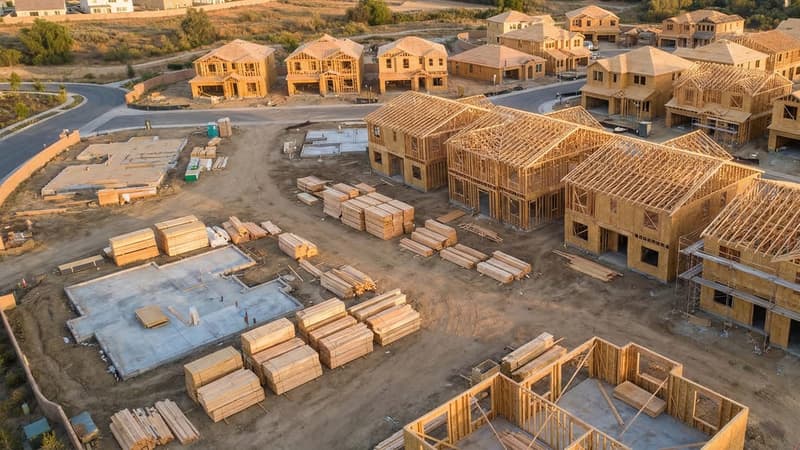
The NAHB/Wells Fargo Housing Market Index for March 2026 rose one point to 38 — technically an improvement from February's 36, but still the 21st consecutive month below the 50-threshold that separates builder optimism from pessimism. To put that in context: the HMI has been signaling net pessimism among single-family homebuilders for nearly two full years.
The March component breakdown: current sales conditions at 42, expected future sales at 49, and traffic of prospective buyers at a deeply depressed 25. The traffic sub-index — the measure of actual buyer foot traffic at model homes and developments — has been stuck in the low-to-mid 20s for months. It correlates closely with actual single-family starts activity. When buyers aren't walking through model homes, builders aren't breaking ground.
The price-cut data is particularly revealing. 37% of builders cut prices in March, up from 36% in February, with an average price reduction of 6%. Meanwhile, 64% are using sales incentives of some form — mortgage rate buydowns, closing cost assistance, appliance packages — marking the 12th consecutive month that this share has exceeded 60%.
This is not the behavior of a construction sector operating in a healthy market. It is the behavior of builders trapped between two policy-driven cost pressures: materials costs elevated by tariff policy, and demand suppressed by the rate environment created by prior monetary policy. NAHB analysis of tariff impacts on home building estimated that tariff actions already in place added $10,900 per new home in costs before the March escalations of steel and aluminum tariffs. Builders cannot simultaneously cut prices to attract buyers, absorb rising input costs, and maintain economically viable margins. The HMI reading of 38 is not a sentiment number. It is a forward-looking indicator of supply production. And it is flashing amber.
Supply Pipeline: What 21 Months of Builder Pessimism Means
The NAHB HMI, the permits data, and the builder behavior metrics together describe a supply pipeline that is operating well below the level needed to close the structural housing deficit. The Census Bureau's most recent New Residential Construction release — which tracks housing starts and permits at the national level — provides the quantitative dimension. The series is updated monthly; current housing starts and permits data is available from the Census Bureau.
What the builder surveys confirm is that even where starts are occurring, they are occurring with narrowing margins, compressed by material costs and carrying costs on inventory that isn't moving at full list price. The future sales expectations component of the March HMI — at 49, just below the break-even line — suggests builders see modest improvement ahead, likely contingent on any further rate relief. But that relief appears unlikely in the near term given the FOMC's stated posture and the new Middle East risk premium in market pricing.
What This Week Reveals About Policy-Distorted Markets
Milton Friedman's core insight about monetary policy was that the lags are long and variable — that the effects of policy decisions play out over 12 to 24 months, often in ways that confound the policymakers who made the original choice. The housing market in March 2026 is living inside Friedman's lag. The near-zero rates of 2020–2021 drove prices to levels that borrowers at today's rates cannot comfortably qualify for. The normalization that began in 2022 suppressed demand, compressed affordability, and, through the rate lock-in effect, also suppressed supply as existing homeowners refused to sell and trade into higher-rate mortgages. And tariff policy, applied without regard for its housing market consequences, has embedded additional cost floors into the new-construction pipeline.
None of these pressures originate in market failure. Buyers would transact at lower prices if they could. Sellers would list if they could trade without financial penalty. Builders would build if material costs permitted viable margins. The impediments are institutional: a central bank still navigating the consequences of its own prior excess; a trade policy that taxes domestic home buyers to protect domestic material producers; and decades of exclusionary zoning that restrict the land on which additional supply could otherwise be built.
The pending sales data gives the free-market framework its clearest validation this week. The markets posting the strongest year-over-year gains — Sun Belt metros that added supply, diverse mid-tier cities where land and permitting constraints are less severe — are the markets that allowed the market to work. The Northeast, where zoning and regulatory barriers are among the nation's most restrictive, is down 12.1% year over year. The data does not argue for more policy. It argues for less.
Week Ahead
No major housing data releases are scheduled for the week of March 23–27. The next FOMC meeting is April 28–29, 2026 — not a Summary of Economic Projections meeting. Between now and then, markets will watch incoming CPI, PCE, and labor data for signals about whether the Fed has room to cut before June. The March 19 rate reading of 6.22% will be followed by the next PMMS on Thursday, March 26. Any movement in 10-year Treasury yields tied to oil markets or geopolitical developments will register directly in that figure. The spring buying window — compressed and rate-sensitive — remains open but is narrowing with each basis point gained.
Part of the Market Data & Indicators research cluster.