
The Inclusionary Zoning Trap: How "Affordable Housing" Mandates Destroy the Supply They Promise to Create
· 5 min read · By Affordable Housing Initiative
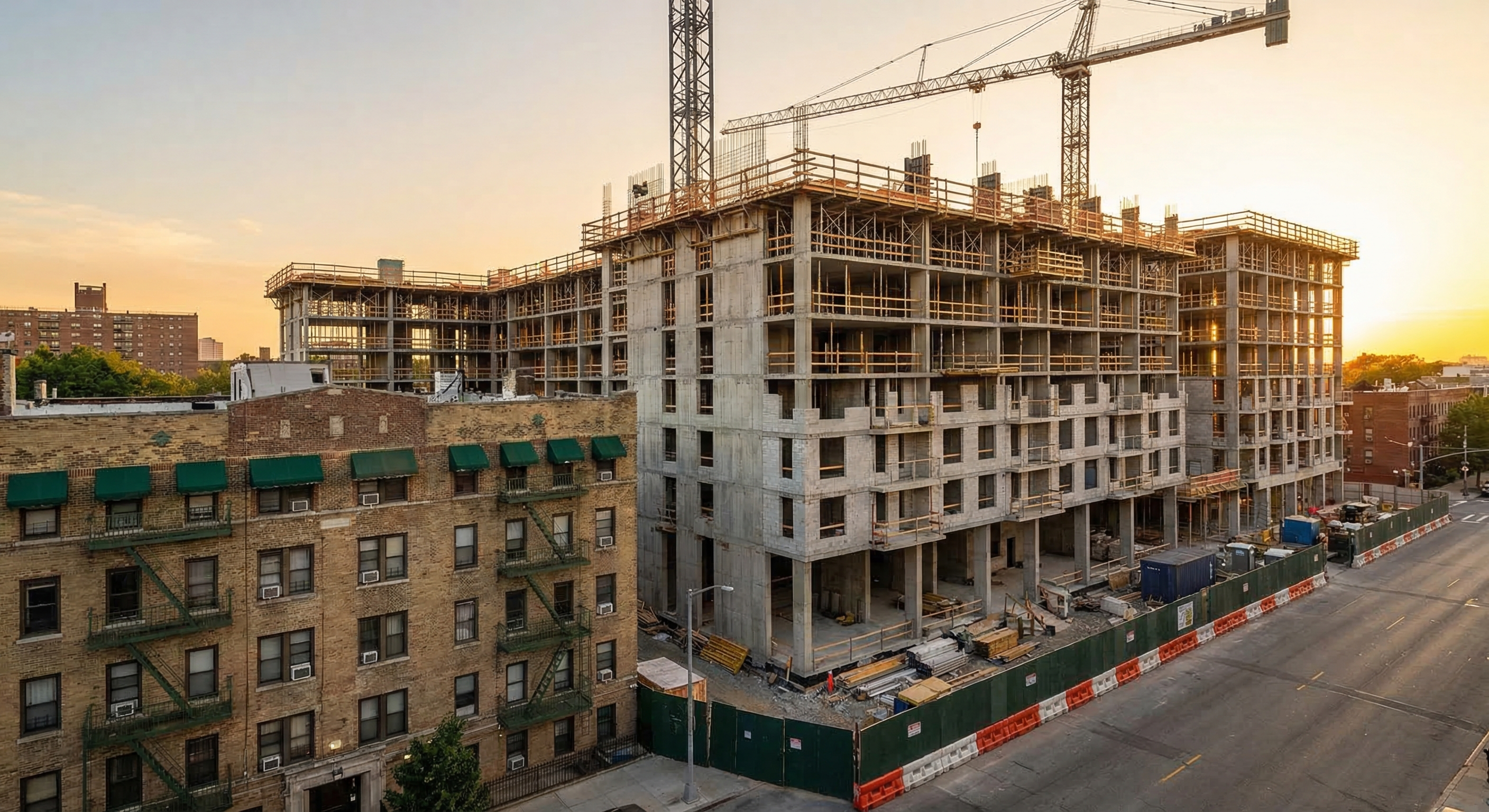
There is no better illustration of the law of unintended consequences in housing policy than inclusionary zoning. Across more than 800 American cities, local governments require developers to sell or rent a fixed percentage of new units at below-market prices — a mandate that sounds like an obvious solution to the affordability crisis. The logic is seductive: developers build housing anyway, so why not extract a quota of affordable units from each project? The problem, as a growing body of empirical evidence confirms, is that this logic inverts basic price theory — and the results are housing markets with less of everything: fewer market-rate homes, fewer below-market homes, and higher prices for everyone.
The Economics of a Subsidy Mandate
Inclusionary zoning (IZ) is, at its core, a tax on new residential construction. When a municipality requires that 15 or 20 percent of units in a new building be priced at, say, 60 percent of area median income, it is compelling developers to sell those units at a loss — and mandating that the remaining market-rate buyers absorb the subsidy. Developers are not charities. The cost of each below-market unit gets redistributed across the rest of the project, raising prices for market-rate buyers and shrinking the pool of financially viable projects.
This is not a controversial observation. It is standard microeconomics. A price ceiling on a portion of a good, financed by a price floor on the remainder, reduces total quantity supplied. Milton Friedman observed that price controls, wherever applied, reliably produce shortages. Inclusionary zoning applies exactly this logic to housing — with precisely the predicted result. The Mercatus Center at George Mason University documented that despite more than five decades of IZ programs nationwide, the total number of affordable units produced since inception is estimated at only 129,000 to 150,000 — a national drop in the bucket against a shortage measured in the millions of units.
The UCLA Terner Center's Stark Trade-Off
The most rigorous recent analysis of this trade-off comes from a 2024 study by the UCLA Lewis Center for Regional Policy Studies, published by the Terner Center for Housing Innovation at UC Berkeley. Focusing on Los Angeles's Transit Oriented Communities program, the study modeled what happens to total housing production as IZ requirements increase. The findings are striking.
Each percentage-point increase in IZ requirements between 1 and 16 percent is associated with the elimination of between 4,600 and 11,900 market-rate units. At a 20 percent IZ requirement, the model predicts that while 50,000 below-market units would be created, over 200,000 market-rate units would be destroyed. That is a net loss of 150,000 homes — a four-to-one destruction ratio. The study was explicit: beyond a certain threshold, higher IZ requirements produce less affordable housing and less market-rate housing simultaneously. The policy devours itself.
Portland and San Francisco: Case Studies in Policy Failure
Abstract modeling becomes concrete reality in two of America's most expensive cities. Portland, Oregon adopted a mandatory inclusionary housing fee in 2017. The result was immediate and severe: housing permits in the city fell from 5,094 units in 2019 to 1,779 units in 2020 — a collapse of 65 percent. Developers did not simply absorb the mandate; they moved their capital to surrounding suburban jurisdictions just outside Portland's limits. As the Sightline Institute documented, multifamily permit filings within Portland fell 40 percent from their 2016 peak — while the Tigard Triangle and Vancouver waterfront saw a surge of new construction. The IZ mandate had effectively exported Portland's housing supply to its suburbs, reducing total affordability within the city while doing nothing to address regional demand.
San Francisco offers an even more instructive case. For decades, the city maintained one of the most aggressive inclusionary mandates in the country — roughly 22 percent of units in new on-site developments required to be affordable. Then, in 2023, San Francisco's own Technical Advisory Committee found that no residential project prototype it studied would be financially feasible under those requirements. Development had ground to a near-halt. In response, the city that pioneered aggressive IZ quietly reduced its requirement to approximately 12 percent — an implicit admission that its mandate had been strangling the very supply it sought to supplement.
The Arithmetic of 27 Units Per Year
Step back from the case studies and examine the aggregate national performance. According to data compiled by Inclusionary Housing, the average production rate across all IZ programs in the United States is 27 affordable units per year per program. The top 20 programs average 235 units annually — but those are outliers in a landscape of hundreds of programs producing almost nothing. Meanwhile, the National Association of Home Builders estimates that 74.9 percent of U.S. households — roughly 100.6 million families — cannot afford the median-priced new home of $459,826 in 2025. The mismatch between IZ output and housing need is not a gap; it is a chasm.
Thomas Sowell's insight applies directly here: "There are no solutions — only trade-offs." Inclusionary zoning mandates represent a particularly costly trade-off: trading a small number of subsidized units in exchange for a much larger reduction in total housing supply, with the additional side effect of raising prices for every market-rate buyer in the city. It is a policy that takes from the many to give to the few — while ultimately failing even the few.
The Density Bonus Illusion
Proponents of IZ frequently point to density bonuses — allowances to build more total units than base zoning would permit — as the mechanism that makes IZ financially viable. The argument is that a developer required to set aside 15 percent of units at below-market rates can offset that cost by building a taller or denser building. This is theoretically sound as far as it goes. But as the National Association of Home Builders has noted, the density bonuses embedded in IZ programs derive their value entirely from the underlying exclusionary zoning that restricts development in the first place. The density bonus does not create value; it partially returns value that exclusionary zoning has already destroyed. A city that simply reformed its base zoning to allow higher density would achieve the same (or greater) housing production at zero cost to affordability — without the mandatory subsidy extraction.
Friedrich Hayek's concept of the knowledge problem is instructive here. City planners setting IZ percentages do not have access to the project-level financial models, land acquisition costs, construction debt terms, or local market conditions that determine whether a given development pencils out. They set a single mandatory rate and apply it uniformly — blind to the enormous variation in project feasibility. The result, predictably, is that the mandate is set either too low to produce meaningful affordable units, or high enough to kill development entirely. There is no centrally optimal rate, because the information required to calculate it is dispersed, local, and constantly changing.
What Actually Works
The evidence on IZ is not uniformly negative — programs with modest mandates, well-calibrated density bonuses, and strong underlying market demand do produce affordable units without catastrophically suppressing total supply. But these programs are the exception, not the rule. And in every case, the affordable units produced represent a fraction of what unrestricted market construction could deliver through the filtering mechanism — as older market-rate housing depreciates into the affordable stock over time.
The most effective interventions to improve housing affordability share a common feature: they expand supply rather than restrict it. Eliminating single-family zoning exclusions, streamlining permitting timelines, reducing impact fees, and allowing density by right all increase total housing production without extracting subsidies from new buyers. When governments stop taxing the construction of housing and start enabling it, housing gets built — and affordability follows. Inclusionary zoning, however politically appealing, achieves the opposite: it taxes supply in the name of subsidizing demand, and ends by delivering less of both.