Taxing Land, Not Buildings: Milton Friedman's Radical Fix for America's Housing Crisis
Standard property taxes penalize construction and reward idle land-banking. In 1978, Friedman called land value taxation "the least bad tax." With home prices 54 percent above their 2020 levels, his insight deserves a serious policy hearing.
· 6 min read · By Affordable Housing Initiative

The affordable housing debate generates predictable proposals: more subsidies, rent freezes, inclusionary mandates, and public housing programs. What almost never appears on the agenda is an idea that Milton Friedman called, in a 1978 interview, "the least bad tax." He was talking about land value taxation, and it may be the most underexplored supply-side tool available to American housing policy.
How Today's Property Tax Discourages Building
Standard property taxes are levied against the total assessed value of a parcel: land plus improvements. This creates a structurally perverse incentive. Build a house on your lot and your tax bill rises. Add a floor, renovate a kitchen, or convert a vacant storefront into apartments, and the government charges you more for doing so.
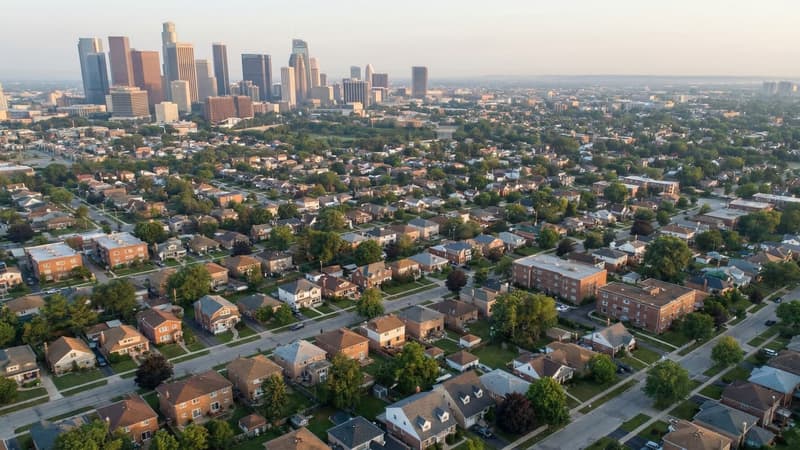
The result is predictable. In dense urban cores — precisely where housing is most needed — property owners face a systematic penalty against development. A surface parking lot in downtown San Francisco generates far lower property taxes than a six-story apartment building on the same footprint. The fiscal signal points toward underuse.
According to the Tax Foundation, U.S. home values rose 54.4 percent in nominal terms between January 2020 and July 2024 — an increase that reflects years of constrained supply rather than any fundamental improvement in housing quality. The average sales price of an American home climbed from $371,100 in early 2020 to $525,100 just two years later, a 41 percent jump. Property taxes rose alongside, rewarding municipalities for inaction while burdening buyers for the privilege of financing someone else's land appreciation.
Friedman's Insight: Tax What Cannot Shrink
The theoretical case for land value taxation rests on basic supply-and-demand logic. Land within a fixed geographic area is, by definition, in fixed supply. No level of taxation on land causes less land to exist. The same is not true of buildings, which can be constructed, renovated, or demolished in response to price signals, and which therefore shrink in supply when the government taxes them heavily.
As EconLib documents in its summary of the land tax debate, Friedman's argument echoed Henry George's Progress and Poverty (1879): land value is largely created by surrounding public infrastructure and economic activity — roads, transit, schools, employers — rather than by the landowner's own productive effort. Taxing that value therefore captures a windfall that wasn't generated by the property owner in the first place. Tax land at full market value and you do not change how much land exists; you change only who captures the locational premium.
This is what makes the land value tax (LVT) analytically unusual: it is both progressive in economic incidence and efficiency-neutral in supply terms. Reducing the tax on buildings — or eliminating it entirely through a pure LVT — removes the penalty on construction and maintenance, redirecting the fiscal pressure toward landowners who choose to hold parcels idle rather than develop them.
The Prop 13 Case Study: Freezing the Wrong Variable
The failure mode of American property tax policy is well-illustrated by California's Proposition 13. Passed in 1978, Prop 13 capped property tax rates at one percent and limited annual assessment increases to two percent until sale — creating a large implicit subsidy for long-term homeowners that compounds with every year of appreciation.
The NBER Digest analysis of research by Wasi and White offers a telling illustration: Warren Buffett paid $2,264 per year on a $4 million California home versus $14,410 on a $500,000 home in Nebraska — a 25-fold discrepancy in effective rates produced entirely by the assessment freeze. The full study, NBER Working Paper 11108, finds that from 1970 to 2000, the average tenure of California homeowners increased by more than a year relative to comparable states as the lock-in subsidy made moving economically irrational for long-time owners.
The lock-in effect is largest in coastal California cities, the same markets where housing scarcity is most severe. Assessment caps effectively freeze supply: they make long-time owners reluctant to sell, and they create no fiscal pressure on holders of underdeveloped land to put it to productive use.
A shift toward land value taxation solves both problems simultaneously. It eliminates the lock-in subsidy by taxing land at current market value regardless of when a parcel was acquired. And it removes the construction penalty that discourages infill development, renovation, and densification.
The Supply Constraint: How Large Is the Stakes?
Land value taxation does not work in isolation. It would function alongside, not instead of, zoning reform. The landmark Glaeser-Gyourko study established that in expensive markets, home prices exceed the physical cost of construction primarily because of zoning and land use controls. The gap between price and construction cost represents the "zoning tax" — a pure economic rent captured by land, not by buildings or labor.
The macroeconomic cost of that constraint is substantial. In their 2019 paper in the American Economic Journal, Chang-Tai Hsieh and Enrico Moretti estimate that housing supply constraints in high-productivity cities — New York, San Francisco, and a handful of others — lowered aggregate U.S. GDP growth by 36 percent between 1964 and 2009. Workers could not move to where jobs paid most because housing costs were prohibitive. And housing costs were prohibitive, in part, because urban landowners faced no fiscal incentive to develop vacant or underused parcels.
Land value taxation directly addresses that incentive gap. Vacant lots and surface parking in high-demand urban areas become expensive to hold not through arbitrary regulation, but because the annual carrying cost of land reflects its full market value. Owners who warehouse land rather than develop it pay full freight for that decision. Capital flows toward productive use.
Where the Housing Market Stands Today
The urgency is real and current. AEI Housing Market Indicators for February 2026 show that year-over-year home price appreciation slowed to just 1.5 percent in January 2026 — the lowest reading in the series — as elevated prices, a 5.9 percent median purchase rate, and a thinning pool of qualified entry-level buyers collide. A reversion toward historical norms is underway, particularly in Sun Belt metros.
But deceleration in appreciation is not affordability. Homes remain 54 percent above their 2020 nominal values. The structural supply deficit has not been resolved. No demand-side subsidy closes that gap; only new supply does. And new supply requires that the tax code stop penalizing construction.
The Objections Are Manageable
Critics raise legitimate concerns. LVT valuation is technically demanding: jurisdictions must separately assess land and improvement values, which most U.S. assessors do not currently do with precision. Assessment errors could misallocate the tax burden. Agricultural landowners near growing metros could face disproportionate pressure if nearby development drives up land values they have no intention of monetizing.
These are implementation challenges, not theoretical dealbreakers. AIER's analysis of property tax reform notes that the existing property tax is already "relatively economically efficient" by public finance standards; the land value tax simply pushes further in the direction economists broadly endorse. Several Pennsylvania municipalities operated split-rate systems — taxing land at higher rates than buildings — for decades without administrative collapse, and the urban economics literature shows higher construction activity in treated jurisdictions. The valuation challenge is tractable; modern geographic information systems and automated mass appraisal tools have made separate land and improvement assessment far more reliable than it was in George's era.
The Real Test of a Housing Policy
Every housing policy must ultimately answer one question: does it change the incentives that determine supply? Rent control does not. It discourages new construction while locking existing inventory. Down payment assistance does not. It amplifies demand into a constrained supply, bidding up prices. Inclusionary mandates do not. They raise costs on market-rate units and reduce the returns to development.
Land value taxation does. It removes the construction penalty from the tax code, rewards efficient use of scarce urban land, and makes idle land-banking economically uncomfortable. It is not sufficient on its own. Zoning reform remains essential. But it pulls in the same direction, through market incentives rather than government commands.
Friedman called it the least bad tax in 1978. In a housing market that remains 54 percent more expensive than it was five years ago, that judgment deserves a serious policy hearing.
Part of the Subsidies & Tax Policy research cluster.