One Year of Liberation Day: How Trade Protectionism Became Housing's Hidden Tax
· 8 min read · By Affordable Housing Initiative
On April 2, 2025, President Trump stood in the White House Rose Garden and declared a national emergency over the U.S. trade deficit. He held up a chart. He called it "Liberation Day." The tariffs he announced that afternoon — sweeping import duties on goods from nearly every nation on earth — came with a set of promises: manufacturing would be reborn, jobs would roar back, consumers would pay less, and the national debt would shrink under a flood of tariff revenue. One year later, the housing market offers a precise and data-rich verdict on each of those claims. It is not a favorable one.
The specific interest of this publication is narrow and clear: what did Liberation Day do to the cost of building a home in America? The answer, drawn from the Federal Reserve, the Bureau of Labor Statistics, the National Association of Home Builders, the Tax Foundation, and the Yale Budget Lab, is that tariffs on construction materials functioned exactly as free-market economists predicted they would — as an excise tax on housing production. They raised the cost floor for new homes, suppressed supply at the margin, and concentrated the burden on the households least able to absorb it.
The Policy Architecture: From Rose Garden to Construction Site
To understand the tariff burden on housing, it helps to distinguish between the two overlapping regimes that have shaped construction costs since 2025. The first is the longstanding Section 232 framework — steel tariffs of 25% and aluminum tariffs of 10%, imposed under national security authority and upheld by the courts. These were in place before Liberation Day and remained intact even after the Supreme Court struck down the broader IEEPA framework in late 2025. They form a structural cost floor that has been embedded in residential construction for years.
The second layer was the Liberation Day IEEPA tariff regime. At its peak, the effective average tariff rate reached 21.5%, encompassing 42% of U.S. imports at a blended 13.6% rate before the Supreme Court ruling constrained the IEEPA authority. The administration pivoted to alternative legal authorities: a global 10% surcharge under Section 122 now sits on top of the surviving Section 232 rates. The cumulative regime is historically elevated. The Tax Foundation estimates the tariffs imposed between 2025 and 2026 represent a 10-year fiscal drag approaching $3.2 trillion at their peak exposure.
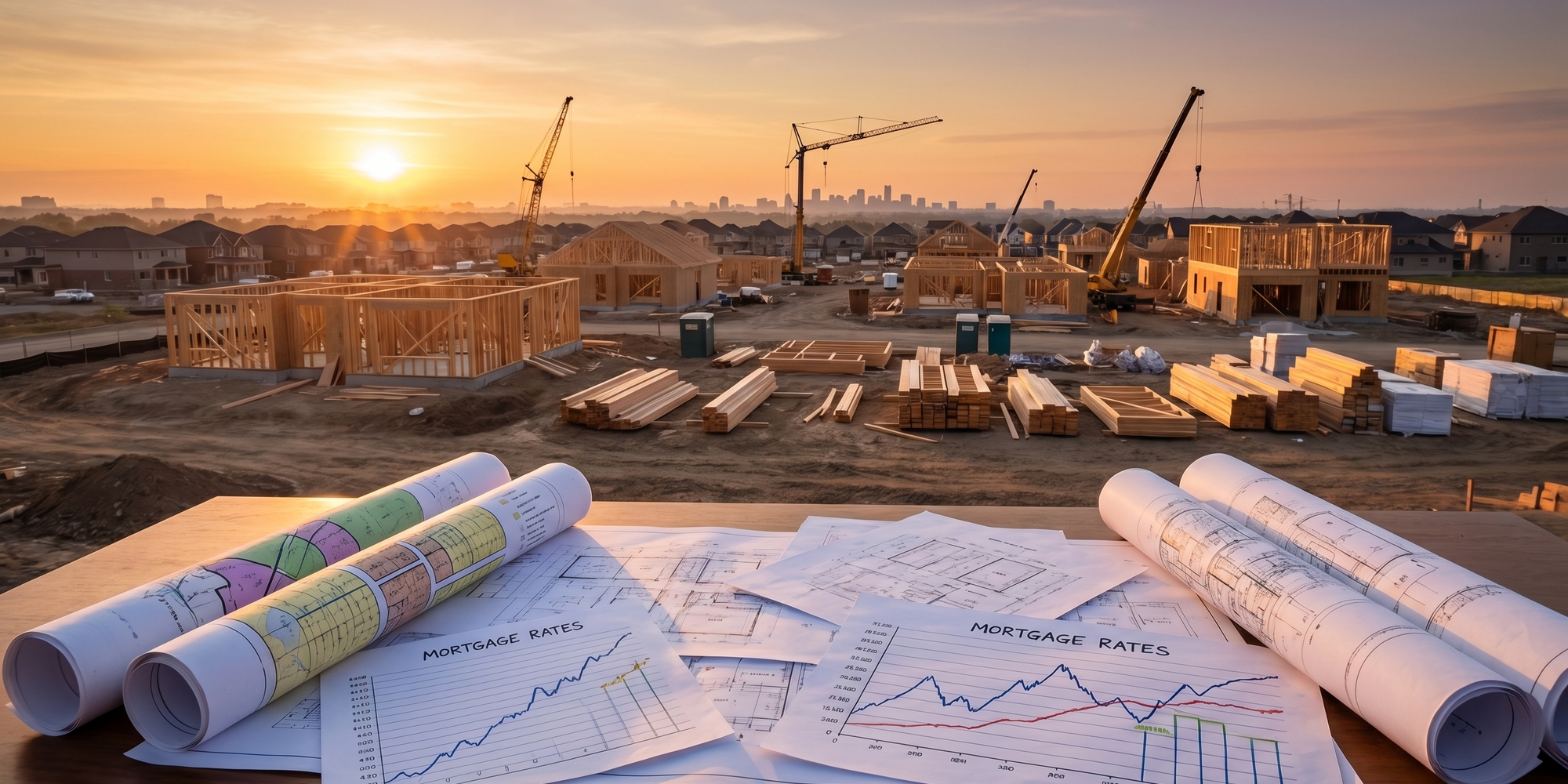
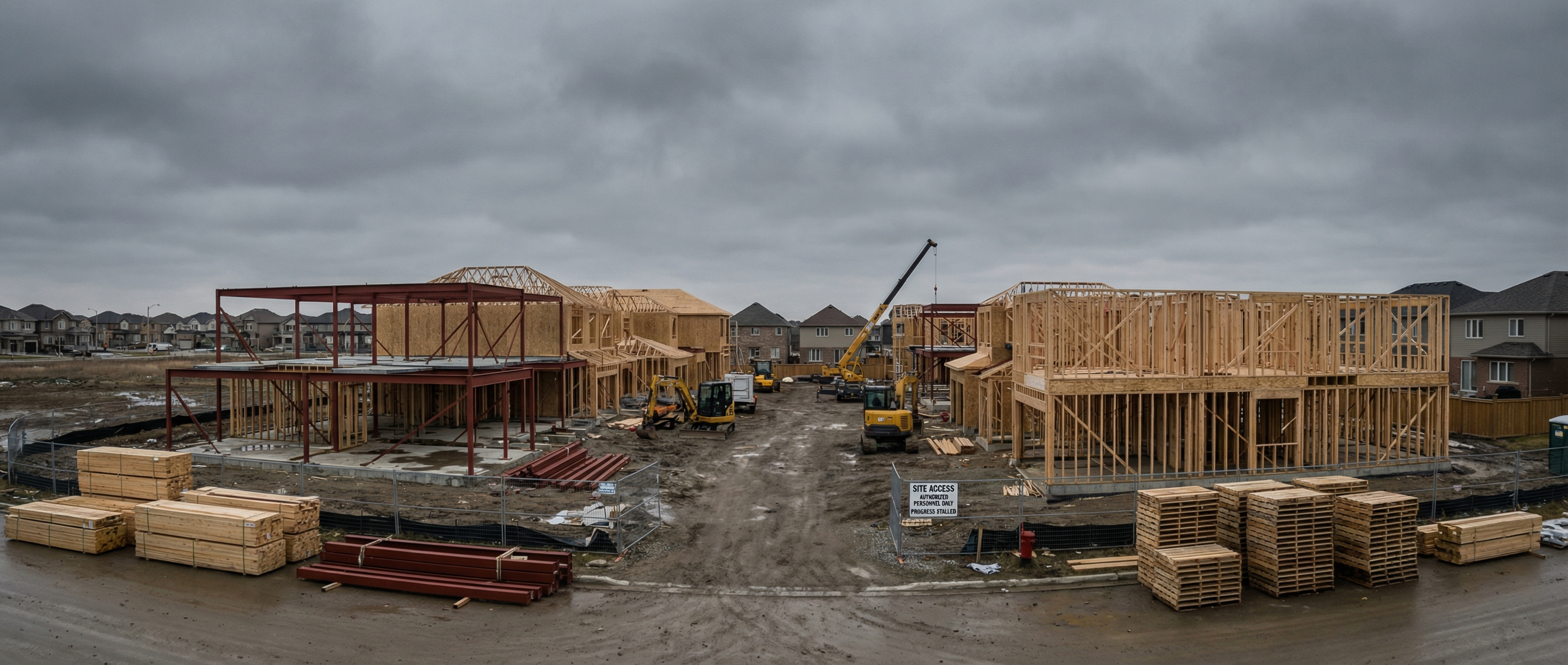
For residential construction, the transmission mechanism is direct. Homes are built from steel, aluminum, and lumber. Each percentage point of tariff protection on those materials is a percentage point increase in the cost of the finished product. There is no exception, no workaround, and no insulation. The excise tax lands at the framing stage.
What the BLS Data Shows: A Structural Cost Escalation
The Bureau of Labor Statistics Producer Price Index for construction inputs tells the story in numbers. As of February 2026, construction input prices were up 3.4% year-over-year. That headline figure understates the tariff-specific impact because it blends across all input categories. The metals data is far more striking:
- Metal building components: +16.6% year-over-year
- Metal molding and trim: +61.7% year-over-year
- Metal windows and doors: +20.2% year-over-year
These are not supply chain disruptions or demand spikes. They are the predictable consequence of a 25% tariff on steel inputs. The domestic steel producers benefiting from those tariffs have raised prices to just below the tariff-inclusive import price — a rational response, but one that passes the cost directly to builders.
The lumber picture is structurally different but equally damaging. Canada supplies approximately 80% of U.S. softwood lumber imports. Canadian softwood now faces a combined antidumping, countervailing, and Section 232 duty of approximately 45%. The result: U.S. softwood lumber imports in 2025 totaled an estimated 12.7 billion board feet — the lowest annual import level since 2014. American sawmills, insulated from Canadian competition, have not increased output to compensate. They have maintained elevated prices against reduced competition. The family building the home pays the spread.
Based on NAHB construction cost survey data and materials intensity analysis, the tariff-driven additions to construction costs range from approximately $7,000 to $13,000 per median new home from metals alone, with additional impact from lumber tariffs. These costs are not absorbed by builders. They are passed to buyers. The builder who absorbs them simply builds fewer homes.
60 Percent of Builders Report Direct Tariff Cost Increases
NAHB's own survey data, cited in connection with the bipartisan Housing Tariff Exclusion Act introduced by Senators Rosen and Coons in February 2026, found that roughly 60% of builders have already seen cost increases directly attributable to tariffs. The legislation would create an automatic exemption process for building materials — a recognition by Congress that the tariff regime is functionally incompatible with housing affordability goals.
NAHB Chairman Bill Owens stated directly: "This bill is an important step forward to create more certainty for American businesses and to address the nation's housing affordability challenges." The legislative recognition is notable because it comes from the industry, not from critics. Builders are not ideologically opposed to tariffs as a general matter. They are reporting a factual constraint: the cost of materials has risen to a level that makes projects economically marginal.
The Housing Market Index — NAHB's monthly confidence reading — has been below 50 for 23 consecutive months as of March 2026, sitting at 38. A reading below 50 signals that more builders view conditions as poor than favorable. In March, 37% of builders cut prices (average 6%) and 64% offered incentives. Builders are cutting prices in a market where input costs are rising. That is a mathematically unsustainable posture. The outcome is fewer projects greenlit, not a long-run equilibrium. Supply destruction is quiet, incremental, and invisible — exactly what Thomas Sowell would describe as the unseen cost.
The Massachusetts Case Study: Where the Numbers Become People
National aggregates obscure the human dimension of supply destruction. Massachusetts provides a specific, verifiable illustration. Governor Maura Healey signed a $5.1 billion housing bond bill in 2024 with a stated target of 222,000 new homes by 2035. One year into implementation, permits issued in 2025 totaled approximately 12,000 — a pace that would yield roughly 108,000 units by the target year, less than half the goal.
Nonprofit builders in Massachusetts are reporting a specific cost problem: Canadian lumber, which has historically supplied Northeast construction projects, now arrives with a 45% tariff premium. The alternative — shipping from Pacific Northwest domestic mills — adds substantial freight cost on top of already elevated prices. The construction economics of the affordable units the bond program is meant to produce have deteriorated in direct proportion to the tariff burden. The state has appropriated the money. The units will not get built on schedule. The policy costs are real; the homes they preclude are invisible.
Rider Levett Bucknall's Q4 2025 construction cost report for the Eastern U.S. found that Boston construction costs rose more than 4% from the end of 2024 to 2025, with metal-intensive components driving the largest share of the increase. This is not an outlier. It is a region-wide reflection of national tariff policy applied to local construction economics.
The Regressive Structure: Who Actually Pays
The burden distribution of construction tariffs is doubly regressive. First, they raise the cost of the good — a new home — and housing costs as a share of income fall most heavily on lower-income households. Second, they reduce the supply of entry-level housing, which is the segment most sensitive to construction cost floors and most critical to housing access for first-time buyers.
The NAHB/Wells Fargo Cost of Housing Index for Q4 2025 found that a family earning the national median income of $104,200 needed 34% of its income to cover the mortgage payment on a median-priced new home. A family earning half the median income — $52,100 per year — would need 67% of its income for the same payment. The tariff-induced cost increase of $7,000 to $13,000 per home translates directly into a qualification barrier: at a 6.5% mortgage rate, a $10,000 increase in home price raises the required qualifying income by approximately $2,500 per year.
The Yale Budget Lab estimated that Liberation Day tariffs represented a peak household income loss of $2,400 — and that this burden fell regressively, hitting lower-income households harder as a percentage of their consumption. In 2025, the Tax Foundation calculated an average household tax burden of approximately $1,000 from tariffs, with an additional $600 estimated for 2026.
Milton Friedman's framework for evaluating excise taxes applies with precision here: a tax on a consumption good that constitutes a larger share of lower-income budgets is regressive by definition. A tariff on construction materials is an excise tax on shelter. It extracts resources from the poorest consumers and redirects them to the most politically organized domestic producers. The steel mill and the sawmill lobby effectively; the renter who will never qualify for a mortgage because the cost floor rose does not.
Did Liberation Day Deliver on Its Promises?
The Tax Foundation's retrospective assessment of Liberation Day's one-year record is systematic and worth engaging directly. On manufacturing employment: manufacturing shed approximately 89,000 jobs between April 2025 and February 2026, per Bureau of Labor Statistics data. ISM Manufacturing contracted for nine consecutive months following the Liberation Day announcement. Construction employment in manufacturing fell. The sector that was supposed to be "reborn" contracted.
On revenue: customs duties raised an estimated $264 billion in 2025 — the highest effective tariff rate since 1947 on a percentage-of-imports basis. This is a real number. But the promised debt paydown did not materialize. Federal debt continued to rise. And the revenue came at the cost of offsetting reductions in income and payroll tax bases as economic activity contracted.
On prices: tariffs contributed an estimated 0.8 percentage points to CPI inflation during 2025. Manufacturing output fell 3.2%. The promised investment surge did not materialize in the data. For housing specifically, the tariff regime generated real government revenue — and it extracted that revenue directly from the residential construction sector, reducing supply at the margin and raising the cost floor for every American family trying to buy a new home.
The Free-Market Prescription: Zero Tariffs on Construction Inputs
The bipartisan Housing Tariff Exclusion Act represents a pragmatic recognition that building materials should be carved out of the tariff regime. It is better than nothing. But the comprehensive free-market case goes further: tariffs on construction inputs should be zero.
Every imported construction material — lumber from Canada, steel from Mexico, drywall, windows, hardware from any willing global supplier — represents a reduction in the cost floor facing homebuilders. Every percentage point of tariff protection on those materials is a percentage point increase in the cost of shelter for the American buyer. The domestic sawmill and steel industry's protected margins should not come at the cost of 100 million renters' and would-be homeowners' housing affordability.
Friedrich Hayek's argument about price signals is directly applicable. The housing market is communicating clearly: there is a shortfall of approximately 1.2 million units, according to NAHB estimates. The appropriate response is a construction surge. The government has made each unit of that surge more expensive to execute by taxing the inputs. The supply response that the market demands is suppressed by the cost structure that policy has created.
Sowell's concentrated benefits/diffuse costs framework describes the political economy with precision. Domestic steel producers and sawmills are geographically concentrated, politically organized, and capable of sustained lobbying. The families who will rent for an extra three years because the new subdivision that would have been built was not — because the pro forma didn't pencil at post-tariff lumber prices — are diffuse, unorganized, and unaware of the specific policy that delayed their homeownership. The political economy favors the protection. The economics do not.
One Year On: The Arithmetic of Policy
The anniversary of Liberation Day is an appropriate moment for a clear-eyed accounting. On housing, the promises have not been kept, and free-market theory explains exactly why they could not have been. When you tax construction materials, you get less construction. When you reduce construction, you reduce supply. When you reduce supply against persistent demand, you get higher prices. The family who couldn't qualify was not failed by the market — they were failed by the policy.
A 1.2 million unit housing shortfall is not solved by making each unit more expensive to build. The solution is not more targeted exemptions, more exclusion processes, or more legislative carve-outs — though each of those would be an improvement. The solution is the recognition that trade barriers on construction materials are, in effect, tariffs on shelter. Twelve months of data confirm what economic theory has always predicted. The question now is whether the policy responds to the evidence.