The Tariff Tax on New Homes: How Import Duties Are Pricing Out American Buyers
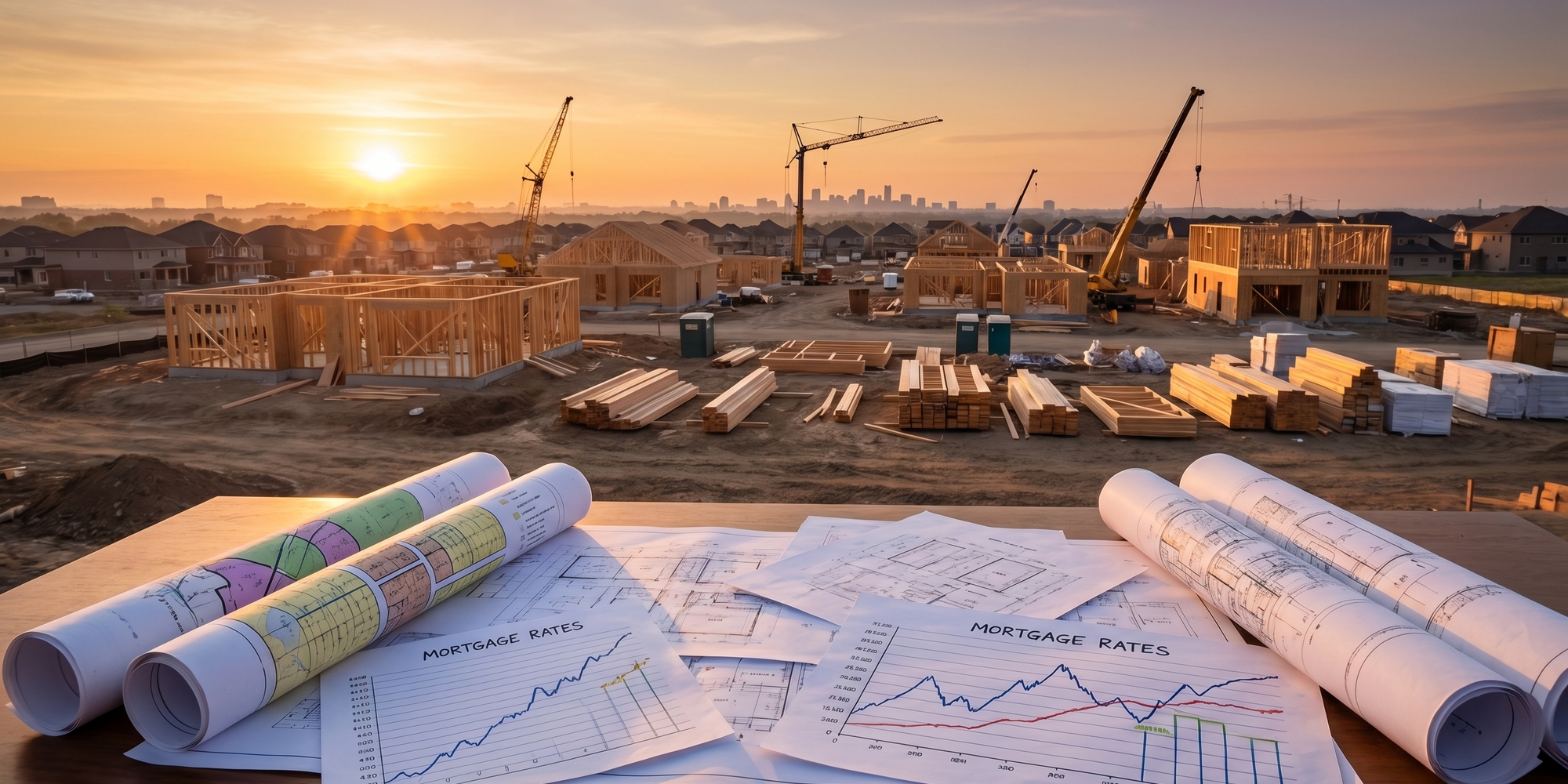
Builder confidence fell to 38 in March 2026 — the twelfth consecutive month below the 50-point threshold. Thirty-seven percent of builders are cutting list prices. Sixty-four percent are offering sales incentives. The market is not failing on its own. It is being failed by policy.
· 8 min read · By Affordable Housing Initiative
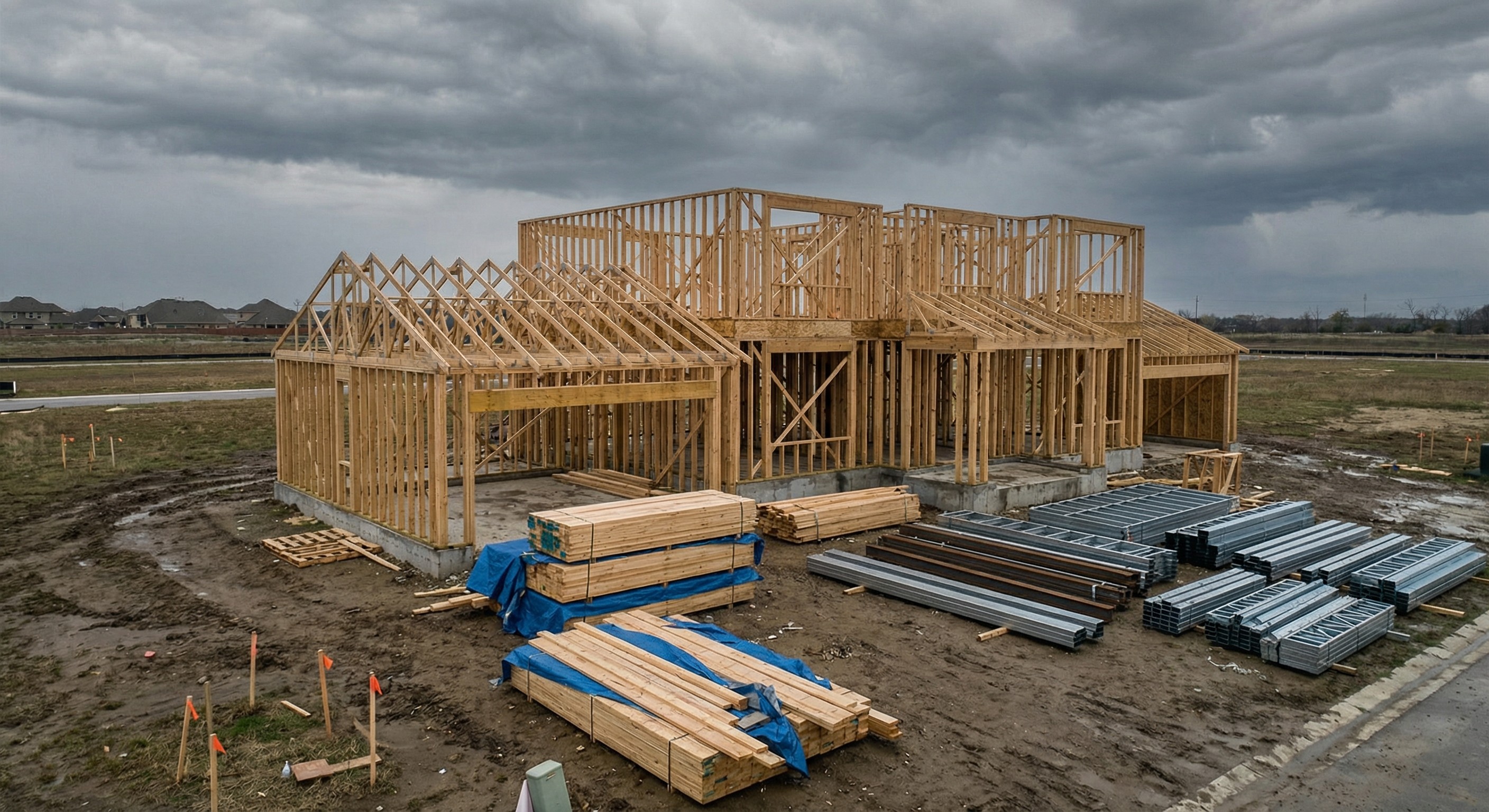
The NAHB/Wells Fargo Housing Market Index for March 2026 registered 38 — below the 50-point threshold that separates optimism from pessimism, and the twelfth consecutive month in which the majority of American homebuilders have viewed market conditions as poor. Buyer traffic, a leading indicator of near-term demand, came in at 25. That is not a soft market. That is a market in which buyers are visibly absent from model homes and sales offices across the country.
The instinctive diagnosis is "high mortgage rates." That is partly correct. But it is incomplete in a way that matters enormously for policy. High mortgage rates are partly a function of Federal Reserve policy, yes — but the floor price of new construction has been independently elevated by a separate set of government decisions: import tariffs on the materials American builders use to build American homes. Understanding the distinction matters because the remedies are different. One requires monetary policy restraint. The other requires trade policy restraint. Both are within the power of government to correct. Neither correction is politically easy. Both are economically necessary.
What Materials Actually Cost in 2026
Materials account for roughly 49 percent of the final sales price of a new single-family home, according to NAHB cost-of-construction research. That share makes the production price of dimensional lumber, steel studs, aluminum framing, copper pipe, and imported finished goods — not the cost of land, labor, or financing — the largest single input category in American homebuilding.
The February 2026 Producer Price Index, published by the Bureau of Labor Statistics, shows the scale of the problem. Final demand goods prices rose 1.1 percent in a single month — the largest monthly advance in that category since August 2023. Year-over-year, final demand goods are up 3.4 percent. The subindex for final demand less foods, energy, and trade services — which strips out the most volatile components and reflects the structural, embedded cost environment — rose 3.5 percent year-over-year, marking ten consecutive months of advance. Construction materials are woven throughout these numbers. They do not appear as a line item, but their influence is visible in the trajectory: persistent, not transitory, and accelerating.
The specific tariff regime driving these costs is layered. Canadian softwood lumber — the dimensional lumber used in nearly every American wood-frame home — now carries a combined duty rate of approximately 45 percent after antidumping, countervailing duty, and Section 232 assessments. Steel and aluminum, subject to Section 232 tariffs since 2018 and extended or expanded since, flow into steel studs, reinforcing bar, HVAC components, and fasteners. A broad range of manufactured building products imported from China — electrical fixtures, plumbing components, tile, flooring — carry tariff rates ranging from 7.5 percent to 145 percent under various Section 301 actions. These are not emergency measures. They are the permanent cost floor of American residential construction in 2026.
The Pass-Through Mechanism: Who Actually Pays
The political framing of tariffs presents them as a cost imposed on foreign exporters. The economic reality is precisely the reverse for intermediate goods — the inputs to production. Decades of empirical research on tariff incidence consistently find that tariffs on intermediate goods are borne predominantly by domestic buyers of the final product, not by the foreign producer.
The mechanism is straightforward. A Canadian lumber mill does not absorb a 45 percent duty imposed at the U.S. border — it prices in U.S. dollars for the U.S. market, and American builders pay the duty at the point of import. The builder then faces a choice that is not really a choice: absorb the cost at the expense of margin, or pass it through to the buyer in the form of a higher list price. In a healthy market — one in which buyer traffic is strong and demand exceeds supply — builders would pass the cost through. In the March 2026 market, where buyer traffic is at 25 and 37 percent of builders have already cut prices an average of 6 percent, the answer is both: margins are being compressed and prices are still too high for marginal buyers to qualify.
NAHB has published research estimating that every $1,000 increase in the median new home price prices approximately 150,000 potential buyers out of the market nationally. The arithmetic of tariff pass-through, applied to a home with $150,000 in materials content at a 45 percent average duty rate on Canadian lumber and a 25 percent rate on steel, produces an embedded tariff cost well into five figures. The buyers who disappear at that margin are not wealthy. They are the first-time buyers, the dual-income households at 100–120 percent of area median income, the people for whom a new entry-level home represented the last affordable rung on the homeownership ladder.
The Mortgage Rate Amplifier
The tariff cost does not arrive in isolation. It arrives embedded in a home price that must then be financed at elevated interest rates. The Federal Reserve's H.15 Selected Interest Rates release of March 24, 2026 shows the 10-year Treasury constant maturity at 4.34 percent. The 30-year Treasury is at 4.91 percent. Conventional 30-year mortgage rates typically price at a spread of 2.5 to 3.0 percentage points above the 10-year Treasury — placing the effective mortgage rate for most buyers in the 6.75 to 7.25 percent range.
At 6.75 percent, every $10,000 added to a home's purchase price increases the monthly payment by approximately $65 and the 30-year cost by roughly $23,000 in interest. A tariff-induced materials premium of $15,000 to $20,000 — a conservative estimate given current duty structures — translates to $100 to $130 per month in additional mortgage burden for a buyer who is already stretching to qualify. For a household at the margin of qualification, that difference is not cosmetic. It is disqualifying.
Friedrich Hayek and the Price Signal the Market Is Sending
Friedrich Hayek's central insight about price signals applies directly to what the March 2026 Housing Market Index is telling us. In a functioning market, prices encode information about costs, preferences, and scarcity. When government distorts input prices upward — through tariffs, regulatory mandates, or any other mechanism — the price signal to the market is: produce less of this. Builders respond to that signal not with ideological resistance, but with rational business decisions. They start fewer homes. They defer projects that no longer pencil. They walk away from land they would otherwise develop.
The HMI's buyer traffic subindex at 25 is the downstream expression of this signal. When input costs push list prices beyond what buyers can finance, buyers stop appearing. When buyers stop appearing, builders stop building. The result is a housing shortage that is not a market failure — it is a policy outcome wearing a market failure's clothes.
Milton Friedman's analysis of tariffs in Free to Choose is instructive here: every tariff is, in the final analysis, a tax on domestic consumers, dressed in the language of protection for domestic producers. In housing, there is no meaningful domestic substitute for Canadian dimensional lumber — the U.S. does not produce sufficient softwood timber to replace Canadian imports at scale, certainly not on the timeline that matters for housing affordability. The tariff does not create American lumber jobs sufficient to offset the damage to American homebuyers. It raises costs, suppresses construction, and concentrates the pain on the households least able to absorb it.
The Shelter CPI Connection
The feedback loop between construction cost suppression and shelter inflation is visible in the headline price data. The February 2026 Consumer Price Index, published by the Bureau of Labor Statistics, shows shelter costs rising 3.0 percent year-over-year and contributing more than any other category to the monthly CPI increase. Shelter is rising at 3.0 percent because housing supply is structurally insufficient — and tariffs on construction inputs are one of the forces holding that supply down.
The policy incoherence here deserves explicit attention. Policymakers at the federal level simultaneously express concern about housing unaffordability and maintain tariff regimes that systematically inflate the cost of building new homes. These positions are not in tension. They are directly contradictory. You cannot impose a 45 percent duty on the lumber that frames American homes and simultaneously claim to be working to make housing more affordable. The math does not permit both to be true.
What Builder Behavior Is Actually Telling Us
The March 2026 HMI data from the National Association of Home Builders is more than a sentiment gauge. It is a real-time inventory of builder responses to the current cost environment:
Sixty-four percent of builders are using sales incentives — mortgage rate buydowns, closing cost assistance, appliance packages, design upgrades — to move inventory. This is the twelfth consecutive month in which that figure has exceeded 60 percent. Builders are not incenting buyers out of generosity; they are incenting because the base price, at current materials costs, is above where buyers can qualify without structural assistance.
Thirty-seven percent are cutting list prices, with an average cut of 6 percent. A 6 percent price cut on a $400,000 home is $24,000 in absorbed margin. That $24,000 is not a builder gift to buyers — it represents the compression of margins that would otherwise fund the next project. When margin compression is deep enough and prolonged enough, new project approvals decline. The Census Bureau's new residential construction data reflects this dynamic over time. Fewer starts today means fewer homes available to buyers in 18 to 24 months — perpetuating the cycle of undersupply that tariff-inflated input costs helped create.
The Free-Market Case for Trade Reform in Housing
The policy argument here does not require any sympathy for foreign producers or any indifference to domestic industry. It requires only a clear-eyed reading of the data. The United States cannot build its way out of its housing shortage while simultaneously taxing the inputs required to build. Eliminating or substantially reducing tariffs on imported building materials is, structurally, a pro-housing-affordability policy — as direct in its effect as eliminating an impact fee or a zoning restriction.
The regulatory cost of housing in America is a layered problem. Zoning restrictions limit where homes can be built. Permitting delays add months to project timelines. Davis-Bacon wage mandates inflate labor costs on federally subsidized projects. Energy codes add thousands in upfront costs. Impact fees are levied before the first foundation is poured. Tariffs on building materials add yet another layer — collected not by a local planning department but at the border, embedded invisibly in every invoice from every lumber yard and steel service center in the country.
Thomas Sowell's observation about the housing market applies precisely: the question is never whether a policy has good intentions, but whether it produces good outcomes. Tariffs on building materials have produced a measurable, documented, statistically significant increase in the cost of American homebuilding. The March 2026 HMI at 38, with buyer traffic at 25 and 64 percent of builders resorting to incentives, is the market's accounting of that outcome. The shelter CPI at 3.0 percent year-over-year is the consumer's bill.
A government that taxes the production of housing while lamenting the cost of housing is not working at cross-purposes by accident. It is working at cross-purposes by policy choice. The correction is available. It requires only the political will to acknowledge what the data has already made plain.