Construction Under Tariff: How Import Duties on Building Materials Are Pricing Buyers Out of New Homes
Metal molding prices up 61.7% year-over-year. Canadian lumber carrying a 45% combined duty rate. Building material inputs up 3.4%. The arithmetic of political economy is cruel, and first-time buyers are doing the math at closing.
· 5 min read · By Affordable Housing Initiative
Milton Friedman famously observed that there is no such thing as a free lunch. Tariffs, he would add, are perhaps the least-free lunch in all of economic policy. They impose their costs invisibly — passed through supply chains, embedded in material prices, and ultimately extracted from the buyer at the closing table. In 2026, with housing affordability already at generational lows, the tariff burden on construction materials has become one of the most consequential — and least-debated — drivers of new home costs.
The latest data from the Bureau of Labor Statistics, analyzed by the National Association of Home Builders' Eye on Housing research blog, make the magnitude of the problem clear. The price index for inputs to new residential construction rose 3.4% year-over-year as of February 2026, with goods inputs — the materials that actually go into a house — up 3.0% from a year ago and services inputs up 4.2%. These are not transitory fluctuations; they represent a structural elevation in the cost of building.
The Price Signal the Market Cannot Ignore
Within the broad materials index, the damage from tariffs on metal products is stark. Across all metals and metal products used in residential construction, prices are up 16.6% year-over-year. The specific line items are more alarming. Metal molding and trim — the connective tissue of modern framing — saw prices rise 61.7% compared to one year ago. Metal windows, increasingly standard in new construction, are up 20.2% year-over-year, according to the NAHB Eye on Housing analysis of BLS Producer Price Index data.
These are not numbers that builders can absorb through efficiency gains or value engineering. When the raw material cost of a window frame rises by a fifth in a single year, that cost is passed forward — to the builder's margin, then to the contract price, and finally to the buyer's mortgage. Tariffs on building materials are not a tax on imports; they are a tax on new homes.
The Lumber Story: Duties, Disrupted Imports, and Sawmill Contraction
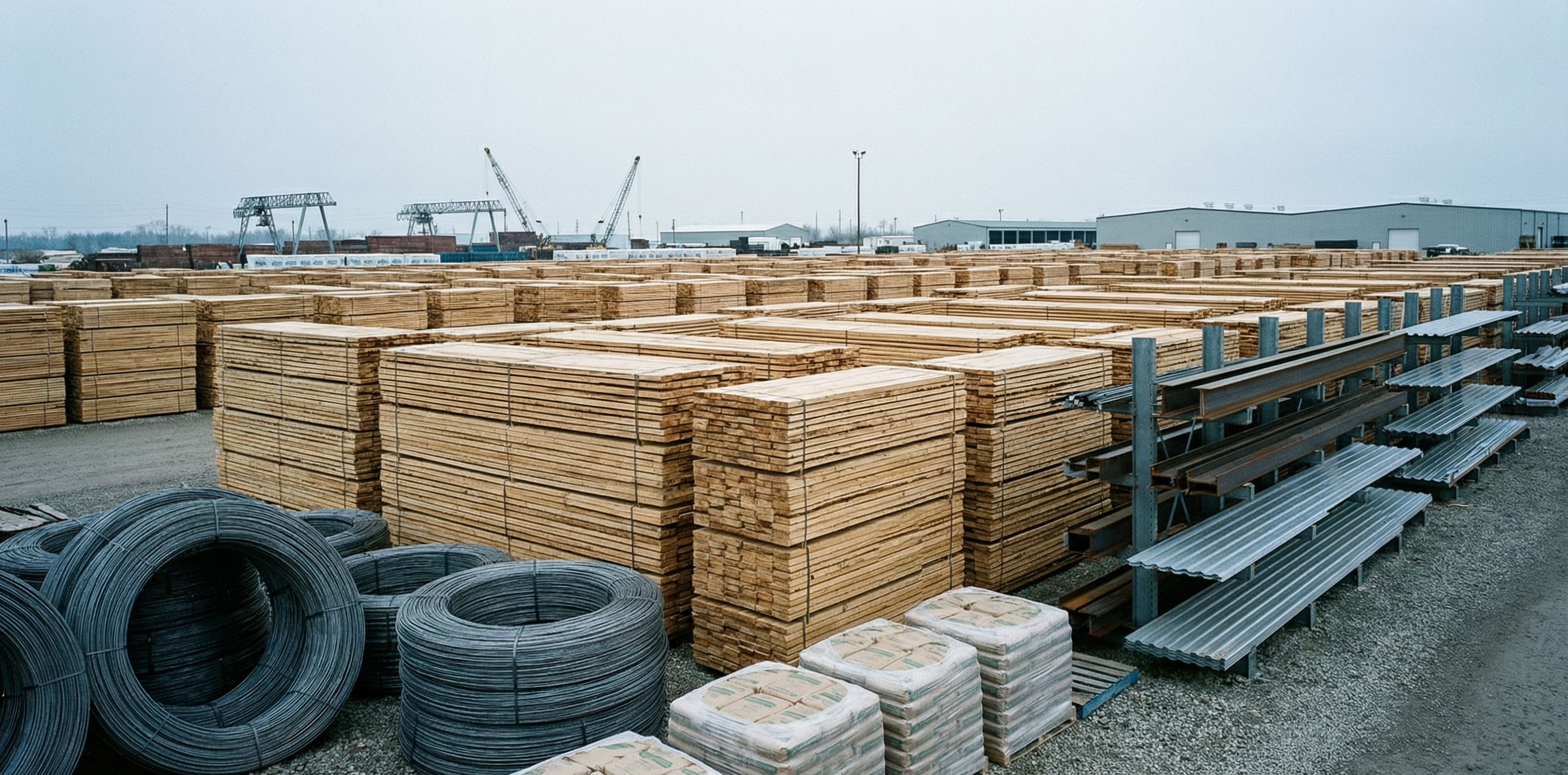
No building material illustrates the tariff problem more concretely than softwood lumber. Canada supplies roughly 80% of U.S. softwood lumber imports, and throughout 2025, the duty burden on those imports was systematically raised. NAHB data tracking lumber market conditions shows that combined antidumping and countervailing duties on Canadian lumber doubled to 35%, and all softwood lumber imports then became subject to a new 10% Section 232 national security tariff effective in October 2025. The result: Canadian softwood lumber — the single largest input to residential framing — now enters the United States facing a combined 45% duty rate.
The market responded exactly as economists would predict. U.S. imports of softwood lumber in 2025 totaled an estimated 12.7 billion board feet — the lowest annual import volume since 2014. Fourth-quarter import volumes were the lowest recorded since the first quarter of that same year. The supply contraction was not offset by domestic production; sawmill utilization rates remained near 70%, and sawmill employment fell to approximately 85,400 workers in Q3 2025, the lowest level since Q1 2013 — the tenth consecutive quarterly decline in an industry that is simultaneously being taxed on its primary foreign input and starved of residential construction demand to justify domestic expansion.
Hayek's insight about price signals is directly applicable here. In a free market, rising lumber prices would attract new investment in domestic sawmill capacity and incentivize suppliers to find alternative sources. But when high prices are the product of a government-imposed duty rather than a genuine scarcity signal, the market's self-correcting mechanism is confounded. Investment signals are distorted, domestic capacity does not scale to meet the implied demand, and the buyer is left paying a premium with no increase in supply to show for it.
The New Home Price Paradox
The cost pressure from materials is visible in a striking price inversion in the new home market. Historically, new homes commanded a substantial premium over existing homes — from 2010 to 2019, that average premium was approximately $66,000 — reflecting the value of fresh construction, modern systems, and builder warranty. That relationship has been collapsing.
According to Census Bureau and National Association of Realtors data compiled by NAHB, the median price for a new single-family home in the fourth quarter of 2025 was $405,300 — while the median price for an existing home was $414,900. This marks the third consecutive quarter in which existing home prices have exceeded new home prices, an anomaly that has appeared in five of the past seven quarters.
The explanation is straightforward: builders are absorbing cost pressure and cutting margins to move product, because the alternative is sitting on unsold inventory while mortgage rates remain elevated. New home median prices fell 3.34% year-over-year in Q4 2025. But this price moderation is not a sign of a healthy market finding equilibrium — it is a sign of builders being caught between artificially inflated material costs on one side and an affordability-constrained buyer pool on the other. The squeeze reduces the volume of homes that can be profitably built, which worsens supply, which ultimately pushes all prices higher.
Builder Confidence and the Investment Signal
The forward-looking measure for residential construction, the NAHB/Wells Fargo Housing Market Index, has reflected this cost-side pressure all year. Builder confidence ticked upward in March 2026 but remains well below the 50-point threshold that separates expansion from contraction. An index reading below 50 means that more builders view current conditions as poor than good — and the most frequently cited reasons are construction costs, regulatory burden, and affordability constraints on buyers.
When the investment climate for builders is consistently pessimistic, the downstream effect is predictable: fewer housing starts, reduced pipeline, and sustained upward pressure on prices. A tariff policy that artificially raises input costs is, by direct mechanism, a housing-supply suppression policy. It is as if the government imposed zoning restrictions not in local ordinances but in the trade ledger.
The Friedman Framework: What Tariffs Actually Do
Friedman's argument against protectionism was never abstract. He asked a simple question: who benefits, and who pays? The answer for building material tariffs is the same as for any tariff. A small number of domestic producers — steel mills, domestic lumber operations, metal component manufacturers — receive protection from foreign competition. The cost of that protection is spread across millions of housing transactions, home buyers, renters, and construction workers whose employment prospects are reduced when building activity slows.
Thomas Sowell's observation that "there are no solutions, only trade-offs" applies with particular force here. Tariffs do not eliminate the need for lumber or steel; they raise the price of obtaining it. The trade-off is between the concentrated benefit to protected industries and the diffuse, invisible cost borne by every American who wants to buy or rent a home. That the cost is diffuse and invisible is precisely why it is politically sustainable — even as it compounds the affordability crisis year by year.
The Only Durable Solution Is Supply
The path toward genuine affordability runs through supply, not protection. Reducing or eliminating tariffs on building materials would lower the cost of new construction without requiring a dollar of public spending or a new regulatory apparatus. The data on softwood lumber imports make the counterfactual clear: before duty escalation, import volumes supported significantly higher levels of residential construction activity. Those units were not built — and the households who would have occupied them are still searching for housing in an undersupplied market.
The cost of building a home in America in 2026 is, in meaningful part, a policy choice. Metal molding prices have nearly doubled in a year. Lumber duties have layered 45% on top of the base price of the country's primary framing material. These are not market outcomes; they are legislative and regulatory outcomes that markets are being forced to absorb. And the absorbers — the end-points where these costs ultimately settle — are buyers who cannot afford the result.