The Tariff Surcharge Nobody Talks About: How Metal Price Inflation Is Adding Thousands to Every New Home
BLS data for February 2026 shows metal molding and trim up 61.7% year-over-year, metal windows up 20.2%, and all residential-use metals up 16.6%. Imported materials are getting cheaper — tariffs are protecting domestic prices above them. In the post-SCOTUS tariff era, this cost is embedded in every new home built in America.
· 8 min read · By Affordable Housing Initiative
The price of a new home has never been only about mortgage rates. But as the spring market opens in 2026, it is worth examining what is actually embedded in that sticker price before a single brick is laid or a loan is approved.
According to the Bureau of Labor Statistics' Producer Price Index for February 2026, analyzed by NAHB Eye on Housing, metal molding and trim prices are up 61.7% year-over-year. Metal windows are up 20.2%. Across all metals and metal products used in residential construction, prices are up 16.6% year-over-year. These are not rounding errors — they are among the largest sustained input cost increases recorded for any construction material category in a generation.
The source of this increase is not a natural scarcity of steel or aluminum. It is not driven by the kind of supply chain disruptions that characterized 2020–2021. It is driven by trade policy — specifically, the layered tariff architecture that survived the Supreme Court's February 2026 ruling on IEEPA authority, and which continues to function as an excise tax on the inputs required to build American homes.
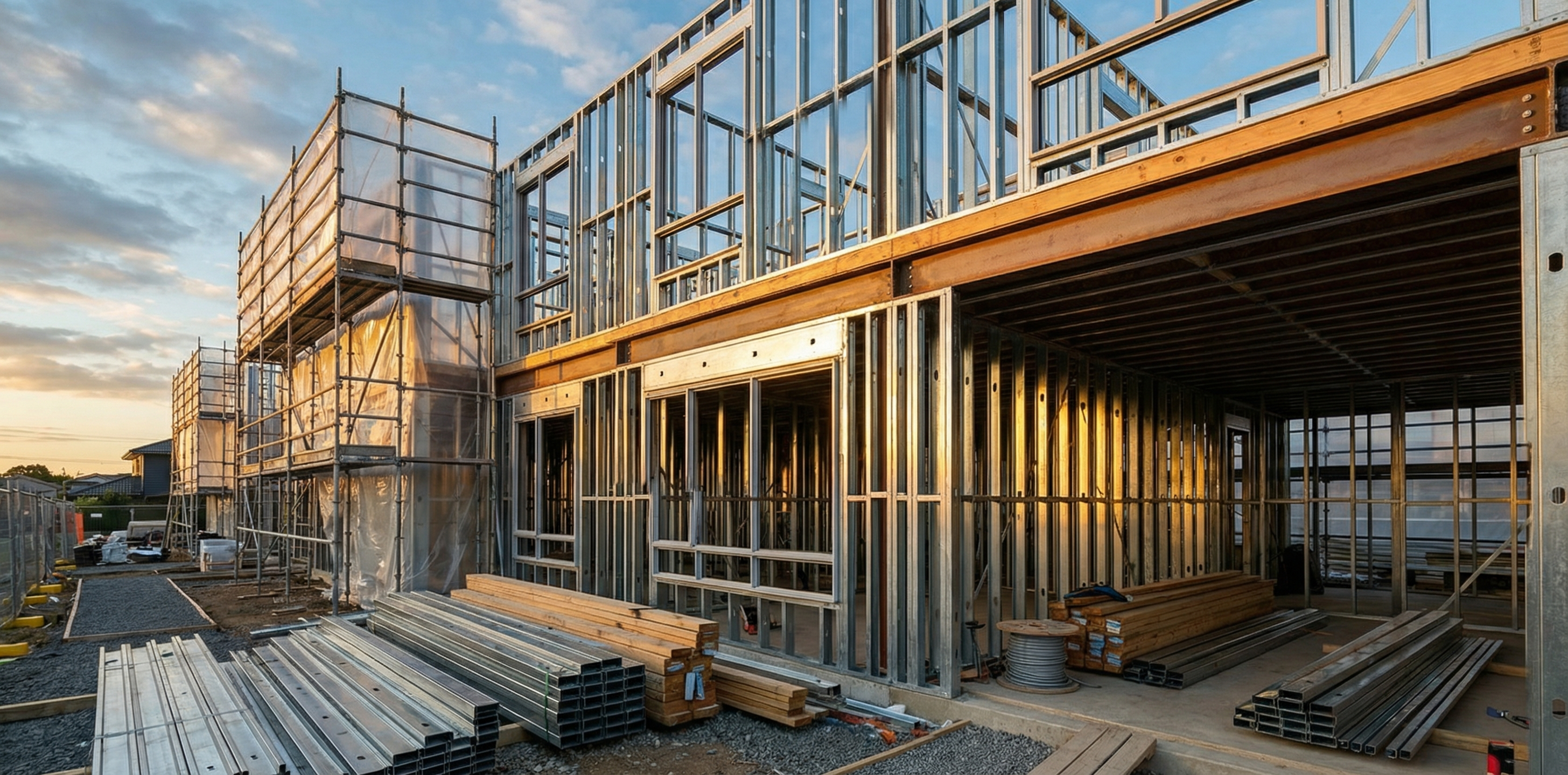
This is the tariff surcharge nobody talks about. Policy conversations about housing affordability focus on mortgage rates, zoning laws, and land prices. But metal molding and trim — the structural framing, window casings, and ductwork of a modern home — is 61.7% more expensive than it was a year ago. That cost doesn't appear as a line item on a housing policy white paper. It appears as a higher number on a builder's materials invoice, which becomes a higher price tag on every new unit sold.
What the BLS PPI Is Telling Us
The NAHB analysis of BLS Producer Price Index data for February 2026 gives a systematic view of where construction cost pressure is concentrated. The overall price index for inputs to new residential construction rose 3.4% year-over-year and 0.7% in February alone — persistence that rules out a transient one-time shock. Building materials specifically: +3.5% year-over-year, +0.6% in February.
But the headline figure undersells the story. Within that overall increase, the distribution is sharply skewed toward metals:
- Metal molding and trim: +61.7% year-over-year — the single largest annual increase in any building material category BLS tracks
- Metal windows: +20.2% year-over-year — accelerating throughout 2025–2026
- All metals and metal products in residential construction: +16.6% year-over-year
BLS notes that this data was collected during the week of February 13 — before the additional Section 301 trade investigations announced in March 2026 targeting approximately 80 trading partners. Current figures likely understate the trajectory.
But the most analytically significant piece of the data is not the headline increase. It is what BLS experimental data on import vs. domestic construction inputs reveals about the mechanism of those price increases. Domestic goods in new construction rose 3.0% year-over-year through December 2025. Imported goods in new construction fell 3.2% year-over-year. Imported materials are getting cheaper. Domestically produced materials are getting more expensive.
In the absence of tariffs, these price signals would converge through market competition — importers undercutting domestic prices, domestic producers responding by reducing margins or improving efficiency. Tariffs prevent that arbitrage. The Section 232 tariffs on steel (25%) and aluminum (10%) floor domestic metal prices above the level at which imported competition would otherwise price them. The tariff's primary visible effect is not to restrict imports — those are falling in price. It is to allow domestic producers to maintain elevated margins in a market where their foreign competition is actually cheaper.
Thomas Sowell called this the "third-party cost" structure: the benefits of the tariff are visible, concentrated, and politically legible (domestic steel and aluminum producers in identifiable congressional districts). The costs are diffuse, invisible, and spread across millions of housing consumers who have no seat at the trade policy table.
The Tariff Architecture After the Supreme Court
On February 20, 2026, the Supreme Court ruled 6-3 in Learning Resources Inc. v. Trump that the International Emergency Economic Powers Act does not authorize the president to impose tariffs unilaterally. Chief Justice Roberts, writing for the majority, held that Congress's delegation in IEEPA did not encompass broad tariff authority, and that the major questions doctrine required clearer statutory authorization. The full opinion is available from the Supreme Court.
The administration responded within hours. President Trump invoked Section 122 of the Trade Act of 1974, imposing a new 10% global import surcharge through a separate legal mechanism. Section 122 carries a 150-day statutory clock that expires approximately in July 2026, creating a defined but unresolved sunset. In March 2026, the U.S. Trade Representative additionally opened Section 301 investigations into approximately 80 trading partners for alleged unfair labor and trade practices — a process that could layer additional duties atop the existing structure.
For homebuilders, the most important element of the post-SCOTUS landscape is what the ruling did not change: Section 232 tariffs on steel (25%) and aluminum (10%) were not imposed under IEEPA authority. They rest on a separate statutory basis and were not affected by the ruling. The metals driving the sharpest residential construction cost increases — the 61.7% surge in metal molding and trim — are precisely the products most exposed to Section 232.
The combined effect is a layered tariff regime that is simultaneously legally uncertain and materially persistent. For builders trying to project material costs six months forward, this is Hayek's "impossibility of planning" problem in concrete form: the price of the steel studs in next quarter's homes is genuinely unknowable.
Friedman's Cost Floor: The Tariff as a Housing Tax
Milton Friedman's analysis of how government-imposed cost floors operate explains precisely why Section 232 tariffs function as an excise tax on residential construction rather than a protection for domestic industry.
When the government imposes a tariff on an input for which there are no ready substitutes, the tariff operates not as a competitive barrier but as a price floor. Structural metals in construction have no scalable substitutes at current price points. Wood framing cannot replace steel window systems; composite materials cannot replace metal molding and trim at anything approaching comparable cost. The builder does not have an exit option. The cost floor holds regardless of what happens to demand.
In this context, the Section 232 steel tariff functions exactly like an excise tax on new residential construction. The revenue from the tariff flows to the federal government. The above-market margin flows to domestic steel and aluminum producers. The cost is borne by the homebuyer — not because they are party to any of these transactions, but because the cost is embedded in the production function of every new unit built. A family paying $8,000–$10,000 more for a new home than they would in the absence of Section 232 tariffs — a reasonable estimate given the materials intensity of residential construction and the 16.6% metal cost increase — is not filing comments with the USTR. They are writing a check to a builder who has already absorbed the full cost before determining the listing price.
This is what Friedman identified throughout his career: costs that are diffuse and invisible to individual consumers aggregate into significant harm but generate no political response, while concentrated, visible benefits generate intense lobbying. The political economy of the tariff is perfectly designed to persist regardless of its effects on housing affordability.
Hayek's False Price Signal and the Builder Response
The Hayekian insight is both simpler and more damaging: tariffs do not merely redistribute costs — they distort the information system through which markets coordinate activity.
When metal prices rise 16.6% year-over-year due to government intervention, builders receive a price signal that says: build less, build smaller, cut quality, or don't build at all. And they are doing exactly that. NAHB reports that builders have been reducing specifications, moving to smaller footprints, and offering price concessions — rate buydowns, upgraded fixtures, closing cost contributions — to move inventory in a market where the cost structure doesn't support the prices buyers can pay.
The problem: this rational response is responding to a false signal. The price signal that elevated metal costs sends is not a signal of genuine scarcity. It is a signal manufactured by government intervention. The market is allocating resources in response to a policy distortion, not a real underlying condition. The homes getting smaller are not smaller because that's what the market efficiently produces — they're smaller because tariff-inflated input costs have priced out the square footage that buyers actually want.
The uncertainty dimension compounds this: because Section 122 expires in July, Section 301 outcomes are unpredictable, and congressional action on trade policy is unlikely before that deadline, builders cannot price their pipeline confidently. Uncertainty is itself a cost. A project that pencils out at current material prices may not pencil out at post-July prices if the tariff regime escalates. The rational response — which many builders are executing — is to delay ground-breaking on projects where material cost assumptions are too uncertain to underwrite. That delay becomes a supply reduction that persists for years.
The New Home Price Inversion: Third Quarter of Builder Stress
The aggregate consequence of rising input costs is visible in NAHB's analysis of Census Bureau and NAR data for Q4 2025. The median new single-family home price was $405,300 — a $9,600 discount to the existing home median of $414,900. This is the third consecutive quarter of this reversal.
The historical norm from 2010 to 2019 was a $66,000 new-home premium over existing homes. New homes carry modern specifications, energy efficiency, builder warranties, and no deferred maintenance — buyers paid for that freshness. The collapse of the premium, from $66,000 above to $9,600 below, tells you how much margin builders have surrendered trying to stay price-competitive in a market where input costs have surged.
New home prices fell 3.34% year-over-year in Q4 2025. Existing home prices rose 1.25% over the same period — their tenth consecutive quarter of increases. Builders are absorbing rising input costs through margin compression. Existing home sellers, who face no such input cost pressure, are not. The result: new homes are now cheaper than existing, but builders are building fewer of them. Housing starts were down 6.2% year-over-year in early 2026. Less new supply means continued pressure on existing home prices — which means sustained affordability deterioration for buyers in every market segment.
Household real estate wealth reflects this dynamic. Federal Reserve Z.1 data shows total household real estate market value declined to $47.9 trillion in Q4 2025 — down 0.7% from Q3, the second consecutive quarterly decline — while outstanding mortgage liabilities reached a record $13.8 trillion. Owners' equity remains at 71.3%, but the trend reversal is meaningful for buyers who purchased at peak prices.
The Fed Trap: Monetary Policy Can't Fix a Cost Floor
The Federal Reserve held the federal funds rate at 3.75% at its March 2026 FOMC meeting — the second consecutive pause. Chair Powell characterized the housing market as "weak" in the press conference. The Fed's Summary of Economic Projections revised core PCE inflation upward to 2.7% for 2026 (from December's 2.4% projection), with a return to the 2% target not projected until 2028. NAHB now expects just one rate cut in 2026, down from its prior forecast of two. The Federal Reserve H.15 release showed the 10-year Treasury at 4.42% and 30-year at 4.93% as of March 26, with 30-year mortgage rates hovering just above 6%.
The structural irony is precise: the Federal Reserve is holding rates elevated in part because of supply-side cost-push inflation — while that same elevated inflation is partially driven by tariff-imposed cost floors that monetary policy cannot address. The Fed cannot solve tariff-driven construction cost inflation by adjusting the federal funds rate. Lower rates would ease mortgage payments for buyers and reduce financing costs for builders — both real benefits at the margin. But they would not reduce the price of steel studs, metal window systems, or galvanized structural components. Section 232 operates independently of monetary conditions.
The correct framing — evident in any supply-side reading of the March FOMC data — is that when inflation is supply-side in origin, the appropriate response is supply-side in nature. Demand suppression through elevated rates cannot fix a cost floor imposed by trade policy. The free-market prescription is not complicated. Section 232 can be terminated by presidential proclamation. Section 122 carries its own July 2026 sunset. The mechanism exists. The political question is whether it will be deployed.
The 21st Century ROAD to Housing Act — which passed the Senate 89-10 and was signed in March 2026 — provides NEPA streamlining, zoning incentive grants, and manufactured housing deregulation. These are genuine supply-side gains. But a manufactured home whose chassis requires steel that is 16.6% more expensive than last year captures fewer of those gains than the legislation's architects intended. Zoning reform without construction cost reform delivers into a cost environment that partially negates it.
Conclusion: Remove the Cost Floor
The BLS data for February 2026 is not a political document. It is a measurement. Metal molding and trim is up 61.7% year-over-year. Metal windows are up 20.2%. The domestic vs. imported data inversion tells us these costs are not being driven by global supply conditions — they are being maintained by a government-imposed price floor that protects domestic metal producer margins above the level at which import competition would otherwise price them.
Section 122's 150-day clock creates a decision point around July 2026. Section 232 can be removed by presidential proclamation at any time. Section 301 investigations can be resolved through negotiated frameworks rather than additional duties.
The most direct near-term policy action available to reduce housing affordability's construction cost component is not a new program, subsidy, or legislative initiative. It is the removal of a tax on residential construction inputs — one that was partly imposed through a legal authority the Supreme Court has now determined does not exist — and that continues to embed thousands of dollars of artificial cost in every home built in America.
The market is trying to build. The data shows exactly what is stopping it.
Data sources: BLS Producer Price Index (February 2026) via NAHB Eye on Housing; BLS PPI Input Indexes (Experimental, December 2025) via BLS.gov; New vs. existing home prices Q4 2025 via NAHB Eye on Housing / Census Bureau; Federal Reserve Z.1 Financial Accounts via NAHB Eye on Housing / Federal Reserve; FOMC statement and SEP (March 2026) via Federal Reserve; H.15 interest rates via Federal Reserve; SCOTUS opinion, Learning Resources Inc. v. Trump, via supremecourt.gov.