The Market Solution They Won't Allow: How Regulations Suppress Manufactured Housing
· 5 min read · By Affordable Housing Initiative
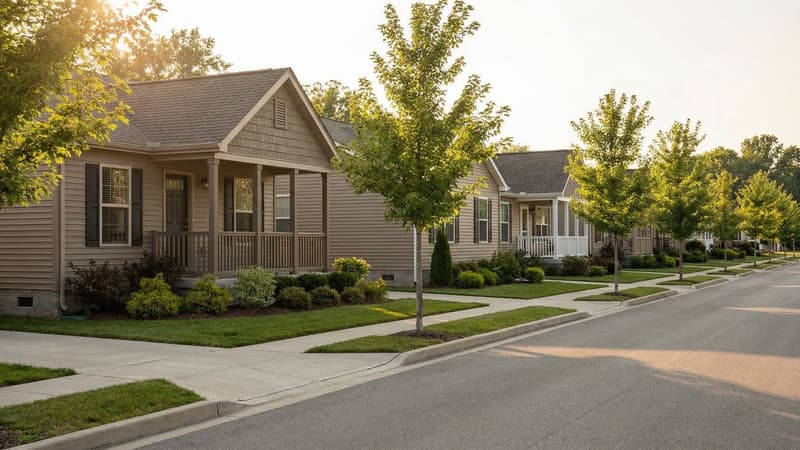
When a market produces a product at half the cost of its closest competitor — without sacrificing safety, durability, or livability — economists call that a solution. When governments systematically ban that product from most land, penalize its buyers with higher interest rates, and exclude it from mainstream mortgage financing, economists call that a policy failure. That is precisely the story of manufactured housing in America. According to the U.S. Census Bureau's Manufactured Housing Survey, new manufactured homes sold for an average of $123,300 in 2024, compared to a median single-family site-built home value of $367,282. The market has engineered a $244,000 price gap. Policy has spent decades trying to make it disappear.
Factory Efficiency, Government-Certified Quality
Manufactured housing is not the mobile home of decades past. Since Congress passed the National Manufactured Housing Construction and Safety Standards Act of 1976, every manufactured home has been built to a federal HUD Code — a uniform national standard covering structural integrity, fire safety, electrical systems, plumbing, and energy efficiency. These homes are built in climate-controlled factories, inspected at every stage of production, and shipped to site ready for installation. The factory process eliminates weather delays, reduces material waste, and enables industrial-scale efficiencies unavailable to stick-frame construction.
The result is measurable. The Manufactured Housing Institute reports that new manufactured homes cost approximately $87 per square foot, compared to $166 per square foot for site-built homes — less than half the cost. For a family earning the national median household income, this difference is not aesthetic; it is the difference between homeownership and permanent renting. Some 22 million Americans already live in manufactured homes, according to data cited in a December 2025 National Mortgage News report, representing approximately 5.4% of all occupied housing. That figure should be far larger — and would be, absent the regulatory apparatus designed to constrain it.
The Zoning Exclusion: Discrimination in Plain Sight
The primary constraint is zoning. Across most American municipalities, manufactured homes are either explicitly prohibited from single-family residential zones or subjected to aesthetic requirements so stringent — foundation mandates, roof pitch minimums, siding specifications — that placement becomes economically impractical. A 2024 Lincoln Institute of Land Policy working paper documents how zoning restrictions create "unequal treatment" for manufactured housing, effectively barring federally-certified homes from most of the residential land in the country.
This is not an accidental outcome. It is the predictable consequence of the same exclusionary logic that drives single-family zoning, minimum lot sizes, and height restrictions. Local governments use aesthetic and land-use regulations as instruments of economic separation — keeping lower-cost housing, and by extension lower-income households, out of established neighborhoods. Hayek's insight in The Constitution of Liberty applies directly: when government restricts competition among housing types, the politically organized preferences of existing property owners systematically override the economic needs of those seeking entry. Manufactured housing, the natural market response to affordability pressure, is not merely under-incentivized. It is affirmatively prohibited.
The Manufactured Housing Institute has documented a growing trend of municipalities attempting to use zoning and land-use regulations to restrict or eliminate manufactured housing entirely. The 1976 federal HUD Code was specifically designed to preempt local construction standards, but as the Federal Housing Finance Agency has noted, "local zoning restrictions" and "local land use laws may also inhibit the installation of new manufactured homes" — a gap the federal preemption statute has never been fully interpreted to close.
The Financing Penalty: A Market Distortion by Design
For buyers who do find zoning-compliant land, a second barrier materializes: financing. Most manufactured homes — particularly those placed in community parks, where residents own the home but not the land beneath it — are titled as personal property and financed through chattel loans rather than traditional mortgages. The interest rate differential is substantial. Federal Reserve Survey of Consumer Finances data indicates that chattel loans on manufactured homes carry average interest rates of 8.69%, compared to 6.81% for manufactured home mortgages — a nearly two-percentage-point penalty applied to the buyers least able to afford it.
Why do chattel rates run higher? Because Fannie Mae and Freddie Mac — the government-sponsored enterprises that guarantee the vast majority of U.S. home loans — do not purchase or guarantee chattel loans. As the Consumer Financial Protection Bureau's analysis of Home Mortgage Disclosure Act data makes clear, manufactured housing buyers relying on chattel financing are excluded from the secondary market liquidity that holds conventional mortgage rates down. Despite a Duty to Serve mandate, FHFA data shows that GSE acquisition of manufactured housing loans remains a small fraction of their overall portfolios, and chattel loans remain largely outside their guarantee framework, leaving millions of manufactured home buyers without access to the subsidized credit that site-built homeowners take for granted. This is not a private-market failure. It is a government-created two-tier lending system.
Friedman's analysis of credit market distortions is instructive here. When government guarantees lower lending costs for one class of housing (site-built homes via GSE backing) while leaving another class (manufactured homes via chattel) to higher unguaranteed rates, it does not merely fail to help manufactured housing buyers. It actively subsidizes their competitors. The 30-year conventional mortgage, with its implicit GSE guarantee, is not a neutral instrument; it tilts the entire demand structure of the housing market toward site-built homes.
Supply Data: What Removal of Barriers Would Produce
The market has not stood still. According to Federal Reserve Economic Data tracking U.S. manufactured home shipments, the industry shipped 103,300 units in 2024, recovering from a sharp 2023 decline, with the annualized rate reaching approximately 106,000 units by mid-2025. But this recovery occurs within a severely constrained market. At the industry's 1998 peak, manufactured housing shipments exceeded 373,000 units annually — more than triple current levels. The collapse was not driven by consumer rejection; it was driven by the same combination of tightened zoning enforcement, GSE financing changes, and regulatory layering that characterizes housing policy broadly.
A housing market genuinely open to manufactured housing would look materially different. At $87 per square foot, a 1,200-square-foot home can be produced for roughly $104,000 before land costs — well within reach for households earning $40,000–$60,000 annually on conventional 15-year financing. The manufactured housing industry, freed from exclusionary zoning and given equal access to GSE secondary market financing, represents one of the few mechanisms by which the U.S. housing market could produce genuinely affordable ownership-track units at scale without a single dollar of subsidy.
The Policy Agenda the Market Has Already Written
The free-market solution to manufactured housing's suppression does not require new spending or new agencies. It requires removing three specific interventions. First, state legislatures should preempt local zoning ordinances that treat HUD-code manufactured homes differently from site-built homes of equivalent size and cost — as a growing number of states are beginning to do. Second, Congress should require Fannie Mae and Freddie Mac to guarantee chattel loans meeting underwriting standards comparable to their site-built portfolios, eliminating the artificial rate premium that penalizes manufactured-home buyers. Third, the federal government should fully enforce the preemption provisions of the 1976 Manufactured Housing Construction and Safety Standards Act against local aesthetic mandates used as exclusionary proxies.
Thomas Sowell's fundamental insight — that the housing affordability crisis is not a shortage of subsidies but a surplus of restrictions — finds its clearest expression here. The market has already built the affordable home. The only thing standing between it and the millions of households who need it is a network of zoning codes, GSE policies, and local ordinances that collectively ensure the cheapest solution is never allowed to compete. That is not a housing policy. It is a cartel enforced by government on behalf of existing property owners, and the data on manufactured housing makes it impossible to pretend otherwise.
Part of the Zoning & Land Use research cluster.