The Missing Middle: How America Banned Its Most Efficient Affordable Housing
· 7 min read · By Affordable Housing Initiative
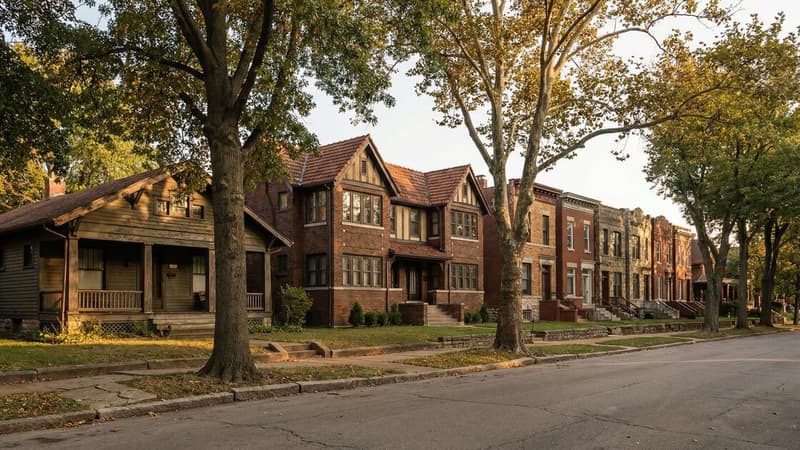
Walk through any neighborhood built before 1940 and the housing stock tells a story that postwar planning deliberately ended. Duplexes behind craftsman facades. Three-flat buildings that read as large houses. Bungalow courts arranged around shared courtyards. Boarding houses, rowhouses, and six-unit walk-ups fitted seamlessly onto lots between single-family homes. These buildings were not accidents or violations — they were the organic output of a housing market that had not yet been told what it was allowed to produce.
Today, that entire category of housing — the "missing middle," as urban designer Daniel Parolek termed it — is illegal to build on approximately 75% of residential land in American cities, according to research published by the Mercatus Center on zoning as a barrier to multifamily housing development. The market did not stop producing duplexes and small apartment buildings because demand disappeared. Government made them illegal. That single policy decision — replicated across thousands of municipalities in the postwar decades — is one of the most consequential acts of supply destruction in American economic history.
The Legal Origin of the Housing Shortage
The enabling precedent arrived in 1926. In Village of Euclid v. Ambler Realty Co., 272 U.S. 365, the Supreme Court upheld the constitutionality of Euclidean zoning — the practice of segregating land uses into separate, mutually exclusive districts. The decision opened the door to a principle that was quickly weaponized by suburban municipalities: apartments and duplexes could be legally excluded from single-family districts not because they posed safety hazards, but simply because existing homeowners preferred not to have them nearby.
Friedrich Hayek's insight on knowledge problems applies with unusual precision here. The pre-war market had already solved the affordable housing problem in most American cities. Duplexes, triplexes, and small walk-up buildings were the natural output of competitive land markets: they maximized households per lot while remaining small-scale enough to blend into existing neighborhoods. No planner designed them. No subsidy program produced them. They emerged because builders and buyers found them to be the efficient solution. Euclidean zoning overrode this distributed market knowledge with a top-down prohibition, and called it planning.
By the 1950s and 1960s, single-family-only zoning codes had become standard across American suburbs and in many urban neighborhoods. The result, measured in the Census Bureau's Building Permits Survey, is stark: annual permits for 2-to-4-unit structures — the heart of the missing middle — have declined from hundreds of thousands in the 1960s to approximately 30,000–40,000 per year today. Meanwhile, total housing starts remain well below the level needed to meet population growth and household formation, contributing to a structural deficit that Freddie Mac estimates at 3.8 million units nationally.
Why the Missing Middle Is More Efficient Than Its Replacements
The economic case for the missing middle rests on a simple arithmetic that large-scale housing policy consistently ignores. A duplex produces two units on a single-family lot for roughly 1.4 to 1.6 times the cost of one detached home. The per-unit construction cost of a duplex or small apartment building is therefore substantially lower than either a single-family detached home or a large high-rise tower — which requires structural engineering, elevator systems, and complex zoning variances that push per-unit costs well above $400,000 in most major markets.
The average sales price of a new single-family home stood at approximately $495,000 in late 2025, per Federal Reserve Economic Data — a figure that reflects, in part, the regulatory requirement that most residential land be developed at the least efficient density possible. Zoning codes that prohibit duplexes on residential lots do not simply limit housing types; they mandate that every unit of new supply be produced at the maximum cost per unit. Thomas Sowell's observation holds: there are no solutions in economics, only tradeoffs. The tradeoff of single-family-only zoning is fewer homes at higher prices for everyone who is not already a homeowner.
Missing middle housing also has a scale advantage that matters politically. A sixplex designed to look like a large Victorian home generates far less neighborhood opposition than a 200-unit apartment tower. The classic NIMBY objection — traffic, parking, neighborhood character — applies far less acutely to a four-unit building than to a large-scale development. This is precisely why cities that want to increase density without triggering political backlash have found the missing middle to be the path of least resistance.
The State-Level Revolt Against Single-Family Zoning
The most significant zoning reform of the past decade is not a federal program or a subsidy — it is states pre-empting local exclusion. In 2019, Oregon's Senate Bill 2001 became the nation's most ambitious statewide upzoning, requiring cities with populations above 25,000 to allow duplexes on all lots zoned for single-family use, and cities above 25,000 to permit middle housing up to fourplexes and cottage clusters. The bill removed the local veto on market-rate missing middle production that had been exercised for decades.
Minneapolis made the same move through its Minneapolis 2040 Comprehensive Plan, adopted in 2019 and implemented in 2022, which eliminated single-family-only zoning citywide and permitted triplexes as-of-right on all residential lots. The results supported the theory: permit activity for small multifamily structures increased, and Minneapolis has maintained rental vacancy rates and rent growth that compare favorably to peer cities that preserved exclusionary zoning.
California's Assembly Bill 2011, enacted in 2022 and effective July 2023, streamlined by-right approval for multifamily housing — including missing middle types — in commercially zoned corridors, bypassing the discretionary review process that had been a tool for blocking infill development. These reforms share a common mechanism: they remove the local government's authority to prohibit market-rate housing types that the market would otherwise produce. No appropriation required. No subsidy mechanism. No developer preference program. Just permission to build what buyers and renters actually want.
The Subsidy Substitution Problem
The conventional government response to a missing middle housing shortage is not to legalize missing middle housing — it is to fund affordable housing programs designed to produce a small number of deeply subsidized units. The Low-Income Housing Tax Credit, Section 8 vouchers, and various state housing trust funds are the most prominent instruments. Each has its place in serving households at the extreme low end of the income spectrum. None of them can substitute for the organic market production of the 30,000 to 50,000-unit annual missing middle deficit created by zoning prohibition.
Milton Friedman's framework on demand subsidies is directly applicable here. Every voucher that enters a constrained housing market is partially or fully captured by higher prices, because the supply that would compete those prices down has been regulated out of existence. The federal government spends tens of billions annually trying to make a market work that it has spent decades regulating into dysfunction. You cannot subsidize your way past a supply prohibition. You can only remove it.
The National Association of Home Builders estimated the U.S. housing deficit at 3.8 million units as of 2024. Building permits for 2-to-4-unit structures — the segment most directly suppressed by single-family zoning — are running at roughly 5% of their 1960s levels relative to population. Restoring even a fraction of that capacity, through the mechanism states like Oregon and Minnesota have demonstrated, would produce more housing for more households at lower cost than any comparable federal spending program.
The Free-Market Case Is Also the Practical Case
The argument for legalizing missing middle housing is often framed as ideological — a free-market position opposed to government planning. That framing is accurate but incomplete. The free-market case and the practical case are identical: the market already found the answer, built it for decades, and produced affordable neighborhoods across every American city. Government then banned the answer and replaced it with programs that produce a fraction of the units at multiples of the cost.
Hayek's knowledge problem is not a philosophical abstraction in this context. It has a building permit count attached to it. Permits for 5+ unit buildings have partially recovered since the 1980s, but that recovery has overwhelmingly concentrated in large urban towers — the most capital-intensive, most heavily regulated, most slowly approved housing type available. The 2-to-4-unit segment, the one that requires no elevator, no structured parking, no complex financing, and no variance process — remains at historic lows. That is a policy outcome, not a market outcome.
The simplest reform available to American cities costs nothing and requires no legislative appropriation: legalize the buildings that already exist in their own pre-war neighborhoods. Allow a homeowner to add a rental unit above the garage. Permit a developer to build a fourplex on a single-family lot. Remove the discretionary review requirement that adds months and thousands of dollars to a project too small to bear the cost. These are not radical interventions. They are the removal of a prohibition that the evidence suggests was counterproductive from the beginning.
What the Data Requires
The housing crisis is not a mystery. It is the predictable consequence of restricting supply through government prohibition and then being surprised when prices rise to clear a constrained market. The missing middle — duplexes, triplexes, fourplexes, small walk-up apartments — represents the market's natural solution to that constraint. Its absence from current building permit data is not a sign that the market has failed. It is a sign that the market has been prevented from succeeding.
Oregon, Minnesota, and California have demonstrated that statewide pre-emption of local exclusion is politically achievable and supply-positive. The model is replicable. The median home sales price, which has roughly doubled since 2015 per Federal Reserve Economic Data, will not bend until supply does. Supply will not increase until the prohibition is removed. The missing middle is not missing by accident. It was deliberately banned. It can be deliberately unbanned — no appropriation required.
How Zoning Selects Which Housing Types Get Built
Zoning does not merely regulate how much housing is built. It determines which forms are legal, and American zoning has for decades made the middle of the range difficult to produce.
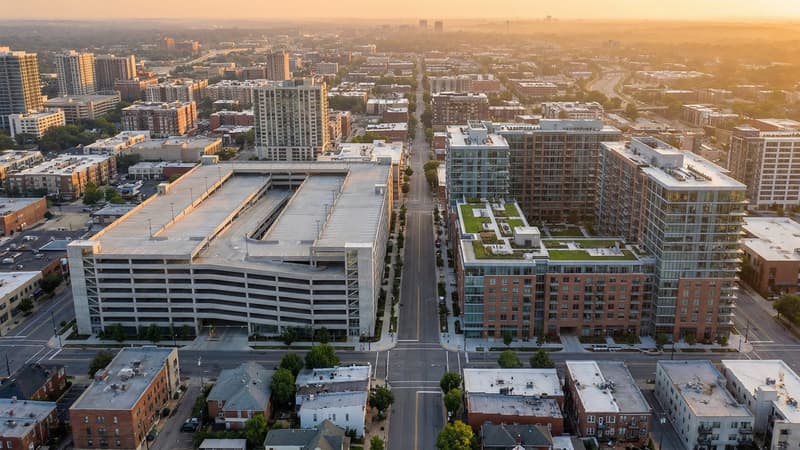
The result is a built landscape with a conspicuous gap. Detached single-family houses are legal nearly everywhere. Large apartment buildings are legal in a small number of designated districts, usually along arterial roads. The forms between them — duplexes, triplexes, fourplexes, courtyard apartments, townhouses, small walk-ups — are legal almost nowhere, despite having been ordinary components of American neighborhoods before the middle of the twentieth century.
The exclusion is rarely accomplished by an explicit prohibition. It is produced by a stack of numeric requirements that individually sound technical: a minimum lot size that makes splitting a parcel impossible, a minimum lot width, a floor-area ratio cap, a setback on all four sides that leaves a buildable envelope too narrow for a side-by-side unit, and a parking mandate that consumes what remains. Each is defensible on its own terms. Together they make a triplex arithmetically impossible on the lots where a triplex would be useful.
This is why reforms that legalize a housing type without touching the dimensional standards frequently produce less than expected. A city can amend its code to permit fourplexes in every residential zone and see very few built, because the lot-size and parking requirements that actually bind were never amended. The instructive reform packages — Minneapolis pairing type legalization with parking repeal is the clearest — change the form rules and the dimensional rules in the same ordinance. Reform efforts aimed at single-family zoning run into the same arithmetic, and parking minimums are usually the constraint left standing.
Part of the Zoning & Land Use research cluster.